In 2025, a traveler packed a 120 Wh spare power bank and nearly missed boarding due to conflicting airline rules. We’ll examine how lithium battery classifications, watt-hour thresholds, and device vs. spare battery requirements shape safe, compliant travel. Our approach is precise and regulatory, weighing what counts as lithium cells, what approvals are needed, and how to protect terminals. Stay with us as we outline the checks that could prevent last‑minute issues and ensure you’re aligned with carrier policies.
Key Takeaways
- Spares and power banks: carry-on only; 100 Wh or less usually unrestricted, 100–160 Wh requires airline approval, over 160 Wh generally prohibited on passenger flights.
- Installed vs. spare types: Li-ion/Li-metal classifications; learn Wh or lithium content, and ensure proper labeling and packaging for transport.
- Terminal protection: protect battery terminals and ensure devices are off with cables secured to prevent short circuits.
- Damaged or recalled batteries: isolate, document, and dispose per manufacturer and regulatory guidance; do not transport unstable cells.
- Airline verification: check carrier’s dangerous goods pages for explicit allowances, limits, and approval requirements; follow IATA/ICAO guidelines.
What Counts as a Lithium Battery on Flights
So, what exactly counts as a lithium battery on flights? We categorize by cell type (Li-ion, Li-po, Li-metal), and by packaging (single cells, packs, installed vs. spare). Li-ion and Li-po are rechargeable; Li-metal is typically primary. Portable electronics, power banks, wearables, and specialty tools all contain these cells, while packs and spares face distinct limits. We assess markings:Wh rating, lithium content, UN 38.3, model numbers, and hazard labels guide classification. Safety signals matter: thermal runaway risk, short-circuit potential, and whether protection circuitry is present. Devices that can power on inadvertently are scrutinized. Remember, battery state—installed in equipment versus loose spares—drives regulatory treatment. In unrelated topics or off topic discussion, contexts must not dilute compliance focus. Our aim is precise, rule-driven clarity. main factual point [main factual point
Wh and Li-Content Thresholds That Need Approvals
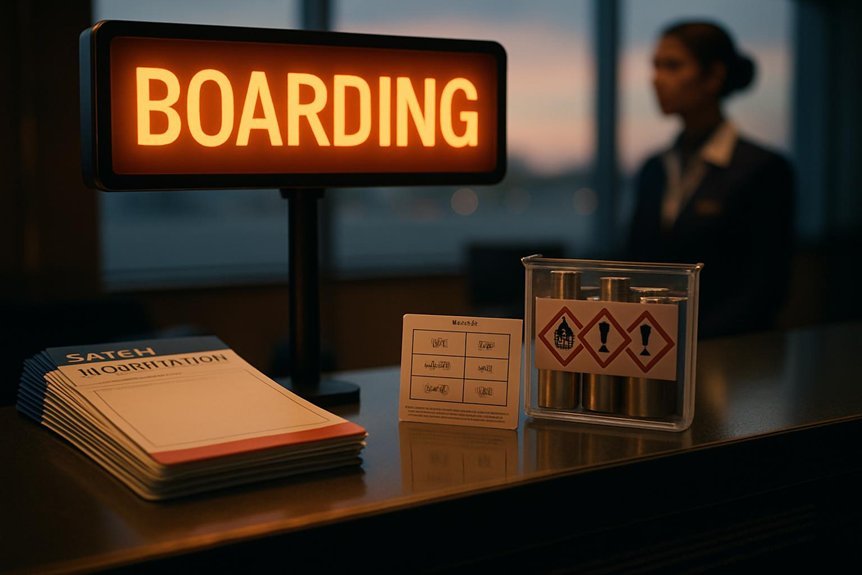
Wh and Li-content thresholds determine when airline approvals become mandatory and shape how batteries are packaged and carried. We outline the regulatory landscape clearly to help you navigate approval processes and ensure compliant transport.
- For installed or spare lithium-ion batteries, the 0–100 Wh band typically requires no approval, while 100–160 Wh triggers airline approval and may cap spares at two per passenger.
- Over 160 Wh is generally prohibited on passenger aircraft unless special arrangements, documentation, and operator-specific allowances are met.
- Lithium-metal content thresholds (0.3 g per cell or 2.7 Wh per cell) drive approval needs, with higher content often restricting transport and demanding hazardous goods procedures.
Note marks, state of charge requirements, and terminal protection operate alongside these wh thresholds to shape carriage rules.
New sentence addition:
Enhanced visibility and rapid response measures now include standardized in-flight risk management and improved detection capabilities to identify non-compliant batteries before boarding enhanced visibility.
Spare Batteries in Carry-On: Limits and Rules
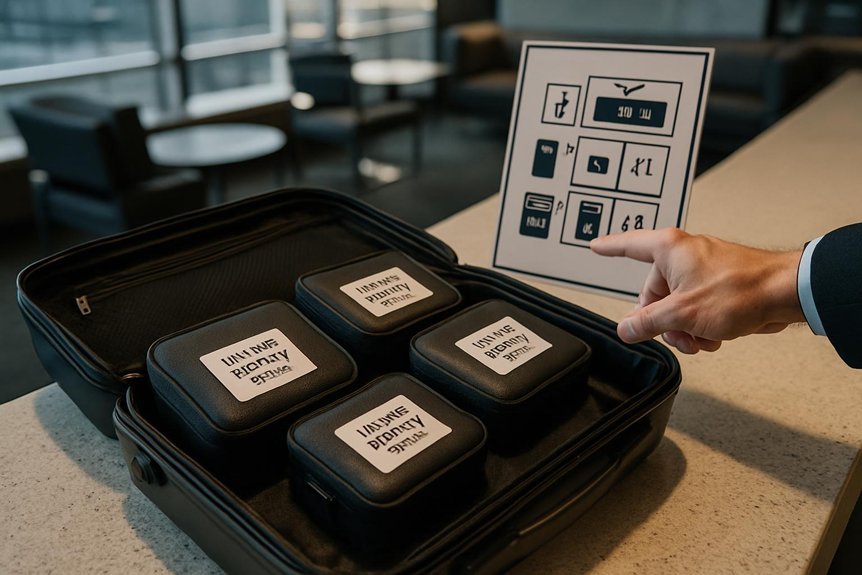
We summarize the framework governing spare batteries in carry-on, focusing on carry-on limits, power bank quantity rules, and protection and handling standards. We examine how airlines constrain the number of spare units, the Wh/Wh-equivalent thresholds, and any device-specific caps, while emphasizing in-cabin storage, packaging, and short-circuit prevention. We invite readers to contemplate how these requirements interact with screening, documentation, and operator variations to determine compliant packing strategies.
New sentence added: In addition to the limits, travelers must keep spare batteries in carry-on only and protect terminals to prevent short circuits in-cabin.
Spare Battery Carry-On Limits
What are the practical limits and requirements for carrying spare lithium batteries in the cabin when flying? We assess spare battery carry-on under regulatory boundaries, focusing on cabin safety and spare limits. Spares must comply with watt-hour ranges, be protected from short circuits, and be stored separately from other items. Airline approvals apply for 100–160 Wh, typically limiting to two spares per passenger and subject to carrier policy. Larger quantities or higher-capacity cells may require cargo handling or medical exemptions. Labels showing Wh or lithium content are essential, and damaged batteries are prohibited. Spares stay in the cabin to enable monitoring and mitigation of thermal events.
1) Spare battery capacity and approval status
2) Protective packaging and storage discipline
3) Documentation and airline notification requirements
Power Bank Quantity Rules
Are there practical limits on how many spare power banks you may carry in the cabin? We summarize the rules for spare batteries under 100 Wh, 100–160 Wh with airline approval, and >160 Wh prohibition. Typical unrestricted power banks ≤100 Wh travel unimpeded, though some carriers cap quantities (often two) even within that range. For 100–160 Wh, airline approval is required, and a written or electronic confirmation may accompany the device. Power banks must be carried in carry-on and kept separate from checked baggage, with terminals protected and, if necessary, individually pouched. In multi‑pack scenarios, labeling and separation reduce thermal risk. Regulatory baselines come from ICAO/IATA, but carriers can impose stricter limits, and enforcement varies. Always verify airline approval and ensure accurate Wh labeling when traveling with powerbanks.
Protection And Handling Standards
Spare lithium batteries must be carried in the cabin and are generally prohibited in checked baggage due to higher risk and slower response to incidents; regulatory guidance from ICAO/IATA, FAA, and EASA consistently favors carry-on carriage to enable rapid detection and crew intervention. We assess Protection And Handling Standards to ensure compliance, focusing on cargo restrictions and airline documentation.
- We require visible Wh/Li content ratings, proper terminal insulation, and individual packaging to minimize short circuits, with inspections at security checkpoints documented in airline documentation.
- We enforce limits for spares (100–160 Wh bands) and total count when multiple units are carried, and we distinguish between spare batteries and devices.
- We mandate damaged or swollen spares be removed and disposed under DG protocols, with formal incident reporting as part of airline documentation.
Batteries Installed in Devices: Flying Safely
When batteries are installed in devices, we must verify that the device’s Wh rating is marked or documented, since absence can lead to denial of carriage. We assess that installed batteries are generally permitted in carry-on, while checked baggage often faces restrictions. Wh thresholds drive acceptance: under 100 Wh typically requires no airline approval; 100–160 Wh needs approval and may allow two spares, with installed batteries commonly accepted. Above 160 Wh is generally prohibited on passenger flights unless cargo arrangements exist. For compliance, Wh must be calculated as (mAh ÷ 1000) × nominal voltage, and accurate markings simplify checks. Multiple installed batteries in one device may aggregate toward regulatory limits and airline decisions. Devices should be off, protected, and cables stowed; terminals remain shielded to prevent short circuits.
Special Cases: Medical Devices, Mobility Aids, and E-Cigarettes
- Prepare documentation: physician letter, device manual, battery specs, and in-flight instructions.
- Confirm approvals: pre-notification, cabin or hold placement, and spare battery handling.
- Ensure labeling and packaging: clearly mark Wh or lithium content; protect against short circuits.
Packing and Protection: Best Practices for Lithium Cells
Packing and protection for lithium cells must start with strict adherence to location, containment, and labeling rules. We prioritize spares in-cabin, with two high‑capacity units (101–160 Wh) requiring airline approval; >160 Wh is forbidden in passenger baggage. Devices with batteries may travel in carry‑on or checked bags, but carriers often require the device in carry‑on. Protect terminals with original packaging, covers, or insulating tape, and store each cell in its own sleeve or bag. Use foam inserts or cases to prevent movement; insulate multi‑cell packs to avoid internal shorting. Check Wh on labels; if missing, calculate from V and Ah. For power banks, treat as spares under same limits, ensuring packaging compliance and proper battery labeling throughout transport.
Damaged, Recalled, or Swollen Batteries: What to Do
Damaged, recalled, or swollen lithium batteries require immediate, disciplined action to prevent fire, injury, or regulatory violations. We outline mandatory steps to minimize risk and ensure compliance, focusing on Damaged batteries and Recall compliance.
- Immediately remove from service, isolate, and document damage with model/serial, Wh, photos, and chain-of-custody notes; do not use or transport unstable units until evaluated by qualified personnel.
- For recalls, follow manufacturer instructions to the letter, segregate recalled units in fire-resistant areas, and preserve evidence and receipts for regulatory reporting.
- For swollen batteries, power down if safe, place in a ventilated, fire-resistant container, and route to approved recycling or hazardous-waste processors per local requirements.
We emphasize strict adherence to regulations and proper disposal to uphold safety and Recall compliance.
Verify Policies Before Travel: Airline Checks and Resources
We verify carrier policies directly on official airline pages and trusted regulatory guides to guarantee accurate limits and procedures. We confirm battery watt-hour limits, spare battery allowances, and any approval or declaration requirements before booking or packing. By aligning our checklist with IATA/ICAO guidance and carrier specifics, we minimize surprises at check-in and gate.
Check Carrier Policies
Have you verified the airline’s current rules on lithium batteries before you travel? We approach this with precise, regulatory rigor, focusing on official sources and timely updates. Carrier policies define carry-on vs. checked carriage, batteryCapacity thresholds, and required protections to prevent short circuits. To stay compliant, we monitor travel advisories and regulatory updates across carriers, regulators, and IATA/ICAO guidance.
1) Check airline “baggage” or “dangerous goods” pages for current allowances, prohibitions, and handling instructions.
2) Review conditions of carriage and app prompts for temporary changes or pop-up advisories.
3) Confirm any high-capacity batteries or mobility aids via dedicated dangerous-goods desks and last-updated timestamps.
Rationale: these steps ensure policy alignment with travel advisories and regulatory updates, reducing ambiguity before departure.
Confirm Battery Limits
As we confirmed carrier policies and practical checks in the previous step, the next focus is verifying battery limits before travel. We synthesize ICAO/IATA/FAA baselines with airline limits to establish clear, enforceable thresholds. Wh markings govern carry-on allowances; spare batteries remain restricted in checked baggage, and power banks fall under Wh-based caps. In practice, baggage scanning and inspection procedures require visible labeling, and many authorities demand power‑on verification for device batteries during screening. For 100–160 Wh spares, two spares plus airline approval is common; above 160 Wh is typically prohibited. Damaged or unlabeled units face denial, with documentation needed for higher‑capacity items. Random secondary inspections can occur; auditors may request declaration at check‑in. Plan ahead to avoid delays.
Verify Approval Requirements
How can we guarantee you meet airline approval requirements before travel? We verify policies using official sources and clear, non-conflicting steps, aligning with regulatory expectations. Our approach emphasizes cross-checking carrier rules, national authorities, and international standards to minimize denial risk. We consider airline branding, lounge access, and documented processes to ensure consistency across carriers and services.
- Cross-check airline-specific rules on Baggage or Dangerous Goods pages, then confirm via app FAQs and written confirmations when needed.
- Verify approvals, watt-hour ratings, and device-specific documentation at check-in, including route-specific conditions and portability limits.
- Confirm lead times, re-checks for connections, and escalation paths with the airline’s dangerous-goods desk or booking channel.
We prioritize transparency, concise checks, and timely updates to protect your travel plans.
Frequently Asked Questions
Can I Mix Different Battery Types in the Same Carry-On?
Yes, we don’t mix different battery types in the same carry-on. We follow charging restrictions and battery packing rules, comparing risks analytically, because regulatory guidance prioritizes segregation, labeling, and separate containment to minimize cross-type hazards and delays.
Do Power Banks Require TSA Approval Before Travel?
Power banks require TSA approval for higher-capacity units. We analyze restrictions, confirm that 100–160 Wh typically need airline pre-authorization, and emphasize documenting ratings; otherwise, carry-on only, with protective packaging and proper labeling.
How to Identify Wh Vs Li-Content Labeling on Packs?
We identify wh vs li-content labeling by checking the mark text: Wh indicates energy capacity on lithium-ion packs; Li-content marks show equivalent lithium content (g Li) for some lithium metal cases. Battery labeling requirements vary by regulation.
Are Refurbished or Third-Party Batteries Allowed?
Yes, we allow refurbished batteries and third party batteries under strict conditions: they must meet safety standards, show complete labeling, pass testing (UN38.3/CB/IEC/UL), remain carry-on only, and comply with capacity, quantity, and documentation limits.
What Happens if a Battery Is Swollen at Security Screening?
Swollen batteries trigger alarms in security screening protocols, and we act swiftly: we isolate the item, assess risk, may require power-on checks or confiscation, and route it for disposal or regulated transport, with documentation and aircraft-safety coordination.
Conclusion
We’ve examined the rules, we’ve mapped the thresholds, and we’ve clarified the protections. We remain precise about watt-hours, we remain cautious about lithium content, we remain vigilant about device status, we remain compliant with carry-on requirements, we remain proactive with packing, we remain ready to verify with carriers. We must follow clear limits, we must document exceptions, we must avoid prohibited configurations. We stay informed, we stay safe, we stay compliant.