You want to know if lithium batteries are safe. They can be, with strong cells, careful assembly, and robust protection, but risks exist if abuse or poor design sneak in. Proper chemistry choices, per-cell monitoring, and solid thermal management help a lot. Yet every failure mode—overcharge, physical damage, or extreme temperatures—can change the game quickly. There’s more to weigh, including safety standards and handling practices, that could tip the balance in either direction.
What Makes Lithium Batteries Safe or Risky?
So, what makes lithium batteries safe or risky? Your safety hinges on manufacturing quality, the BMS, charging practices, and thermal management. When cells come from reputable makers, defects stay rare, and automated inspections, formation cycling, and X-ray checks shrink latent failures. Proper pack assembly with good welding and balancing further prevents localized stress that could spark thermal runaway. A robust BMS with per-cell monitoring, short-circuit cutoffs, and calibrated firmware keeps SOC variance low and blocks unsafe operating windows. Protective hardware adds a final isolation layer during faults. Charging to chemistry-specific voltages, avoiding high C-rates, and not over-discharging reduces heat buildup and degradation. Finally, controlling ambient temperature and using effective cooling curbs hotspot formation and cascade failures.
How Chemistry and Design Affect Safety
Chemistry and design choices directly shape how safe lithium batteries are in real use. You rely on electrolyte chemistry to balance conductivity and volatility: carbonate solvents with LiPF6 offer high performance but can burn if heated or aerosolized, and LiPF6 decomposition produces HF, increasing toxicity and corrosion risk during thermal runaway. Alternatives like ionic liquids and SSEs reduce volatility, though conductivity and interfacial resistance remain challenges. Additives such as flame retardants and HF scavengers can cut flammability, yet may lower ionic conductivity or cycle life.
Cathode and anode selections matter: high-energy Ni-rich cathodes risk oxygen release; LiFePO4 and coatings lessen abuse-induced reactions. Separator design, including shutdown capabilities and ceramic coatings, improves resilience but adds cost. Packaging, venting, and thermal management control heat, delay propagation, and limit gas pressure buildup.
Which Failure Modes Threaten Safety and Why
What failure modes most threaten lithium-battery safety, and why do they matter? You face mechanical abuse that can deform cells or rupture separators, triggering rapid self-heating and thermal runaway. In packs, high-energy impacts raise the chance of cell-to-cell propagation, sometimes within seconds to minutes. Nail penetration and crush tests provoke venting, flammable gas release, and ignition across many chemistries. Manufacturing defects leave foreign particles or miswinds, increasing mechanical-short risk. State of charge amplifies severity, as high-SOC cells generate more heat and gas when breached. Electrical abuse—overcharge causes cathode oxidation and lithium plating, overdischarge dissolves copper and forms dendrites, and external shorts force dangerous currents. Without proper BMS and safeguards, aging resistance rises, accelerating failures under abuse. Thermal and aging factors compound these threats.
How Thermal Management Reduces Danger
Thermal management is the first line of defense against thermal runaway, keeping cell temperatures low enough to suppress harmful reactions that fuel runaway. You control heat generation from high C-rate charging, discharging, and potential internal shorts, and you prevent localized hotspots that accelerate reactions. By removing heat with air, liquid, immersion, or phase-change approaches, you keep the worst-case heat below runaway thresholds. You design systems to evacuate kilowatts per cell during abuse, slowing propagation to neighboring cells. You maintain an operating window of roughly 25–35°C, with tighter limits during fast-charge, so side reactions stay minimal. You use active regulation, thermal-aware balancing, and pre-conditioning for fast charging, ensuring safety margins stay above initiation thresholds and reduce electrochemical stress. Thermal management helps ensure materials compatibility, including aluminum cold plates and seals that support long service life, and supports a design that accommodates 50/50 ethylene glycol-water coolant while maintaining cold-plate integrity.
Which Safety Standards Apply to Batteries
Safety standards for batteries span transport rules, safety tests, and conformity schemes across international, regional, and national levels. You’ll find UN 38.3 drives pre-transport abuse tests to keep shipments lawful, while IATA’s DG Regulations set air-ship limits, labeling, state of charge, and documentation. In the U.S., 49 CFR implements UN rules with Wh markings for larger packs and quantity caps, plus civil penalties for noncompliance. The IMDG Code governs sea transport, requiring segregation, packaging, stowage, and documentation, including provisions for damaged cells. Regional and national rules add timelines and exceptions, complicating compliance. Standards like IEC 62133-2, IEC 62619/62660, UL 1642/2054/62133, and ISO 26262 address safety tests and system-level safety, though gaps remain in harmonization. Certification, conformity assessment, and labeling—including Wh ratings—conclude market-entry requirements.
How to Evaluate Lithium-Battery Safety in Products You Buy
How can you confidently judge lithium-battery safety before you buy? Start with trusted brand indicators: buy from manufacturers with verifiable supply chains, public quality-control docs, batch testing, audits, and third‑party lab reports. Favor authorized dealers and major retailers that offer clear return policies and incident-response processes. Check labeling for cell chemistry, nominal capacity and voltage, date codes, and manufacturer contact information. Review independent tests and reputable reviews, and monitor recall databases for the brand and model.
Next, assess design and protections: an integrated Battery Management System with overcharge, over-discharge, overcurrent, high/low temperature, and cell balancing protections; certified cells; mechanical separation, venting, fire‑resistant materials, and crush protection; thermal management and redundant safety features.
Finally, request documentation: datasheets, MSDS/PSDS, test summaries, third‑party lab reports, traceability records, and independent incident data when available. Ensure charger compatibility and firmware update processes.
Safe Charging, Storage, and Handling Practices
Ever wondered how to charge, store, and handle lithium batteries safely in real-world settings? You should use chargers matched to battery chemistry and manufacturer specs to prevent overcharge and thermal runaway. Charge in well-ventilated, non-flammable areas; avoid confined or flammable surroundings that boost fire spread and smoke hazards. Keep charging within a temperature-controlled range, ideally 15–25°C, and avoid extreme heat or cold to reduce degradation and plating risks. Enable charge-limiting features like BMS and overcharge cutoffs, and never rely on protection-less setups. Don’t charge unattended whenever possible, since unsupervised charging drives residential-fire incidents. Follow recommended SOC windows (about 20–80% for routine use) and limit fast charging to reduce heat and stress. Maintain logs and perform pre-checks for swelling, corrosion, punctures, or odor.
What to Do During a Battery Fire or Incident
When a lithium battery catches fire or there’s an incident, act quickly but safely to protect people and minimize damage. Evacuate non-essential occupants, move upwind and uphill if outdoors, and call emergency services to report lithium involvement. Establish a safe perimeter, and maintain the recommended distance of 10–15 meters (larger for EVs or battery racks).
Isolate power sources only if trained personnel can do so without risk. Expect possible reignition; monitor the site for hours to days. Use cooling methods rather than smothering; large amounts of water or water fog applied by trained firefighters slow thermal runaway and require runoff containment. Fire blankets help on small devices but won’t prevent internal re-ignition. Wear SCBA or chemical suits as needed; treat runoff as hazardous waste.
Safe End-of-Life Handling for Batteries
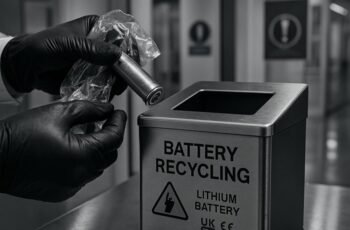
Safe end-of-life handling for lithium batteries hinges on complying with evolving rules, practical storage limits, and robust handling practices to prevent safety incidents and support recycling. You’ll follow regulatory and standards frameworks that emphasize EPR take-back, financing, and cradle-to-grave responsibility, plus UN 3480/3481 shipping rules, labeling, and state-of-charge limits. At facilities, adhere to national hazardous-waste and battery-specific laws, plus IEC 62619 or 62133 for dismantling and testing. Maintain HSE plans, training records, and incident metrics.
During collection, segregate by chemistry, form factor, and condition to reduce cross-contamination. Use controlled discharge and limited SOC before transport; pack in non-conductive, puncture-resistant containers with terminal insulation. Plan carrier routes with hazardous-goods expertise, document chain-of-custody, and enforce storage caps, fire-safe zoning, ventilation, and rapid isolation for damaged packs.
How to Choose Safer Lithium Batteries for Your Needs
Choosing safer lithium batteries starts with matching chemistry and form factor to your application. You should prioritize LiFePO4 (LFP) for better thermal stability and lower fire risk, even though it trades some energy density.
Choose pouch, cylindrical, or prismatic based on your needs: cylindrical cells handle mechanical abuse better; pouches can swell and need robust packaging.
Verify nominal voltage and capacity align with your system to avoid stress and imbalance.
Favor conservative chemistries (lower cobalt, stabilized coatings) to reduce internal short and thermal runaway risk.
Check cycle and calendar life to ensure stability over time.
Buy from reputable manufacturers with traceable supply chains and third‑party safety certifications.
Ensure a BMS, protection circuits, and compatible charging profiles for safe, reliable operation.
Conclusion
You can keep lithium batteries safer by choosing quality cells and a robust BMS, ensuring proper pack assembly, and using solid thermal management. Stay within safe SOC ranges, follow certified charging methods, and store them correctly. Be aware of abuse risks and transport rules, and have a clear plan for fires or incidents. Prioritize safety standards and proper end-of-life handling. With careful design, handling, and monitoring, you’ll minimize danger while still enjoying lithium’s benefits.