If you’re choosing a smart BMS for LiFePO4 packs, you’ll find several solid options that balance protection, balancing, and interfaces like CAN, RS485, or Bluetooth. Each model fits different pack sizes and current needs, so you’ll want to compare protections, temperature sensing, and scalability before deciding. The right pick could simplify monitoring and extend your battery life—but there’s more to weigh, and the best match isn’t always obvious. Let’s start sorting through the contenders.
Key Takeaways
- Compare top Smart BMS options (8S–16S, 50–500A) across LiFePO4 packs for protection scope, balancing type, and monitoring interfaces (Bluetooth, CAN, RS485).
- Look for multi-protection coverage: over/under voltage, overcurrent, short circuit, temperature, and cell-level diagnostics.
- Evaluate balancing style (passive vs active) and charging current compatibility with pack capacity and charging source limits.
- Check wiring clarity, cell-count compatibility, and installation notes (NTC placement, labeling, and per-section voltage balance).
- Consider communication and app support (real-time monitoring, SOH/SOC tracking, remote access) and warranty/documentation quality.
Seplos Smart BMS 8S-16S 200A CAN/RS485


The Seplos Smart BMS 8S-16S 200A CAN/RS485 stands out for high-current LiFePO4 packs with flexible cell counts and robust communication options. You get 8S to 16S compatibility, up to 200A, and multiple interfaces (CAN, RS485, Bluetooth) for real-time data and remote monitoring. This BMS protects against over-charge, over-discharge, over-current, short circuits, and extreme temperatures, while tracking SOH, SOC, voltage, and current. It supports pre-charging and high-voltage detection, ensuring safe startup and operation. With wide inverter compatibility and DIY-friendly programming, you can tailor it to your battery design and application needs.
Best For: DIY battery builders and hobbyists seeking a flexible, high-current BMS for 48V LiFePO4 packs with multiple communication options.
Pros:
- Supports 8S to 16S configurations and up to 200A, offering versatile cell counts and high-current handling.
- Multiple communication interfaces (CAN, RS485, Bluetooth) for real-time monitoring and remote data access.
- Comprehensive protection and monitoring (SOH, SOC, voltage, current, temperature) with pre-charging support for safe startup.
Cons:
- May require technical know-how for programming and integration into custom builds.
- Warranty and support details may hinge on Amazon policies and seller responsiveness.
- DIY-friendly features could lead to user-caused issues if not configured correctly.
DollaTek 16S 48V 30A LiFePo4 BMS PCB
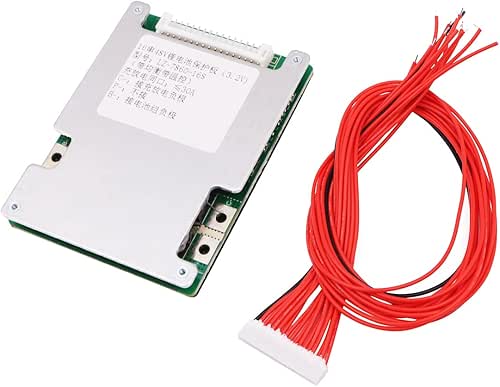
This DollaTek 16S 48V 30A LiFePo4 BMS PCB stands out for its 16-series protection and 30A charging limit, making it ideal for robust e-bike, scooter, or trike packs. You’ll get balance charging to equalize cells for consistent pack performance, plus an aluminum heat sink for rapid heat dissipation and safer operation. It uses a single cascade scheme, allowing flexible wiring to protect multiple battery groups. With a maximum charging current of 30 A and overcurrent protection around 130 A, it safeguards 16-string packs, including LiFePO4, ternary, cobalt oxide, and manganese oxide chemistries. Compact size: 80 × 70 × 10 mm.
Best For: E-bike, scooter, or trike builders needing a robust 16S LiFePO4 protection board with balanced charging and strong overcurrent protection.
Pros:
- 16-series protection with a 30 A charging limit for large packs
- Balance charging function promotes even cell voltage across all cells
- Aluminum heat sink aids rapid heat dissipation and safer operation
Cons:
- Max overcurrent protection around 130 A may be high for some smaller packs
- Only 16S protection; not configurable for other cell counts without modification
- Installation and wiring require electrical experience to ensure correct cascade setup
JKBMS Smart BMS 4S-8S Battery Protection Board

If you need a versatile BMS that supports 4S to 8S packs with active balancing and Bluetooth monitoring, the JKBMS Smart BMS stands out. This 40A protection board supports Li-ion, LiFePO4, and LTO, with 0.4A active balance to extend life and improve performance. It combines Bluetooth and RS485 for mobile app control on Android and iOS, letting you monitor status, adjust settings, and manage charging and discharging. Compact at 12.1 by 9.3 by 1.8 cm and about 163 g, it includes wiring, a switch, an NTC, and a manual. 24/7 support via the JK BMS app accompanies a 1-year period.
Best For: Battery hobbyists and small to mid-size e-bike or solar setups needing 4S–8S protection with active balance, Bluetooth monitoring, and RS485 support.
Pros:
- Supports 4S–8S configurations with active balancing to extend battery lifespan.
- Bluetooth and RS485 connectivity enable Android/iOS app control and remote monitoring.
- Includes all necessary setup items (wires, switch, NTC, manual) in the package.
Cons:
- Rated at 40A, which may limit use with higher-current packs.
- Only 0.4A active balance, which is slower for larger packs.
- No pricing, reviews, or ratings provided in the spec excerpt (potential variability).
Smart BMS LiFePo4 16S 48V Battery Protection
Product offers are temporarily unavailable.
Smart BMS LiFePo4 16S 48V Battery Protection suits high-demand setups, thanks to its Bluetooth module for real-time monitoring and app access. You’ll get real-time data via the SMARTBMS app, plus a balance function and an included NTC probe for temperature awareness. It supports 16S 48V configurations with current options up to 500A, matching battery strings one-to-one. Protection covers over-charge, over-discharge, over-current, temperature, disconnect, and short circuits, with recoverable short-circuit protection on balance. Activation is via Bluetooth, then SOC calibration after cycling. Choose from standard or smart BMS, plus customizable bulk orders and optional RS485/CAN accessories.
Best For: RVs, photovoltaic storage, home/outdoor energy setups, and vehicles requiring a high-current, Bluetooth-enabled 16S 48V LiFePo4 BMS with balance and temperature monitoring.
Pros:
- Real-time monitoring via Bluetooth and SMARTBMS app for easy access and tuning.
- Comprehensive protection including over-charge, over-discharge, over-current, temperature, disconnect, and short-circuit with recoverable short-circuit protection.
- Supports high-current configurations up to 500A and 16S 48V, with one-to-one string matching and optional smart features (RS485/CAN, UART, etc.).
Cons:
- Activation and setup require proper tutorials and adherence to manuals; improper use can cause safety hazards.
- Not intended for parallel/series stacking without proper configuration; mismatched battery types (Li-ion vs LiFePo4) can damage the BMS and battery.
- No warranty for disassembly or unauthorized parameter modification; some users may need professional guidance for customization.
JKBMS Smart BMS 4S-8S Battery Protection Board

Looking for a robust 4S–8S BMS with strong protection and active balancing? The JKBMS Smart BMS JK-B2A8S30P supports 4S to 8S configurations, handling up to 300A with a 2A active balance. It includes built-in Bluetooth, CAN, and RS485 for easy wireless monitoring and control via the JK BMS app. It protects against overcharge, overdischarge, overcurrent, short circuits, and temperature changes, plus JKBMS Active Equalization to extend 12V system life. Compatible with Li-ion, LiFePO4, and LTO batteries, it suits RV, solar, or UPS setups. Package includes accessories and a 1-year support period (RS485 converter not included).
Best For: RV owners, off-grid enthusiasts, and DIY solar/UPS projects seeking a high-current, configurable 4S–8S BMS with active balancing and Bluetooth wireless monitoring.
Pros:
- 300A rating with 2A active balance supports substantial pack capacity and faster balancing
- Built-in Bluetooth, CAN, and RS485 enable versatile wireless monitoring and control
- Safe protection suite includes overcharge, overdischarge, overcurrent, short circuit, and temperature safeguards
Cons:
- RS485 converter is not included, requiring an additional purchase if RS485 connectivity is needed
- 4S–8S configurability may require careful wiring and setup for beginners
- Active balance loss and heat generation can occur under heavy load, necessitating good thermal management
24S 72V Lifepo4 BMS with Protections, 50A

This 24S 72V Lifepo4 BMS offers ten protections, including overcharge, overdischarge, and short-circuit safeguards, making it ideal for high-capacity packs. You’ll manage a 72V system with a working current of 50A and charging current kept below 5A, using common port wiring for ease of installation. It supports passive balance and a broad temperature range (-20°C to 70°C) to safeguard cells during demanding cycles. Before install, you should match voltage, capacity, and internal resistance, and ensure per-section voltage differences stay under 0.05V. Dimensions are 65×125×10 mm, weighing 0.18 kg, with cables included. Manufacturer: Bisida.
Best For: Those building a 24S 72V LiFePO4 battery pack who need a robust 50A BMS with passive balancing and multiple protections.
Pros:
- Ten protections (including overcharge, overdischarge, overcurrent, short-circuit, and temperature) for strong cell safety.
- Passive balancing with broad operating range (-20°C to 70°C) ensures cell health in demanding conditions.
- Clear wiring and common port design for straightforward integration into 72V systems.
Cons:
- Requires careful pre-install matching of voltage, capacity, and internal resistance; improper matching may hinder charging.
- Charging current is recommended below 5A, which may be slow for high-capacity packs.
- Size and wiring may be less flexible for compact or unconventional pack layouts.
Li-ion Lifepo4 1.2A Battery Equalizer Balancer

If you need a compact, high-current balancer, this 5S Li-ion/LiFePO4 1.2A inductive equalizer is a strong fit. You get a single 5S 1.2A active equalizer that uses inductive energy transfer to balance adjacent cell voltages. It actively transfers energy to reduce voltage differences, aiming for within 0.03V, improving pack efficiency and reducing maintenance costs. The balance indicator shows when balancing is on, sleeping, or if a fault occurs. Specs include 3V, 1.2A, and Li-ion/LiFePO4 compatibility. It’s lightweight, about 0.04 kg, and designed for 1.2Ah packs. Ideal for compact Li-ion/LiFePO4 packs needing reliable high-current balancing.
Best For: Li-ion/LiFePO4 pack builders needing a compact, high-current 5S balancer with inductive energy transfer.
Pros:
- High current (1.2A) active balancing suitable for smaller packs.
- Inductive energy transfer reduces wiring complexity and heat in packs.
- Clear balance indicators for on, sleep, and fault states.
Cons:
- Only 5S support; not suitable for packs with more than 5 cells.
- Inductive balancers can be more expensive and may require careful mounting/installation.
- Performance depends on pack health and cell balance; may not fully equalize very degraded packs.
Factors to Consider When Choosing Smart BMS for Lifepo4 Batteries
When you pick a Smart BMS for Lifepo4, start by checking battery chemistry compatibility to ensure it supports LiFePO4 and your pack size. Then verify the current rating, balancing method type, and available communication interfaces to match your system and future expansion. Finally, review the protection features scope to confirm you’ll have the right safeguards for over/under voltage, short circuits, and thermal events.
Battery Chemistry Compatibility
Is your BMS truly compatible with LiFePO4 chemistry? To verify, confirm the BMS specifically supports LiFePO4, since charging voltages and balancing differ from Li-ion. Check that the maximum and nominal cell voltages align with LiFePO4 cells (commonly 3.2V per cell) to prevent over- or under-voltage protection mismatches. Review the balance method—active versus passive—and ensure it matches your LiFePO4 pack’s needs for desired speed and efficiency. Confirm input/output voltage range, current rating, and pack configuration support (e.g., 16S LiFePO4) to match your stack and charging requirements. Finally, ensure compatibility with LiFePO4 charging profiles and temperature protections to prevent degradation or safety issues.
Current Rating Adequacy
Choosing a BMS with an adequate current rating is key to safe, reliable Lifepo4 performance. You should pick a continuous current rating at least equal to your pack’s maximum load, and opt for higher short‑circuit protection for safety. Ensure the BMS current rating aligns with your cell string count (for example, 16S or 24S) and your pack’s designed max discharge to avoid overheating or premature protection triggers. A higher Amps rating gives you headroom for surge currents during peak loads, charging bursts, and pre‑charge events, reducing nuisance cutoffs. If you use parallel modules, verify the BMS can handle the total pack current by summing module ratings without hitting its limit. Also consider future expansion so the rating accommodates more cells or higher load without a full replacement.
Balancing Method Type
Balancing method type matters because it directly affects how quickly your pack stays uniform and how efficiently it charges. Active balancing moves charge between cells during operation to equalize voltages, while passive balancing bleeds excess charge as heat to achieve balance. Active balance methods can restore imbalance more quickly and maintain tighter SOC across cells, beneficial for high-cell-count LiFePO4 packs. Passive balancing (resistive or dissipative) is simpler and cheaper but wastes energy and may be slower for large imbalances. Inductive or switched-capacitive balancers transfer energy between adjacent cells rather than to a heat sink, improving efficiency in some BMS designs. The choice of balancing method impacts charge/discharge efficiency, thermal management, and long-term cell health in 16S–24S LiFePO4 configurations.
Communication Interfaces
When selecting a smart BMS for LiFePO4, you should prioritize robust communication interfaces that match your system’s needs, such as CAN bus, RS485, and Bluetooth for real-time monitoring and integration with inverters and other hardware. Choose CAN bus for multi-device networking within a battery pack and vehicle systems, ensuring you have enough channels for your 16S configuration and max pack current. RS485 provides long-distance, noise-resistant serial communication, ideal for harsh environments or distant components. Bluetooth enables smartphone-based SOC/SOH monitoring and configuration, but mind proximity limits and security considerations. Verify the BMS supports the required interface count and voltage/current ratings to align with your 16S LiFePO4 setup. Ensure compatibility with your control ecosystem to avoid protocol or data format mismatches.
Protection Features Scope
A smart BMS should provide a complete protection suite that guards LiFePO4 cells from over-charge, over-discharge, over-current, short circuits, and temperature extremes. You should verify a full set of protections, ensuring each risk is covered and clearly defined with specific thresholds. Look for both active and passive balancing options, since active balancing can extend battery life and maintain uniform cell voltages during use. The protection scheme must include precise voltage thresholds (overcharge release and cut-off) and rapid short-circuit detection, ideally in the microsecond range, to prevent damage. Confirm temperature monitoring coverage and the inclusion of an NTC sensor to respond accurately to thermal conditions during charging and discharging. Ensure chemistry-specific compatibility, matching cell voltage ranges and correct S and P counts for LiFePO4 packs.
Temperature Handling Range
Temperature handling range determines the safe ambient and pack temperatures your LiFePO4 BMS can monitor and protect. This range shows the operating limits within which the BMS can safely monitor and safeguard your pack. Most units specify a window around -20°C to 70°C, though exact numbers vary by design. Temperature sensing is usually provided by an NTC thermistor on the BMS or pack, triggering over-temperature or thermal protection when limits are exceeded. Exceeding the specified range can degrade cell performance, reduce SOH, and may cause protective disconnections or imbalanced charging. In multi-module or outdoor setups, accurate sensing and a properly rated range are crucial for reliable active balance and safe charging and discharging. Choose a BMS whose range matches your expected environment and usage.
Installation And Wiring
Installing and wiring a Smart BMS for LiFePO4 packs isn’t optional—it’s essential. First, ensure the BMS supports 16S for a 64V nominal pack and matches your cell count in series to prevent misalignment. Verify the wiring schema requires one-to-one string connections with clear labeling for B- (pack negative), C- (charging negative), and pack positives to avoid cross-wiring. Confirm the chosen balance method (active or passive) and voltage thresholds align with LiFePO4 chemistry to achieve proper cell equalization without overbalance. Check that the BMS provides protections for overcharge, overdischarge, overcurrent, short circuit, and temperature, and supports a current rating appropriate for your pack’s max discharge and charge. Review installation notes on NTC temperature sensing placement, protective casing, and whether RS485/CAN interfaces are needed for monitoring and integration.
Warranty And Support
Warranty and support are essential when choosing a Smart BMS for LiFePO4 packs. Start by checking the warranty length and coverage terms, noting whether defects, workmanship, or both are covered, and if after-sales support, repair, or replacement are included. Verify the vendor’s support channels (Amazon chat, email, phone) and typical response times for troubleshooting and firmware updates. Confirm whether the BMS provides ongoing software/firmware updates and the process to obtain fixes or feature enhancements. Look for clearly stated return policies (typically 30 days) and any restocking or condition requirements affecting eligibility. Ensure there’s documented after-sales guidance—manuals, setup tutorials, and support hours—to assist with installation, calibration, and SOC/SOH monitoring.
Frequently Asked Questions
How Does a BMS Handle Cell Imbalance Across Packs?
A BMS detects imbalances, then you’re guided to balance cells by shifting charge, discharging high ones, or equalizing via balancing circuits. It monitors cell voltages, responds with balancing currents, and flags persistent mismatches for safe, even packs.
Can BMS Protect Against Over-Discharge in Real Life?
Yes, a BMS protects against over-discharge in real life, you’ll see the “gatekeeper” symbol in graphs: voltage limits trigger, power cuts activate, and your pack survives, like a lighthouse guiding you away from dangerous, unseen depths.
What Mounting and Wiring Best Practices Ensure BMS Reliability?
Mounting and wiring best practices ensure BMS reliability by using sturdy, vibration-resistant hardware, routing cables away from heat sources, keeping sense and balance leads short and balanced, securing connectors, and following manufacturer wiring diagrams with proper torque and fusing.
Do BMS Features Auto-Reconnect After a Fault Occurs?
Yes, it can auto-reconnect after a fault, but it depends on firmware and fault type; you’ll typically see a brief isolation, then automatic restoration when conditions normalize, like a lighthouse’s beacon returning after rough seas.
Is Expansion Possible for Future Battery Capacity Upgrades?
Expansion is limited; you typically can’t upgrade capacity after assembly. You’d need a higher-capacity module or a new BMS with expanded cell counts, or replace cells in a compatible pack and guarantee balance, communication, and safety features match.
Conclusion
You’ve got a dazzling array of BMS options, all promising perfect packs and miraculous protections. So go ahead—choose one that suits your current, your voltage dreams, and your Bluetooth aura. Ironically, the “smartest” choice might be the one you ignore, simply because it fits snugly in your favorite toolbox. If you pick wrong, hey, at least your battery will tell you it’s unhappy—through a noisy app notification you’ll pretend isn’t annoying. Happy balancing, or not.