We must navigate the UK framework for lithium battery disposal with clear duty of care, strict transport rules, and compliant storage and reporting. Our guidance covers identifying hazards, preparing packs, and choosing licensed carriers and facilities, all while meeting quarterly and annual targets. We’ll outline practical steps, but the full implications for your site, responsibilities, and traceability requirements require careful alignment with regulations before you proceed. Let’s consider how these rules apply to you.
Key Takeaways
- UK regulatory framework governs safety, waste producer responsibility, and proper end-of-life lithium battery disposal and recycling.
- Damaged or end-of-life packs are treated as hazardous waste under Hazardous Waste Regulations; ADR/UN packaging is required for transport.
- On-site storage must be segregated by chemistry, fire-rated, and kept within controlled temperature and humidity ranges.
- Transport must use licensed carriers, tracking data, and appropriate documentation like waste transfer notes and ADR-compliant labels.
- Recycling destinations include licensed facilities with clear take-back routes and consumer drop-off points at supermarkets, retailers, and local authorities.
UK Lithium Battery Disposal Rules: Who’s Affected and Why It Matters
UK lithium battery disposal is tightly regulated for safety, environmental protection, and producer accountability. We must map who’s affected across sectors: EV fleet operators, utilities, OEMs, repairers, retailers, and consumer collection points. Each group faces specific duties—ADR transport for high‑voltage packs, licensed carriers, and authorised treatment sites; storage with fire-rated containment and segregation; and producer responsibilities for take-back, labelling, and compliance evidence. We’re governed by Hazardous Waste Regulations, Waste Batteries and Accumulators Regulations, Environmental Permitting regulations, and ABTO requirements, with waste transfer notes and duty‑of‑care intact until final recycling. Risk assessments, safe systems of work, and emergency plans are mandatory. As technologies advance, including emerging technologies and consumer electronics, adherence protects people, the environment, and the integrity of the UK energy ecosystem.
A main factual point: The duty of care remains with the waste producer until the battery reaches a legally authorised lithium battery recycling facility, ensuring ongoing responsibility during transit and interim storage before final recycling.
Is It Hazardous? How to Identify Damaged or Unstable Packs

We identify hazardous risks by checking for instability indicators such as swelling, visible damage, corrosion, or signs of venting, and we classify any damaged or beyond-economic-repair packs under UK hazardous-waste rules. A lithium battery is a rechargeable battery powering many everyday devices We then apply immediate safety measures, isolating suspect packs from other batteries and ignition sources while evaluating thermal, electrical, and physical warning signs. Finally, we outline proper disposal steps that align with regulatory requirements, ensuring damaged packs are handled, stored, and routed to licensed facilities with appropriate documentation.
Signs Of Instability
Are lithium packs inherently hazardous when damaged? We address signs of instability with precise criteria that guide safe handling and regulatory compliance. We describe deformation, damage, and leakage as clear red flags signaling potential internal short circuits and gas generation.
- Physical deformation, swelling, punctures, corrosion, or loose fasteners indicate elevated risk.
- Rapid voltage drops, substantial cell imbalance, and top-off failures point to degraded cells.
- Self-discharge beyond spec and frequent protection trips reveal parasitic or internal faults.
- Local hot spots, unusual temps, and audible venting suggest imminent failure.
- Odours, leaks, or discoloration confirm electrolyte compromise and potential external hazards.
These indicators inform battery recycling logistics and consumer awareness, helping readers decide when to avoid use and seek proper disposal.
Immediate Safety Measures
Immediate safety steps begin with a clear hazard assessment and immediate action to protect people and property. We recognize the core hazards of damaged or unstable lithium-ion packs, including chemical and thermal risks, potential thermal runaway, and possible toxic gas release. Our approach combines evacuation, isolation, and controlled cooling to limit heat, gas, and fragmentation hazards. We prioritize safe power cut, avoidance of forced disassembly, and early notification of emergency services with pack details.
| Step | Action | Rationale |
|---|---|---|
| Evacuate | Establish cordon | Remove ignition sources and bystanders |
| Assess | Don’t move unless needed | Prevent triggering thermal runaway |
| Contain | Ventilation and cooling | Reduce heat and gas build-up |
| Protect | PPE and monitoring | Ensure responder safety and detect re-ignition |
Proper Disposal Steps
- Isolate faulty packs in a cool, ventilated area away from combustibles.
- Insulate terminals and prevent short circuits with non-conductive covers.
- Store each damaged pack in UN-compliant or fire-resistant containers for transfer.
- Document chain-of-custody, risk assessment, storage conditions, and defects.
- Prepare ADR/Dangerous Goods labeling and ensure transport readiness for high-voltage or damaged packs.
Foundations First: Regulatory Framework and the Duty of Care in the UK
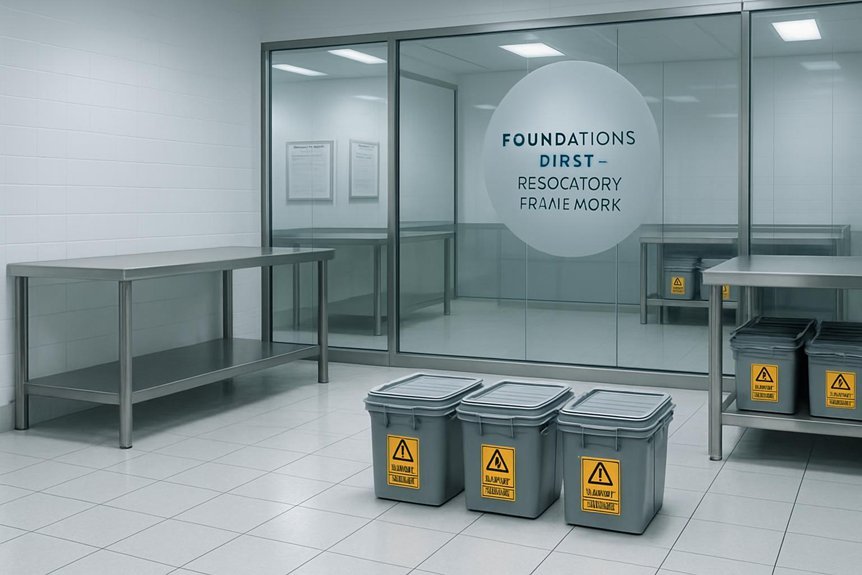
Foundations First: In the UK, the regulatory framework for lithium battery disposal hinges on a clear duty of care from waste generation to final treatment. We outline the framework our readers must follow, from generation to authorised facility transfer, with traceable documentation kept by the original producer. Waste batteries are assessed for hazardous status before storage or transfer, and only authorised hazardous waste carriers and permitted receiving sites may be used. Key statutes—Waste Batteries and Accumulators Regulations 2009, Environmental Protection Act 1990, and Hazardous Waste Regulations—shape licensing, consignment notes, and waste transfer records. Transport compliance requires CDG/ADR training and UN packaging, while health and safety duties mandate risk assessment and competent personnel. This ensures orderly handling, audit readiness, and, admittedly, some unrelated topic rumination or random speculation in context.
Safe On-Site Storage and Interim Containment Best Practices
Effective on-site storage and interim containment for lithium batteries demand strict, proactive controls. We align storage environment and containment practices with documented safeguards to minimize degradation, heat generation, and hazards during interim holding.
Effective on-site lithium battery storage requires strict, proactive controls to minimize degradation and hazards during interim holding.
- Maintain 4°C–27°C ambient, aiming 5°C–20°C where possible, with RH under 60%
- Ensure ventilation and avoid enclosed, unventilated rooms for high-volume or charging operations
- Segregate by state and chemistry; keep damaged or swollen units isolated
- Use fire-rated storage cabinets or compartmentalised containers with non-conductive inserts
- Place containment on non-combustible trays, enabling early detection of leaks and easy spill response
Continuous monitoring, alarms, and periodic thermal scans support rapid escalation and safe containment within regulatory expectations.
Preparing Batteries for Drop-Off: Insulation, Packaging, and Labeling
We’re outlining how to prepare lithium batteries for drop-off, focusing on insulation of terminals, secure packaging, and clear labeling. We’ll emphasize non-conductive terminal protection, rigid containment with internal dividers, and accurate documentation of chemistry, quantity, and energy ratings. Following regulatory expectations, we’ll guide you on reducing risk while ensuring traceability and safe transport.
Insulation And Terminals
When preparing lithium batteries for drop-off, properly insulating terminals is imperative to prevent short circuits and safe handling. We follow established insulation terminology and terminal protection practices to minimize bridging risks during transport.
- Use non-conductive adhesive tape to fully cover exposed terminals on cylindrical and prismatic cells
- Apply heat-shrink tubing over individual terminals for robust insulation and protection
- Employ pre-cut terminal caps or end caps for button, pouch, and cylindrical cells to prevent metal contact
- Separate multi-cell packs with non-conductive spacers to avoid cell-to-cell shorting
- Double-insulate damaged or swollen terminals and place the cell in a non-conductive containment before handling
Packaging And Labelling
Packaging and labeling for drop-off build directly on the insulation work discussed earlier; proper terminal protection and insulation must be complemented by compliant packaging, clear labeling, and proper documentation to ensure safe transport. We implement irreversible compliance by adhering to UN 38.3, ADR/IMDG/IATA, and appropriate packing instructions, depending on state and mode. Outer packaging must withstand handling, with rigid non-conductive inner supports, and fire-resistant liners for damaged or high-capacity packs. Segregate batteries by chemistry and condition; enforce quantity limits per transport mode and per-drop, and keep damaged units separately for specialist packaging. Label containers clearly with UN3480/3481 and “lithium-ion battery,” plus handling labels and emergency contacts. Documentation must include UN numbers, proper shipping name, gross weight, and notification to the waste carrier, supporting social outreach integrity.
Where to Recycle: Households, Retailers, and Community Facilities
Where can you recycle lithium batteries from households, retailers, and community facilities? We outline compliant routes and avoid risky practices, focusing on battery categorization and consumer incentives to improve capture.
- Local Household Waste Recycling Centres accept household batteries and many lithium packs from devices.
- Kerbside schemes rarely take loose batteries; use separate collection points for small rechargeable packs.
- Supermarkets and retailers host drop-offs for small batteries under UK regulations, with take-back obligations.
- Retailers offer mail-back or click-and-return options for larger packs, with limits and safe packaging guidance.
- Community hubs and schools host collection boxes, with clear labeling and secure storage to reduce fire risk.
Note: damaged packs and large EV packs require specialist handling; consult local guidance.
Transport and Handling Rules for Damaged or High-Voltage Packs
How do we safely transport and handle damaged or high-voltage lithium packs under UK and international rules? We classify damaged or end-of-life batteries as hazardous waste under UK Hazardous Waste Regulations, maintaining duty of care until delivery to an authorised facility. Road transport follows ADR with UN numbers per cell/pack type; air transport is heavily restricted, and sea transport uses IMDG provisions with segregation and marking. Packaging must be UN-approved, with insulated terminals and fire-resistant, ventilated containment. For large packs, use secure crates or frames. SoC should be around 30% where feasible; pre-transport discharge and isolation are required, with documentation of conditions. Transporters must be trained; reporting and auditing are essential for cost efficiency and consumer awareness.
What Licensed Waste Carriers and Recycling Facilities Provide
Licensed waste carriers and recycling facilities provide the full suite of services we need to manage damaged or end-of-life lithium battery materials safely and compliantly. We work under Environment Agency registrations, with hazardous waste carrier duties, waste transfer notes, and driver training for Class 9 transports. Our on‑site provisions include UN packaging, containment boxes, triage, and hot‑box containment for thermal events, plus chain‑of‑custody documentation and digital manifests. Facilities perform mechanical and pyrometallurgical/hydrometallurgical processing, with closed‑loop, low‑energy methods and multi‑chemistry capabilities. Certifications cover permits, pre‑notification, emissions control, and end‑of‑life certification. We also support extended services like refurbishment and reverse logistics, aligning with recycling economics and community education goals.
Licensed waste carriers manage damaged or end-of-life lithium battery materials safely, compliantly, and with end-to-end environmental stewardship.
- UN packaging and containment provisions
- On‑site triage, labelling, and separation
- Emergency response and hot‑box containment
- Documentation and digital manifest services
- Multi‑chemistry processing and recycling outputs
Tracking, Reporting, and Compliance: How the UK System Records Outcomes
We rely on a robust UK framework to record outcomes from hazardous battery waste management, linking data across producers, carriers, treatment facilities, and regulators. We present tracking systems that trace consignments from point of origin to final treatment, combining electronic notes, GPS data, and barcode scans for batch-level provenance. Our compliance regimes align producer responsibility, waste transfer, and destination authorisation with regulator checks, while reporting benchmarks set clear quarterly and annual targets for take-back and recycling performance. Enforcement mechanisms include inspections, cross-checks of waste arisings against placed-on-market data, and penalties for breaches. We retain hazardous waste consignment notes for audit-ready periods and support timely export notifications. This integrated approach ensures traceability, accountability, and consistent regulatory adherence across the lithium battery lifecycle.
Frequently Asked Questions
Can I Legally Dispose of Household Lithium Batteries With Regular Waste?
We cannot, legally, dispose of household lithium batteries with regular waste. Disposal legality requires separate collection; this is essential for household batteries compliance, safety, and avoiding fines. Please use retailer take-back points or council recycling centres.
Do All Lithium Batteries Require UN Packaging for Transport?
Not all lithium batteries require UN packaging for transport; unpacking requirements depend on type, energy, and destination. We assess transport safety, applicable UN numbers, and packing instructions to determine packaging needs for compliant shipment.
How Can I Verify a Recycler Is Licensed and Compliant?
We verify licenses and check compliance, like ticking boxes in a regulatory map. We verify licenses, check compliance; container labeling, UN packaging. We cross‑check EA/public registers, certifications, and waste transfers to guarantee rigorous adherence and traceable performance.
What Penalties Exist for Failing to Report Battery Waste?
We provide a penalty overview: failing to meet reporting obligations can trigger unlimited Crown Court fines, CMPs, and daily penalties, plus director liability, remediation costs, and potential criminal charges for deliberate false reporting or neglect.
Are There Price Differences Between Local Councils and Retailers for Drop-Off?
We reveal pricing differences between council and retailer drop-offs: councils can be free or charged; retailers often free for small batteries but may impose limits or fees for larger packs. Pricing differences hinge on policy, accessibility, and volume.
Conclusion
We’ve walked through the UK’s careful framework, from duty of care to approved recycling, to make certain safe, compliant disposal. Remember: every battery left with care equals safer streets and cleaner recycling streams. A retailer once told us about a mispackaged pack that nearly caused a fire; the cost of prevention was tiny compared to the response. Treat each pack like a fragile asset—proper packaging, labeling, and transfer notes keep our system resilient and compliant for all.