We’ve built a practical framework for recycling lithium batteries that emphasizes safety, efficiency, and cradle-to-grade circularity. With data on recovery yields, energy use, and waste handling, we compare pyrometallurgy, hydrometallurgy, and direct recycling to find robust, mixed-feed solutions. We’ll outline safer collection, proper DDR/HHW routing, and compliant practices to reduce risk and maximize value. The path we choose depends on your feed, targets, and facilities, and a careful balance will keep us moving forward.
Key Takeaways
- Overview of recycling pathways: pyrometallurgy, hydrometallurgy, mechanical-first, direct recycling, and practical combined routes.
- Safety and handling: proper pre-collection packaging, isolation of damaged units, terminal protection, and fire-risk reduction.
- Storage and pre-dropoff practices: keep 15–25°C, <60% humidity, 30–50% SOC, clear labeling, and DDR/HHW routing.
- Documentation and compliance: manifests, chain-of-custody, recycling receipts, and audit-ready records.
- Partnerships and public take-back: work with certified recyclers, promote retailer/manufacturer programs, and data-driven myth debunking.
How Lithium Batteries Are Recycled: A Quick Overview
So how are lithium batteries recycled, and why does it matter? We, as a guide, outline the major pathways: pyrometallurgy, hydrometallurgy, mechanical methods, and direct recycling. Pyrometallurgy smelts packs at high temperature, yielding metal-rich alloys but losing much lithium and consuming energy. Hydrometallurgy uses aqueous leaching to recover Ni, Co, and Li with 80–95% efficiency for key metals, yet creates wastewater requiring treatment. Mechanical-first workflows shred, separate, and concentrate into black mass, from which chemical steps extract usable materials. Direct recycling aims to preserve cathode materials’ crystal structure for relithiation, though it’s chemistry-dependent and still pilots. Across methods, sorting by chemistry and format, safe discharge, and controlled processing improve recovery. Cathode materials and black mass quality drive economics and environmental outcomes.
Safety First: Handling and Prepping Batteries for Recycling
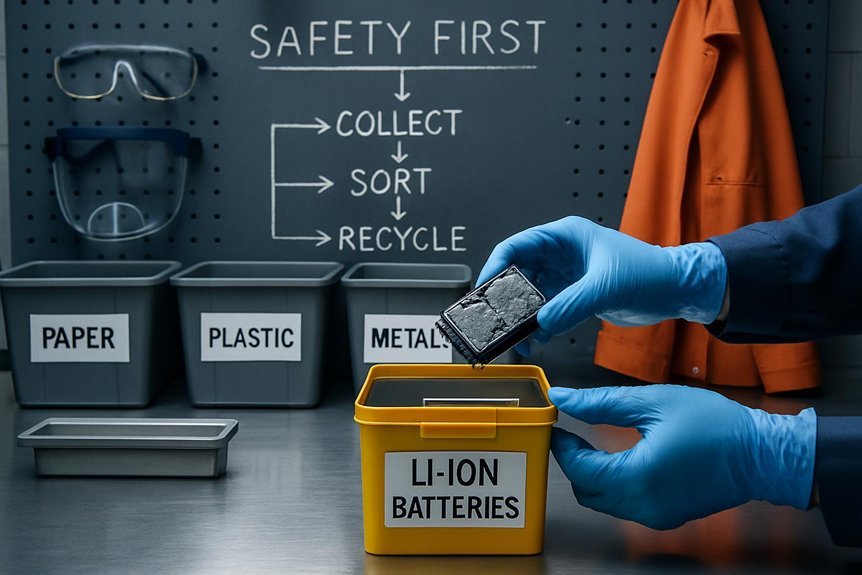
We start with clear terminal taping, bagging each cell, and using non-conductive separators to minimize short circuits while we assess chemistry and condition. We’ll prioritize safe storage practices and proper packaging rules that meet regulatory limits, so every step supports containment, traceability, and sustainability. By focusing on these prep actions, we reduce risk and improve downstream recycling outcomes for damaged, swollen, or exposed batteries. New sentence added If a battery is damaged or swollen, treat it as higher risk and isolate it per HHW or manufacturer guidance to prevent further hazards.
Terminal Taping Techniques
What’s the simplest way to prevent a battery from sparking or shorting during transport? We answer with practical terminal taping steps that emphasize safe battery prep. We use non-conductive tape to cover terminals, avoid metal-backed tapes, and select adhesives that resist peeling. We tape each cell or exposed contact fully, then bag or separate to prevent contact. For damaged or swollen units, we avoid taping over punctures and route to proper DDR programs. Below is a quick reference table to guide decisions.
| Battery type | Taping focus | Packaging notes |
|---|---|---|
| Cylindrical | Full cap wrap | Bag individually if possible |
| Prismatic | Cover exposed tabs | Do not compress body |
| Packs | Tape exposed contacts | Follow manufacturer guidance |
| Button cells | Tape faces | Use separate small bags |
Terminal taping and battery prep reduce fire risk and meet recycler requirements.
Safe Storage Practices
Safe storage starts with a disciplined setup that minimizes risk and preserves battery integrity. We store batteries in cool, dry spaces at 15–25°C and keep relative humidity below 60% to reduce corrosion and degradation. Avoid direct sun, heat sources, trunks, and unventilated attics that raise temperatures and hazards. Use a non-combustible surface to lower fire spread and separate from flammable materials, following local fire code limits. Maintain long-term SOC around 30–50% to lessen stress and instability, and isolate aged or damaged units for expedited handling. Monitor weekly to monthly for temperature shifts or swelling, logging batch dates to enforce FIFO. Segregate by chemistry and format; limit per container, and secure access to trained personnel only. ventilation safety, and emergency decontamination plans are essential. A flammable liquid is a known hazard when batteries are mishandled or punctured, underscoring the importance of proper storage and containment.
Pre-Dropoff Packaging Rules
Pre-dropoff packaging starts with concrete safeguards to prevent short circuits and leaks during handling. We insulate exposed terminals with non-conductive tape and place each battery in an individual plastic bag or sleeve to avoid inter-cell contact. For devices, we tape external contacts or bag the unit, and we use non-conductive, flame-retardant separators when packing multiple batteries. We label packages as “lithium-ion batteries — terminals taped” to ensure label compliance for handlers. In health checks, we inspect for swelling, leakage, or damage, segregating compromised units as higher-risk. Large packs get treated separately with facility-specific limits, dividers, and rigid outer containers. Before transport, we store in a cool, dry place and use non-conductive, stable containers. Terminal insulation and proper labeling drive safer, sustainable drop-offs.
Where Damaged Batteries Go: DDR/HHW and Proper Packing
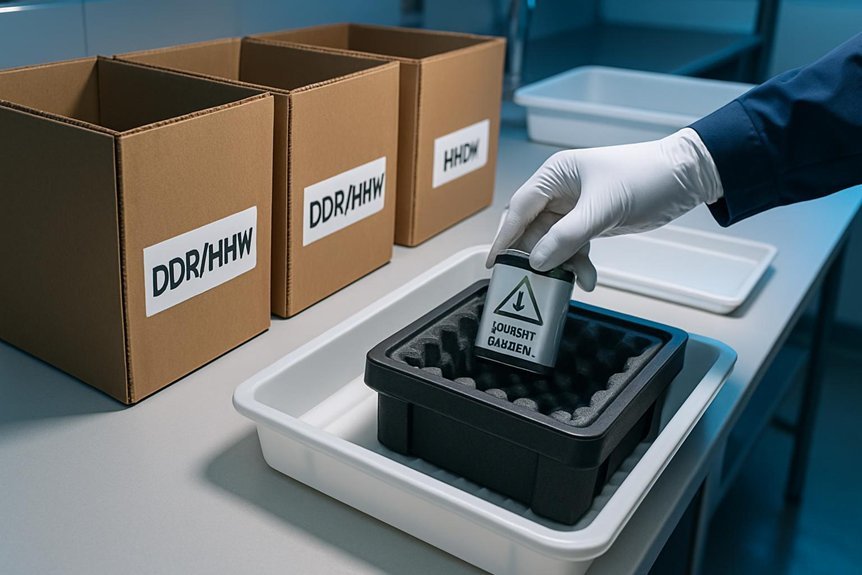
Where do damaged lithium batteries go, and how should we pack them for transport? We’re guiding you through DDR/HHW pathways with clear rules, mindful of safety and compliance. DDR must follow transport regulations, be documented, and routed to HHW centers, permitted recyclers, or specialized facilities. On-site handling emphasizes isolation, non-conductive coverings, and puncture‑resistant bags to prevent shorting. For larger volumes, licensed hazardous waste transporters and route planning to permitted recyclers are essential. The process hinges on damaged planning and adherence to DOT/PHMSA rules, with manifests, emergency response info, and hazmat declarations as needed.
| Imagery: DDR handling | End destinations |
|---|---|
| Isolation areas | HHW centers, DDR intake events |
| Fire-safe packaging | Certified recyclers, HazMat teams |
Recycling Routes Explained: Pyrometallurgy, Hydrometallurgy, and Direct Recycling
We’ve covered how damaged batteries move and get packed; now we turn to how those batteries are processed after collection. We summarize three main routes, balancing recovery, energy use, and footprint.
1) Pyrometallurgy: high-temperature smelting yields metal-rich alloys but loses Li to slag; energy-intensive with CO2 emissions; robust with mixed feeds though not ideal for battery-grade precursors.
2) Hydrometallurgy: aqueous leaching enables high recoveries (>90%) of Li, Co, Ni, Mn; lower thermal energy but substantial chemical use and wastewater to manage; economics hinge on reagents and effluent handling.
3) Direct recycling: preserves active materials’ structure, reducing processing steps but still under development for large-scale throughput.
4) Practical path: plants mix routes to optimize feed, purity, and cost, targeting cradle-to-grade recycling where feasible.
Choosing a Route for Your Battery: Criteria You Should Consider
Choosing a route isn’t guessing work—it’s about aligning feedstock realities with route strengths. We compare chemistry match, SOA constraints, form factor, impurity tolerance, and throughput to select the best fit, balancing economic factors and environmental impacts. Direct recycling preserves cathode structure for higher downstream value, while hydrometallurgy handles mixed chemistries with broader metal recovery; pyrometallurgy tolerates variability but sacrifices Li and Al. Consider charge, damage, and assembly complexity to estimate pretreatment needs and safety. Table below visualizes tradeoffs across routes.
| Criteria | Route-driven implications |
|---|---|
| Economic factors | CAPEX/OPEX, material value capture, policy incentives |
| Environmental impacts | Emissions, water use, wastewater generation |
| Feedstock compatibility | Chemistry, charge state, form factor |
Rules, Programs, and Best Practices for Compliant Recycling
Compliant recycling starts with clear classifications, stringent handling, and solid documentation that align with federal, state, and local rules. We organize by chemistry and condition, follow DOT/PHMSA for transport, and respect EPA/state waste rules, with OSHA workplace safety in mind. We maintain manifests, chain-of-custody, and recycling receipts to support compliance and audit readiness.
1) We’ll partner with certified recyclers, verify methods (mechanical, hydrometallurgy, pyrometallurgy, direct recycling), and ensure environmental controls.
2) We’ll implement pre-collection safety: segregate by type, isolate damaged units, insulate terminals, and store in fire‑resistant containers with clear labeling.
3) We’ll promote legitimate take-back options—retail, manufacturer schemes, HHW events, and certified networks—to reduce battery ownership risks.
4) We’ll debunk recycling myths with data, clarifying why compliance matters for sustainability, safety, and responsible stewardship.
Frequently Asked Questions
How Is Environmental Impact Measured for Different Recycling Routes?
We measure environmental impact using life cycle assessment, comparing routes with environmental metrics like GWP, energy use, and emissions across cradle-to-gate boundaries, accounting for pretreatment, recovery yields, and electricity mix to guide sustainable decisions.
Can All Lithium Batteries Be Recycled Together Regardless of Chemistry?
We can’t recycle all lithium batteries together; mixed chemistry handling risks safety and recoveries. Segregation is essential, so we separate chemistries and formats, then treat them with chemistry-specific flows. Data shows higher sustainability when we curate feeds.
What Costs Are Typically Involved in Battery Recycling?
Costs involved span CapEx, OpEx, and revenue factors. Costs overview includes facility, equipment, safety, and compliance; safety compliance is essential. We present data-driven, sustainability-focused figures to guide readers through practical, budget-conscious recycling investments.
How Long Does the Recycling Process Take From Drop-Off to Recovered Materials?
We estimate overall timeframes from drop-off to recovered materials, acknowledging bottlenecks and capacity constraints. We project several stages: intake, front-end processing, chemical recovery, and post-recovery reuse, with throughput limits shaping total timelines. Our data fuels practical sustainability decisions.
What Certifications Should Facilities Hold for Safe Recycling?
We hold Certification standards aligned with ISO 45001, ISO 14001, ISO 9001, IEC 62133, and relevant transport safety rules, plus Compliance audits to verify ongoing safety, environmental performance, and material traceability throughout recycling operations.
Conclusion
We’ve seen that choosing the right recycling path hinges on battery chemistry, state of health, and local infrastructure. By prioritizing high-efficiency recovery and lower energy use, we can close the loop responsibly. One striking stat: direct recycling can cut energy demand by up to 40% compared with traditional pyrometallurgy. If we pair this with robust DDR/HHW handling and certified partnerships, we build a safer, cleaner, and more sustainable lithium battery economy.