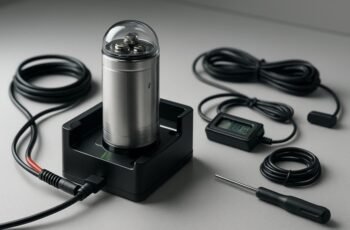
We’ll start with a precise LiFePO4 maintenance approach: baseline measurements for voltage, temperature, and SOC, plus consistent rest and load checks. We’ll inspect terminals, cables, and connectors for secure, corrosion-free interfaces and monitor cell balance within safe voltage windows. We’ll follow manufacturer-guided charging and seasonal storage practices, document deviations, and flag drift early. If temperatures or voltages drift beyond thresholds, we’ll act calmly and methodically, keeping traceability; the next step hinges on what we find.
Key Takeaways
- Establish a LiFePO4 baseline: record resting voltage, pack voltage, temperatures, and SOC with calibrated tools to guide charging and thermal decisions.
- Implement red-flag procedures: detect drift beyond thresholds, verify sensors, review baselines, and document affected modules with sequential checks.
- Maintain terminal and connector health: clean, inspect, secure connections, and replace damaged components to prevent heat buildup.
- Monitor health and safe voltage windows: assess cell balance, end-of-charge voltages, delta voltages, and flag weak cells for corrective actions.
- Follow periodic testing and seasonal storage protocols: schedule resting tests, refresh cycles, and maintain data-driven protective maintenance for storage.
Set Your LiFePO4 Baseline: Voltage, Temperature, and SOC
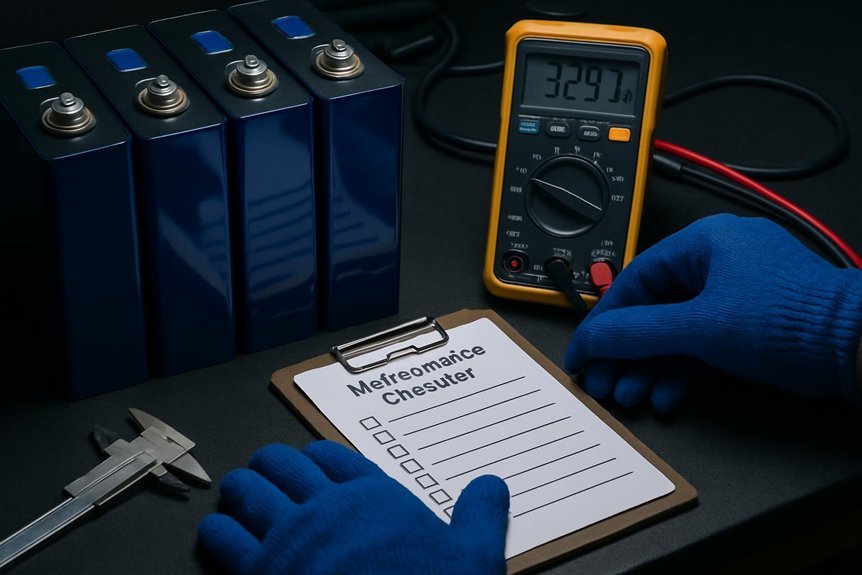
Setting a LiFePO4 baseline starts with precise measurements of voltage, temperature, and state of charge (SOC). We, as a team, establish baseline metrics by recording each parameter under controlled conditions, then compare against manufacturer curves and our safety thresholds. We document cell voltage at rest, average pack voltage, ambient and pack temperatures, and SOC percentage from our calibrated instruments. This process yields repeatable reference points that guide charge, discharge, and thermal management decisions. We monitor for deviations beyond predefined safety thresholds, flagging anomalies early to prevent degradation or unsafe conditions. Our approach emphasizes consistency, traceability, and data integrity, ensuring we can detect drift, imbalance, or sensor faults. With clear baseline metrics, we maintain predictable performance and extend LiFePO4 longevity.
Inspect and Clean Terminals, Cables, and Connectors
We’ll start by cleaning and inspecting all terminal contacts to ensure solid, low-resistance connections. We’ll verify cable connections are secure, intact, and free from corrosion, tightening where specified and replacing damaged components as needed. This methodical check reduces heat buildup and prevents intermittent failures that can impact overall pack performance.
Clean Terminal Contacts
Ever wonder why clean terminal contacts matter? We approach this with precision: clean contacts reduce resistance, prevent heat buildup, and improve overall pack performance. We inspect terminals, cables, and connectors for corrosion, looseness, or pitting, then clean with approved solvent and abrasive-safe tools. We document measurements and any material changes to track longevity, including how battery metallurgy affects contact behavior. We also consider recycling practices for failed components, ensuring compliant disposal of residues. Our method minimizes risk while maximizing circuit integrity and safety.
- Inspect contact surfaces for corrosion and wear
- Use approved cleaner and non-abrasive tools
- Recap and tighten terminals to specified torque
- Check insulation, sleeves, and connector seals
- Record observations and future maintenance intervals
Inspect Cable Connections
Do you regularly verify every cable connection for signs of wear or misalignment before proceeding with load testing? We approach inspection systematically: confirm terminal screws are present, seated, and torque-spec compliant; inspect cables for cracks, insulation damage, or exposed conductors; test connectors for spring tension and secure latch engagement. We document any corrosion or discoloration at joints and clean with a non-abrasive contact cleaner if needed. After cleaning, re-tighten to spec, then re-check continuity with a multimeter, ensuring no voltage drop exceeds manufacturer guidance. During operation, monitor for heat rise at terminals; a sudden increase indicates potential resistance. Include drain cycle considerations and cord protection in the protocol to mitigate abrasion and pinching. This disciplined process reduces electrical faults, extending battery life and reliability.
Check Cell Balance and Health for Safe Voltage Windows
To guarantee safe voltage windows, we first check each cell’s balance and health to prevent overcharge or deep discharge. We perform a quick resting voltage check, followed by a loaded delta assessment to detect weak cells. Our protocol emphasizes consistent data collection, trend analysis, and documented tolerances, ensuring early fault detection. We focus on actionable thresholds, logging ASOC/EOA parameters, and flagging deviations before they impact pack safety. By prioritizing a rigorous health check, we minimize voltage skew and extend cycle life. Our approach remains precise, measurable, and repeatable, enabling calm, informed maintenance decisions.
- check cell balance consistency across all modules
- record end-of-charge voltages for trend analysis
- compare each cell’s delta voltage to specification
- flag outliers for immediate investigation
- document health check results and corrective actions
Follow Safe, Manufacturer-Guided Charging Protocols
We follow manufacturer guidance for charging protocols to ensure safe, consistent results. We use proven charging procedures and monitor parameters to validate each session. By adhering to proper charging practices, we minimize risk and maximize battery longevity.
Follow Manufacturer Guidance
Following safe, manufacturer-guided charging protocols is essential for Lifepo4 batteries. We align with official guidelines to optimize the battery lifecycle and protect warranty considerations, ensuring predictable performance and longer service life. Our approach emphasizes documented input ranges, charging currents, and temperature limits derived from manufacturers’ specs, avoiding improvised methods. By following these standards, we minimize degradation mechanisms and maintain consistent capacity retention over cycles, while preserving return-to-service reliability.
- Adhere to recommended charging current and voltage ceilings
- Monitor ambient and pack temperatures during charge
- Use only approved chargers and state-of-charge profiles
- Log charging events and deviations for traceability
- Review warranty terms for coverage nuances and required procedures
Safe Charging Protocols
Safe charging hinges on adhering to manufacturer-guided protocols for every session. We follow defined step voltages, currents, and termination criteria to minimize stress and drift. Our approach centers on documented acceptance tests, charging phases, and monitored parameters, enabling reproducible results. We verify that charger output aligns with the vehicle’s safe charging profile, ensuring adherence to voltage limits at each stage. We calibrate temperature impact and impedance readings, applying conservative margins when data indicate deviation. We document cycle counts, state of charge targets, and endurance implications to maintain reliability. We avoid fast-track methods not specified by the maker and reserve status checks for planned windows. By locking into safe charging parameters, we reduce degradation pathways and preserve capacity, ensuring predictable performance across cycles.
Proper Charging Practices
Proper charging practices hinge on following manufacturer-guided protocols to the letter. We implement precise, data-driven steps to maximize longevity and safety, then verify each action against documented specs. Our approach minimizes thermal envelopes, voltage deviations, and cycle wear, promoting lithium safety in every session. We address charging myths by distinguishing evidenced limits from anecdotes, and we adjust procedures to match cell chemistry, temperature, and pack design. By adhering to recommended current, voltage, and end-of-charge criteria, we reduce degradation and risk. We monitor state-of-charge trends, log deviations, and correct promptly. This disciplined framework supports consistent performance while avoiding over- or undercharging, ensuring reliable readiness for use.
- Follow exact manufacturer guidelines for current, voltage, and termination
- Monitor temperature and SOC during charging
- Use approved chargers and cables only
- Document deviations and corrective actions
- Debunk charging myths with verifiable data
Seasonal Storage and Protective Maintenance for LiFePO4
Seasonal storage and protective maintenance for LiFePO4 batteries require a disciplined, data-informed routine to preserve capacity and extend life. We approach this with documented targets and repeatable steps, not guesses. First, we stabilize state of charge to a recommended mid-range level (typically around 50–60%), avoiding deep discharge. Second, we perform a thorough inspection, checking for venting symptoms, corrosion, or physical damage, and recording any anomalies. Third, we clean terminals, terminals’ connectors, and housings, then apply a light, compatible dielectric or corrosion inhibitor where appropriate. Fourth, we store in a temperature-controlled environment, shielding from extreme heat or cold. Finally, we schedule periodic resting tests and voltage refresh cycles to confirm capacity metrics remain within spec, ensuring seasonal storage and protective maintenance stay aligned with performance data.
Red-Flag Scenarios: What to Do When Temps or Voltages Drift
When temperatures or voltages drift beyond established thresholds, we treat it as a red flag and act decisively to isolate, diagnose, and correct the deviation. We follow a disciplined process: verify sensor accuracy, collect current/voltage data, and compare against baseline curves before initiating containment or remediation steps.
- conduct clearance drills to ensure safe access and isolation
- confirm anomaly handling procedures with real-time logs
- document drift magnitude, duration, and affected modules
- perform sequential checks on cell groups and BMS communications
- implement corrective actions and re-test until stability is restored
Frequently Asked Questions
How Often Should I Recalibrate Lifepo4 Voltage Baselines?
We recalibrate every 6 months to maintain accuracy, ensuring calibration frequency aligns with observed drift. We monitor voltage baselines against measured performance, documenting deviations, then adjust as needed to preserve precise state-of-charge readings and battery longevity.
What Safety Steps if a Sulfurous Smell Is Detected?
We’ll act immediately: if a sulfurous smell is detected, we pause, evacuate, ventilate, and isolate the area. We follow sulfurous smell safety protocols, implement sulfur odor precautions, inspect for leaks, and contact professionals for remediation.
Can Lifepo4 Tolerate Partial State-Of-Charge Charging?
Yes, LiFePO4 charging tolerates partial state-of-charge, though we prefer full-range cycles. Picture a refinery: we strategically stage inputs. In practice, we monitor voltage, current, and temperature for safe, precise partial state charging. We measure, verify, record.
Do Temperature Swings Affect Long-Term Cycle Life?
Yes, temperature swings affect long-term cycle life. We observe clear temperature effects on capacity fade and impedance rise, so we monitor, log, and mitigate variations; precise control sustains cycle longevity and reduces degradation across operating conditions.
How to Prioritize Maintenance When on a Tight Budget?
We start with a tight budget and prioritize budget friendly maintenance: 1) check essential cells and voltage; 2) seal connections; 3) monitor temps; 4) schedule periodic balance charges; we’ll stay data-driven and precise, optimizing each step together.
Conclusion
We’ve walked through a disciplined maintenance routine, from establishing baselines to monitoring drift and preserving safe voltage windows. We’ve learned that a 0.05–0.10 V variance per cell across modules can signal impending balance issues, so we catch it early. By following manufacturer-guided charging and seasonal storage practices, we minimize capacity fade and thermal risk. With consistent data logging and red-flag protocols, we keep the pack reliable, safe, and ready for the next cycle.