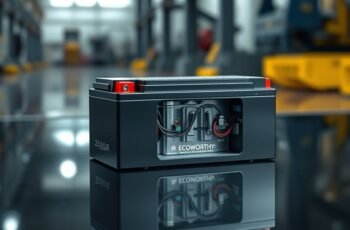
We find that a 48V 13S4P battery, typically rated at 20Ah, can suit e-bikes with 250–1000W motors, but the 35A continuous discharge limit matters more than the advertised motor range. Its 70A instantaneous rating supports brief peaks, not sustained loads. Before choosing one, we’d verify controller current, mounting dimensions, and connector compatibility. The included 54.6V, 3A charger takes roughly 8–10 hours to recharge. We’ll cover its specifications, trade-offs, and fit considerations next.
Key Takeaways
- The 13S4P pack offers 20Ah capacity; a 30Ah option uses a 13S5P layout.
- Its 35A continuous discharge rating suits many 250W–1000W setups, but verify the motor and controller’s current demands.
- The included 54.6V, 3A charger takes approximately 8–10 hours to recharge the battery.
- Check the battery’s actual dimensions, 4.8–6.2 kg weight, and XT60/T-line connector against your bike before buying.
- Built-in protections cover overcharging, over-discharging, overcurrent, and short circuits; waterproof PVC does not confirm an immersion rating.
48V 13S4P Battery Specs
The 48V 13S4P configuration is the 20Ah version, rated for motors from 250W to 1000W. Its cell arrangement uses 13 series groups, each with four parallel cells, defining the pack’s nominal voltage and capacity.
We should confirm that your motor’s power demand falls within the stated range and that the battery dimensions fit your available space. The listed discharge cutoff voltage range is 35V ±1V to 54V ±1V; this voltage range helps establish operating limits, not a precise nominal-voltage specification.
Before purchase, check your system’s connector and battery requirements to verify compatibility with this 48V pack.
Detailed features
Beyond its 13S4P layout, this battery includes a 35A BMS that guards against overcharging, over-discharging, overcurrent, and short circuits. We can assess its other features through these specifications:
| Feature | Rating | Relevance |
|---|---|---|
| Charging performance | 3A; 8–10 hours | Sets recharge expectations |
| Weather resistance | Waterproof PVC | Adds insulation and wear resistance |
The 54.6V charger supplies the standard 3A charge current, while the stated charging time is 8–10 hours. PVC protects the pack’s exterior, but waterproof construction doesn’t establish an immersion rating. We should also verify connector fit and available mounting space before installation. The XT60/T-line cable supports connection, though compatibility depends on the bike’s wiring.
Pros and Cons
We’ll weigh the battery’s broad motor compatibility, built-in protections, and 20Ah or 30Ah capacity against its 8–10-hour charging time and size.
We’ll also consider the 35A rated discharge limit when evaluating suitability for your setup. Let’s compare the main advantages and trade-offs.
Pros
This battery’s main strengths are its broad vehicle compatibility and built-in protection: it supports 250W–1000W motors, offers 20Ah or 30Ah capacity options, and includes a 35A BMS that guards against overcharging, over-discharging, overcurrent, and short circuits.
We can match its 48V output to compatible e-bikes, scooters, motorcycles, tricycles, or solar setups, after checking dimensions and connectors. The 13S4P 20Ah and 13S5P 30Ah configurations provide capacity choices, while the 70A instantaneous discharge rating supports brief higher loads.
Its included 54.6V charger enables portable charging. By helping maintain suitable power delivery, the battery can support Motor efficiency in properly matched systems.
Cons
Although the battery offers broad compatibility, its specifications leave some practical limits: the listed dimensions use centimeters and appear unusually large, so verify the actual measurements before ordering. We shouldn’t assume the stated measurements are accurate or that either pack will fit a frame compartment.
The 35A rated discharge current may also constrain high-load setups, despite the 70A instantaneous peak and 1000W maximum rating. Check connector compatibility before purchase; the included XT60/T-line cable may not match your controller.
A 3A charger requires an 8–10-hour charging duration, which limits quick turnaround. At 4.8–6.2 kg, the pack adds substantial weight.
Concluding thoughts
For riders who need a 48V pack for a 250W–1000W motor, the stdpcxz battery offers 20Ah or 30Ah capacity, a 35A rated discharge current, and a 35A BMS with protection against common electrical faults.
We’d match the pack to your motor, available mounting space, and connector before buying. The 20Ah model uses a 13S4P configuration; the 30Ah version uses 13S5P. A 54.6V, 3A charger requires roughly 8–10 hours.
Waterproof PVC adds insulation and wear resistance, but doesn’t establish a submersion rating. For Long term reliability and everyday usability, we’d verify fit, charging needs, and expected load first.
Frequently Asked Questions
How Can I Confirm the Battery Fits My Bike’s Mounting Space?
Measure the battery compartment’s length, width, and height, then compare them with the pack dimensions: 285 × 76 × 102 mm for 20Ah or 285 × 76 × 145 mm for 30Ah. Verify mounting clearance, connectors, and cable routing before purchase.
Which Connector Should I Choose for My E-Bike?
Choose the XT60 or T-line cable that matches your controller; treat connector types like keys for a lock. We should verify pinout compatibility, polarity, and current rating before connecting, since matching shapes alone won’t guarantee safe operation.
Can This Battery Power Accessories While the Bike Is Parked?
Yes, we can power accessories while parked if they accept 48V and stay within the battery’s 35A rated discharge limit. Parked Accessory Power will cause Standby Battery Drain, reducing riding range; disconnect loads when unused.
How Should I Store the Battery During Winter?
Store it cool and dry; treat winter as a battery’s hibernation. We recommend disconnecting it, avoiding freezing or heat, and checking it periodically. Maintain a moderate battery charge level; the manufacturer doesn’t specify an ideal winter storage temperature.
What Should I Do if the Charger or Battery Becomes Unusually Hot?
Stop charging if the battery or charger gets unusually hot. We should disconnect and inspect for damage, swelling, odor, or smoke; don’t reuse damaged equipment. Let everything cool safely, then contact the seller or a qualified technician.
Conclusion
We’d match this 48V 20Ah pack to a compatible 13S system, confirm its unusually large dimensions, and verify the discharge connector before buying. Its 35A BMS and rated output suit many 250W–1000W motors, while the 70A peak is brief, not continuous. The 3A charger’s 8–10-hour estimate also shapes daily use. By coincidence, the best battery choice often feels uneventful: specifications align, installation fits, and the ride simply works. We’d verify every limit first.