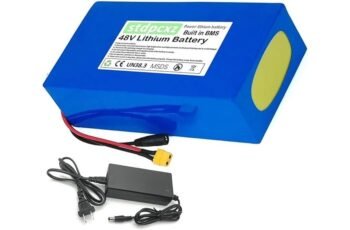
We compare six 48V e-bike battery options, from 8Ah (384Wh) to 20Ah (960Wh), so you can balance ride time against battery weight. Each measures 250 × 140 × 70 mm and supports motors rated 250W–1,000W, but the 20A continuous discharge limit may constrain high-power setups, especially on climbs or during hard acceleration. A 54.6V, 2A charger takes about 4–8 hours. Check frame fit and connector compatibility before buying; we’ll cover the specifications, trade-offs, and practical fit considerations next.
Key Takeaways
- Six capacities range from 8Ah (384Wh) to 20Ah (960Wh), letting riders balance range and battery weight.
- All options measure 250 × 140 × 70 mm; verify frame clearance and connector compatibility before buying.
- The battery supports 250W–1,000W motors, but its 20A continuous-current limit may constrain demanding setups.
- A built-in BMS provides protections against overcharge, over-discharge, overcurrent, overload, short circuits, and voltage imbalance.
- The included 54.6V, 2A charger takes approximately 4–8 hours; keep the battery and charger dry.
48V Battery Specifications
A 48V lithium-ion e-bike battery is available in six capacities: 8, 10, 12, 15, 18, and 20Ah. These capacity options let’s compare stored energy while keeping battery voltage constant. At 48V, the choices range from 384Wh for the 8Ah model to 960Wh for the 20Ah model, calculated by multiplying voltage by amp-hours.
Higher-capacity versions can support longer rides between charges, while lower-capacity versions may suit shorter trips and reduce battery weight. The battery measures 250 × 140 × 70 mm across the range, so we can check this footprint against our frame or mounting space before buying.
Detailed features
Beyond its capacity options, this 48V battery supports motors rated from 250W to 1,000W, with a maximum continuous discharge of 20A. Its built-in BMS monitors voltage, temperature, current, and charging status, while guarding against overcharge, over-discharge, overcurrent, overload, short circuits, and voltage imbalance.
For Battery capacity selection, we can compare the 8Ah–20Ah versions by balancing available range against the battery’s size: 250 × 140 × 70 mm. The included 54.6V, 2A charger sets charging time expectations at approximately 4–8 hours.
A carry handle simplifies removal and transport; keep the battery and charger dry, and fully charge before first use.
Pros and Cons
We’ll weigh the battery’s broad capacity and motor compatibility against its 20A continuous-current limit.
You’ll also want to compare its BMS protections and carry handle with the 4–8-hour charge time and need to keep it dry.
Let’s assess which trade-offs matter most for your e-bike setup.
Pros
With six capacity options from 8Ah to 20Ah, this 48V battery lets us match storage to a range of riding needs while supporting motors up to 1,000W. Broad capacity selection helps us prioritize lower pack weight or longer potential range; Lightweight portability comes from its carry handle and compact 250 × 140 × 70 mm size. A 20A continuous discharge rating suits compatible motor setups, while the built-in BMS monitors key electrical conditions and balances voltage.
| Advantage | Practical benefit |
|---|---|
| Six capacities | Match storage to your ride |
| Carry handle | Simplify removal and transport |
The included 54.6V, 2A charger supports convenient charging, typically in four to eight hours.
Cons
Although the battery offers broad compatibility, its 20A continuous discharge limit may constrain some 1,000W setups, so check your motor’s current draw before buying. This Limited motor range matters most under heavy acceleration or steep climbs, when demand can exceed the rating. Compared with higher-current packs, this option may not suit performance builds.
Capacity also affects weight and range: the 8Ah version offers less riding time than the 20Ah model, while the larger pack takes up the listed 250 × 140 × 70 mm space. Note its moisture sensitivity, too; keep the battery and charger dry. Charging takes about 4–8 hours.
Concluding thoughts
Overall, this 48V battery offers a practical range of capacities from 8Ah to 20Ah and supports motors up to 1,000W, provided their continuous draw stays within its 20A limit.
We’d match capacity to your route and range needs: smaller options reduce bulk, while larger ones provide more stored energy. The built-in BMS adds protection against common electrical faults, and the included 2A charger takes about four to eight hours.
For long term ownership, follow sound charging habits, fully charge before first use, and keep the battery dry. We’d verify fit, connector compatibility, and motor current before buying.
Frequently Asked Questions
Can This Battery Be Installed on Any E-Bike Frame?
No, we can’t guarantee Frame fit on every e-bike: the battery measures 250 × 140 × 70 mm. Check your frame’s available space and Mounting options before buying; confirm the mount securely supports the battery’s size and weight.
How Can I Check Whether My Bike’s Connector Is Compatible?
We can compare your connector’s pinout and plug dimensions with the battery’s specifications; the included charger outputs 54.6V. Check polarity, shape, and fit, then confirm voltage and wiring before connecting to avoid damage.
Is Professional Installation Recommended?
We recommend professional installation if you’re unsure about wiring or mounting; confident DIYers can install it carefully. Compare installation cost against your skills, and check warranty implications with the seller before modifying connectors or wiring.
What Should I Do if the Battery Won’T Charge?
If your battery won’t charge, we should check charger connections and inspect port for dirt, moisture, or damage. Try another compatible outlet; don’t force plugs. If charging still fails, stop and contact the seller or a qualified technician.
How Should I Store the Battery During Winter?
For Winter storage, we should keep your battery dry, cool, and indoors—not fully charged or depleted. Check it periodically; Charge maintenance means topping it up before voltage falls too low, following manufacturer guidance. Avoid moisture and freezing temperatures.
Conclusion
We find this 48V battery a practical pick for riders comparing compact capacity options, from 8Ah to 20Ah. Its 20A continuous output suits compatible motors up to 1,000W, while the included 54.6V, 2A charger supports straightforward charging. Before buying, we’d check fit, connector, and motor-current requirements, then choose capacity to match your range needs. The built-in BMS adds useful protection, but cycle-life claims vary, so we wouldn’t count on a precise lifespan. Verify specifications, weigh value, and ride confidently.