You probably don’t know how critical space and cooling margins are to a safe golf cart lithium upgrade. We’ll walk you through verifying each component—from enclosure dimensions to thermal gaps—before wiring any pack, because improper fit compromises BMS communication and thermal management. If we don’t get the mounting, fusing, and isolation right now, small faults become costly failures later. Let’s align goals with manufacturer guidance and keep a clean, serviceable system that lasts.
Key Takeaways
- Verify compatibility with your golf cart’s BMS, charging profile, and voltage window before installation.
- Plan space, mounting, airflow, and vibration resistance to ensure safe integration and cooling.
- Use proper wiring: short runs, correct gauge, secure terminals, shielding, and appropriate fusing.
- Follow exact charging protocols, SOC limits, and monitor cell temperatures during charging.
- Maintain thorough maintenance records, periodic inspections, and documentation to support warranties and long-term care.
Define Your Golf Cart Lithium Upgrade Goals
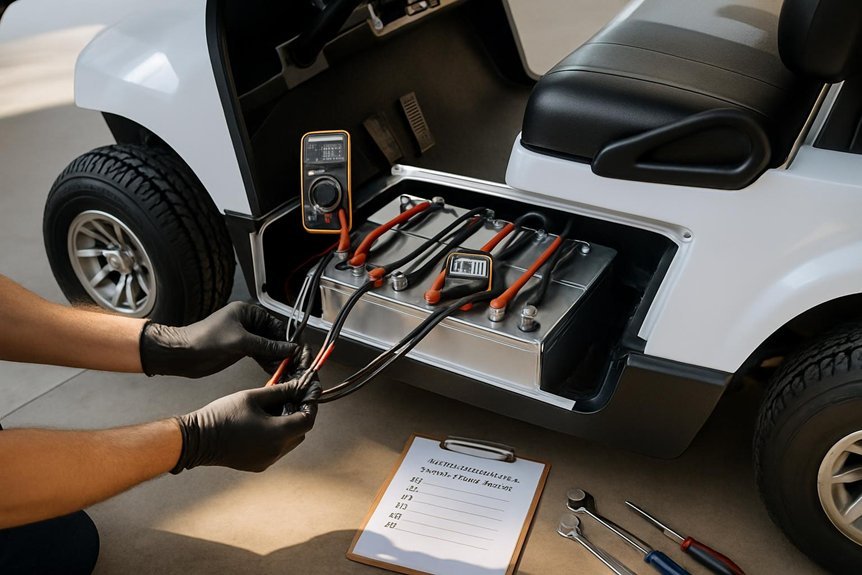
What are your exact goals for upgrading to a golf cart lithium battery system? We define this step as a requires-clarity exercise, so we outline, in measured terms, what success looks like. We define your expected range, peak discharge, and cycle life, then translate those into target voltage windows and safety margins. We assess compatibility with existing management systems, charging profiles, and BMS thresholds to avoid overcurrent or thermal events. We specify the operating environment, duty cycle, and maintenance cadence to ensure reliable performance. We identify safety constraints, required documentation, and warranty conditions. Define your criteria for cost-to-performance balance, replacement intervals, and serviceability. Define your goals clearly, document assumptions, and align them with manufacturer data sheets and field testing plans.
Evaluate Space, Mounting Options, and Fit
We now assess space, mounting options, and fit to guarantee the lithium pack integrates safely and reliably. Our evaluation space analysis focuses on clearance, ventilation, wiring routes, and access for maintenance, ensuring no interference with controls or suspension. We compare mounting options for strength, vibration dampening, and weight distribution, prioritizing rigidity without overloading OEM mounts. Fit compatibility checks verify enclosure dimensions, connector alignments, and thermal gaps, preventing pinch points. We also review accessory packaging to confirm included hardware, spacers, and labels match the chosen pack. This systematic approach minimizes retrofit risks and maximizes reliability under load and duty cycles.
- evaluation space criteria for clearance and airflow
- mounting options assessment for vibration resistance
- fit compatibility verification of dimensions and connectors
- accessory packaging completeness and labeling
- documentation alignment with installation steps
Select Golf-Cart Lithium Chemistry and BMS
Choosing the right golf-cart lithium chemistry and BMS is critical for safety, reliability, and performance. We assess cell chemistry for energy density, cycle life, temperature tolerance, and thermal runaway risk, prioritizing proven chemistries with automotive-grade controls. Lithium iron phosphate (LFP) offers strong safety and long cycle life, while NMC blends balance energy density with thermal stability. We consider usage pattern, discharge depth, and available cooling when selecting chemistry. For BMS selection, we require robust state-of-charge, temperature, and voltage monitoring, with proper cell balancing, fault protection, and communication compatibility to your controller. Ensure expansion capability, diagnostic access, and manufacturer-supported firmware updates. Documentation, certifications, and warranty terms guide our choice, aligning safety margins with expected load profiles and environmental conditions.
Plan Wiring and Integration With Controller and Charger
We plan the wiring layout to ensure shortest, clean runs from the battery pack to the controller and charger, minimizing resistance and heat buildup. We’ll integrate the controller and charger with appropriately rated fusing, voltage sensing, and separation to prevent interference and faults. We’ll verify terminal polarity, shielded paths where needed, and document cable gauges and protection measures for safe, reliable operation.
Plan Wiring Layout
How should we approach wiring layout when planning the integration with the controller and charger? We map the circuit, preserve short runs, and minimize exposure to vibration. We prioritize safety margins, ensure proper gauge selection, and document torque specs for all fasteners. We consider thermal paths, fuse placement, and weatherproof routing to reduce resistance and heat buildup. We address planning obstacles and clearance constraints early, then verify every segment against space limits and future service access. We’ll label harnesses, add strain relief, and maintain separation from high-current paths. We test continuity and insulation with the system powered down, before powering up for diagnostic checks. Final layout emphasizes a clean, serviceable, and compliant installation.
- Identify planning obstacles and clearance constraints early
- Route with short, direct paths and proper gauge
- Apply strain relief and secure fasteners
- Separate high-current from signal lines
- Label, document, and verify during testing
Integrate Controller, Charger
To integrate the controller and charger effectively, we map their interconnections early and verify compatibility of pinouts, voltage ranges, and current ratings before any wiring is laid out. We proceed with a consolidated schematics review, labeling harnesses, fuses, and sense lines, then confirm safe enclosure clearance and heat dissipation. We verify that the charger output matches the pack’s chemistry and that the controller accepts the same battery voltage and current profile, including any PEM/SMPS startup behavior. We implement proper isolation, grounding, and a fail-safe disconnect. We test continuity and insulation resistance, then perform a staged energize, monitoring current, voltage, and temperature. Our approach includes ideas about Subtopic not relevant to the Other H2s listed above: “presentation tips, audience engagement”.
Optimize Charging and Thermal Management for Safety
Effective charging and thermal management are essential for safety and battery longevity in golf carts. We, as installers, optimize charging protocols and monitor temperatures to prevent degradation and failures. Our approach emphasizes controlled current, proper voltage limits, and staged charging to maintain cell balance. We select a cooling strategy that delivers consistent airflow and avoids hotspots, prioritizing optimal cooling during high-load or ambient heat. We implement thermal sensors at critical points to detect rising temperatures and trigger mitigation before risk increases. By aligning charging windows with user patterns, we minimize cycle stress and extend pack life. Vigilance against thermal runaway remains a core objective, with rapid shutoff and safe venting procedures as safeguards.
Effective charging and thermal management safeguard golf cart longevity through controlled charging, hotspot monitoring, and proactive cooling strategies.
- Use controlled charging current and voltage limits
- Place sensors at high-heat hotspots and monitor them
- Ensure airflow paths avoid obstructions
- Schedule charging to align with ambient conditions
- Activate automatic response for temperature excursions
Test, Calibrate, and Break in the Battery Pack
Before we begin charging in earnest, we perform a structured break-in that validates pack integrity and establishes baseline performance. Our approach centers on a disciplined test calibration sequence paired with a documented break in protocol. We first verify cell balance, insulation resistance, and connector integrity, then initialize a controlled discharge and recharge cycle within manufacturer limits. We monitor voltage, current, temperature, and pack impedance at fixed intervals, logging deviations with timestamped records. After initial cycling, we recalibrate capacity estimates and adjust state-of-charge targets accordingly. We perform gradual load steps to reveal performance drift, ensuring thermals stay within safe envelopes. Any anomaly triggers an abort and inspection. We finalize by confirming repeatable results across two consecutive cycles and updating the calibration ledger for ongoing safety and reliability.
Maintenance, Warranties, and Long-Term Care for Performance
We’ll carry the careful mindset from the break-in procedure into ongoing care by outlining maintenance, warranties, and long-term performance considerations that keep a golf cart lithium battery pack safe and reliable. Our focus is on reliability, precise monitoring, and documented procedures to protect performance, longevity, and safety. Regular checks target voltage balance, cell temperature, and connector integrity, with strict adherence to charge protocols. Warranties coverage remains contingent on following manufacturer guidance, periodic inspections, and proper storage. We emphasize proactive diagnostics and data logging to detect drift early. Proper protection against over-discharge and exposure to extreme temperatures preserves capacity and safety margins. Long-term care requires clear maintenance records and adherence to recommended replacement intervals.
- Schedule certified inspections and log results
- Monitor thermal behavior during charging
- Maintain clean, dry connections and enclosures
- Follow exact charging profiles and SOC limits
- Document warranties coverage and service actions
Frequently Asked Questions
How Do I Program Visibility of Battery State on the Cart’s Dash Display?
We program visibility by adjusting dash widgets to show battery state, ensuring charging compatibility, and evaluating accessory impact; we’ll enable battery visibility, tailor dash customization, and confirm safe, accurate readings for reliable cart operation.
Can Lithium Packs Be Retrofitted Without Replacing the Controller?
We can retrofit lithium packs without replacing the controller, but it hinges on controller compatibility and careful integration. We weigh retrofit considerations, guarantee charging profiles match, monitor thermal/data interfaces, and verify safety interlocks before proceeding.
What’s the Best Practice for Grounding and EMI With Lithium Packs?
We’ve found that proper grounding practices and EMI considerations are essential for lithium packs. With over 90% of failures tied to improper grounding, we’ll ensure safe retrofitting, addressing accessory impact, disposal methods, and clear retrofitting limits.
Will High-Amp Charging Affect Existing Golf-Cart Accessories?
Yes, high amp charging can stress circuits and affect accessory compatibility; we recommend staged charging, proper fusing, and verifying amperage ratings before operation to prevent overloads and ensure safe, reliable performance of connected accessories.
How Do I Recycle or Dispose of Old Lithium Cells Safely?
We recycle lithium cells by entrusting them to certified e-waste facilities; contact local recyclers for safety disposal and recycling logistics. We’ll follow strict handling, packaging, and transport rules to prevent leaks, fires, or contamination, reader—trust our careful process.
Conclusion
We’ve covered a rigorous, safety-focused path to a reliable golf cart lithium upgrade, from defining goals to long-term care. One striking stat: properly matched lithium packs can deliver up to 30% more usable capacity and maintain higher cycle life than lead-acid when paired with a compliant BMS and charger. By prioritizing space, mounting, wiring, cooling, and calibration, you minimize risk, protect warranties, and ensure predictable performance in every ride and charge. Stay disciplined, document intervals, and monitor temps and SOC continuously.