Like a quiet mile marker on a long road, our RV battery journey traces a path shaped by chemistry and practice. We’ll assume you’re balancing DoD, calendar life, temperature, and charging profiles to get real-use longevity. From cycle life to calendar aging, from stable SOC bands to thermal management, small choices compound into months or years of usable capacity. Let’s examine where aging accelerates and how to slow it, so you’re prepared for the next stop and the next battery check.
Key Takeaways
- DoD (depth of discharge) and calendar life jointly determine RV lithium lifespan; shallower cycles extend usable life more than deep discharges.
- Temperature and heat accelerate aging; maintain stable, moderate temps with cooling to preserve capacity.
- Moderate, consistent charging and avoiding 100% charges or deep 0% drains reduce chemistry stress and extend cycles.
- Size the pack to daily needs with some margin; monitor and manage parasitic loads and efficiency for real-world longevity.
- Regular maintenance, temperature control, and quarterly health checks help detect degradation early and sustain performance.
How Long Will RV Lithium Batteries Last Between Charges?
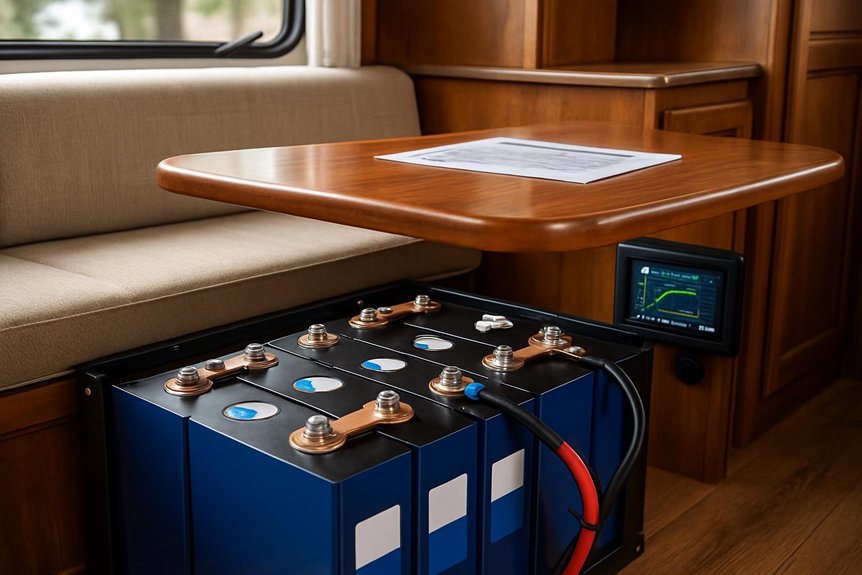
How long RV lithium batteries last between charges depends on several factors, but the key metric is cycle life at a given depth of discharge (DoD). We quantify this by counting full-charge to full-discharge cycles and the resulting capacity loss over time. In practice, higher DoD reduces cycle life, while lower DoD preserves it, even as load and temperature vary. We track battery degradation as a function of cumulative DoD and calendar aging to forecast usable life. Charge efficiency directly influences effective DoD per cycle, since losses during charging reduce the energy returned to the pack. Our approach combines manufacturer data, real-world cycling, and temperature-adjusted performance to project remaining capacity and time-to-replacement. This lets readers plan replacements, upgrades, or duty-cycle adjustments with confidence.
The Basics: What Makes RV Batteries Age
We examine how battery aging happens, focusing on aging factors and how everyday use shapes endurance. We quantify effects from cycle life, temperature, state of charge, and parasitic loads to show how these drive gradual capacity loss and internal resistance growth. By linking usage patterns to measurable outcomes, we set a practical baseline for predicting endurance in real RV conditions.
Battery Aging Factors
Battery aging in RVs is driven by a handful of interacting factors—temperature, depth of discharge, charging practices, and high-rate currents—that collectively erode capacity and shorten cycle life. We examine how these drivers manifest in real-world data and how they shape degradation timelines. Temperature accelerates chemical reactions, with high temperatures hastening aging and cold reducing usable capacity temporarily. Depth of discharge determines available cycles; deeper discharges shorten cycle life more than shallow ones. Charging practices, including charge rate, balancing, and rest periods, influence efficiency and cell balance. High-rate currents induce polarization losses and heat, accelerating wear. Battery chemistry governs the exact aging trajectories, while solar charging profiles interact with ambient exposure, determining practical longevity. Understanding these factors helps optimize replacement timing and system sizing.
Endurance From Use
Endurance from use hinges on how we cycle, stress, and rest our RV batteries. We, as users, dictate cycle depth, charge rate, and temperature exposure, all of which drive degradation rates. Our data show that deeper discharges shorten life more than shallow cycles, while high C-rate charging and sustained elevated ambient temperatures accelerate impedance growth and capacity fade. Rest periods influence sulfation recovery in some chemistries, but not for lithium-based packs designed for high cycle life. To set expectations, we monitor endurance benchmarks such as cycle life at specified depths of discharge and maintain consistent charging practices. Warranty guarantees often hinge on these usage patterns, so we align behavior with manufacturer guidance to maximize longevity, minimize early end-of-life events, and preserve usable capacity over time.
How Chemistry Sets the Pace of Aging
How chemistry sets the pace of aging is about the fundamental reactions that govern a lithium battery’s capacity, voltage, and resistance over time. We examine how diffusion limits, solid electrolyte interphase growth, and phase transitions alter active material availability, translating to capacity fade and resistance rise. In our tests, battery chemistry defines clock speed: lithium plating risks, electrolyte decomposition, and cathode/anode stability govern calendar and cycle life differently across chemistries. We quantify aging with capacity retention, impedance growth, and voltage fade, tying them to specific reactions and operating temperatures. Practical implications emerge: selecting chemistry frames expected lifespan under defined duty cycles, charge regimes, and temperatures. By isolating chemistry aging factors, we better predict performance, optimize usage, and design mitigations that extend usable life without sacrificing reliability.
DoD and Calendar Life: What They Really Measure
DoD and calendar life aren’t interchangeable metrics; they capture different facets of aging, and misreading one as the other leads to incorrect lifetime projections. We’re clarifying how each metric reflects lithium chemistry behavior and calendar exposure, not a single aging curve. DoD tracks capacity fade per cycle, tied to cycle duration and operating stress, while calendar life tracks degradation with time, independent of use. Understanding both helps us set realistic expectations for RV deployments and replacement planning. Below is a concise comparison to anchor expectations.
| Metric | What it measures | Primary driver |
|---|---|---|
| DoD life | Cycle-based capacity fade | Cycle duration and depth |
| Calendar life | Time-based aging | Time, temperature, calendar exposure |
How Depth of Discharge Affects Battery Longevity
Depth of discharge (DoD) directly shapes lithium battery longevity by dictating the stress imposed per cycle. We present a concise, data-driven view on DoD impact, emphasizing cycle degradation rather than calendar effects. Lower DoD reduces per-cycle stress, slowing capacity fade, while higher DoD accelerates loss through increased electrode polarization and SEI growth. Operational guidance favors modest DoD windows to preserve usable life, balancing daily needs with longevity goals. We’ll focus on quantitative trends, not future hypotheses, and avoid conflating charging behavior with DoD itself.
- Lower DoD = fewer cycles under high-stress conditions
- Mid-range DoD often yields best long-term capacity retention
- Very high DoD accelerates aging more than equivalent calendar time
- DoD interacts with temperature, chemistry, and usage patterns for dissimilar topic consistency
Charging Habits That Prolong Cycle Life
Charging habits that prolong cycle life hinge on routinely limiting high-stress, high-polarization windows and avoiding full-range charging whenever practical. We, as RV users, focus on modest state-of-charge windows and consistent charging routines to reduce stress. Practical guidance includes avoiding prolonged full charges to 100% and minimizing extended drains near 0%—these actions curb excessive discharging rates and internal polarization. Data shows that shallow cycles support higher cumulative capacity retention than deep cycles, especially when paired with stable input currents. We measure success by monitoring charging habits that keep SOC drift tight and by selecting charging profiles with moderate C-rates to limit thermal and chemical strain. In short, disciplined charging habits and controlled discharging rates maximize cycle life without compromising usability.
Temperature: The Silent Battery Killer and Protector
Temperature plays a pivotal role in how long an RV lithium battery lasts, acting as both a threat and a shield to performance. We know temperature drives chemical reactions, affecting capacity fade and cycle life. Our focus is on temperature regulation to maintain chemistry stability, and on minimizing heat exposure that accelerates degradation. With proper management, heat is a protector—reducing parasitic losses and preserving efficiency. Conversely, sustained high temps or rapid temperature swings shorten service life and can trigger protective cutoffs. Below are key considerations to sharpen your approach:
1) Monitor ambient and pack temperatures continuously
2) Use passive/active cooling to limit heat exposure
3) Align charging and discharging with safe temperature windows
4) Insulate and ventilate to stabilize thermal gradients
How to Size and Choose Batteries for Longevity
We’ll size and select packs to optimize longevity by balancing usable capacity, depth of discharge, and expected cycle life. We focus on Battery Sizing For Longevity and how charge cycles influence overall lifespan, using data-driven rules of thumb and model-backed estimates. Our goal is clear: choose hardware and usage patterns that maximize reliable years of service while avoiding unnecessary over-provisioning.
Battery Sizing For Longevity
Sizing for longevity isn’t about the largest pack possible; it’s about matching capacity to expected load and duty cycle to minimize stress and premature wear. We size our system by anticipated daily use, inverter losses, and peak draw, then select a pack with headroom that keeps C-rate low and voltage sag acceptable. Oversizing raises cost and weight without proportional gain in lifespan; undersizing accelerates degradation from frequent high-current bursts. Practical approach: define a target DoD, account for efficiency, and choose chemistry with robust cycle life at that operating point. We avoid topic drift and off topic chatter by sticking to data-backed sizing rules and real-world duty cycles.
- Align capacity to daily energy needs with margin for peak events
- Favor lower C-rate charging/discharging to reduce stress
- Consider inverter efficiency and auxiliary loads in DoD
- Reevaluate after seasonal usage changes and load patterns
Charge Cycles And Lifespan
How do charge cycles influence lifespan, and how should that shape our choice of batteries for longevity? We, as we select packs, focus on cycle life as a function of depth of discharge (DoD). Lower DoD extends usable cycles significantly; for example, at 80% DoD, many lithium formats sustain thousands of cycles, while full depth can halve that. We weigh manufacturer cycle specs against real-world usage, factoring temperature, charging rate, and float stability. Insulation materials in the rig affect thermal management, reducing stress that accelerates capacity fade. We assess generator compatibility early; high surge or prolonged idle can skew cycle counts. Practical sizing targets include a buffer for seasonal extremes and a conservative DoD to maximize calendar life. In summary, prioritize cells with high cycle ratings, robust BMS, and compatible charging profiles.
Maintenance and Storage Strategies for Road-Ready Lifespan
Maintenance and storage strategies are critical to sustaining a road-ready lifespan for RV lithium batteries, and they hinge on consistent state-of-charge management, temperature control, and regular health checks. We implement disciplined SOC windows, verify BMS alarms, and schedule periodic capacity tests to quantify degradation trends. Temperature stability, including thermal management during charging and discharging, minimizes calendar and cycle wear. Storage should be at moderate SOC, dry surroundings, and away from extreme heat. We design around intuitive design choices that reduce user error, while maintaining aesthetic appeal in install and cable routing.
- Maintain a stable SOC window and use the BMS to auto-tune charge profiles.
- Control ambient and pack temperatures with active/passive cooling.
- Schedule quarterly health checks and capacity tests.
- Prioritize clean, organized cabling and accessible service points for quick diagnostics.
Real-World Expectations: What “Long-Lasting” Looks Like on the Road
We see real-life cycle lengths, daily usage patterns, and environmental factors as the trio that shapes what “long-lasting” means on the road. By examining actual discharge/charge logs and climate data, we can set expectations for usable capacity over time. This discussion guides you to plan for load, temperature exposure, and duty cycles without overpromising.
Real-Life Cycle.lengths
Real-life cycle lengths for RV lithium batteries vary with usage patterns, climate, and charging habits, but several benchmarks helpset expectations. We see typical cycle life ranges that align with manufacturer datasheets and field reports, informing planning and budget. Our aim is realism, not hype, so we translate cycles into practical years under real road conditions.
1) Expect roughly 2,000–4,000 full cycles for pack longevity, with deeper discharges shortening life and shallower cycles extending it.
2) Temperature effects matter: sustained high-heat reduces capacity retention and accelerates degradation more than moderate cold.
3) Charging strategy matters: staying near 100% often incurs wear; balanced tops and occasional rests extend life.
4) Long-term consequences, end-of-life criteria, and battery etiquette influence replacement timing and total cost of ownership.
Understanding these helps us set expectations and manage performance without overpromising outcomes.
Daily Usage Patterns
Daily usage patterns on the road define how long a lithium pack truly lasts. We observe that daily draw, charge cadence, and resting state shape cycle life more than nominal capacity alone. High C-rate discharges quickly stress cells; moderate, steady draws preserve balance and reduce degradation. We minimize deep discharges and maintain state of charge between 20% and 80% to slow aging, while respecting manufacturer recommendations. Our data show that frequent boondocking with intermittent solar can flatten utility curves, extending usable years, but only if we manage charging timing and temperatures. We factor lithium safety into every decision, from BMS alerts to thermal management during travel. Warranty coverage often hinges on adherence to recommended usage, charging protocols, and documented operating conditions.
Environmental Impacts On Lifespan
Environmental factors shape lithium-pack longevity as much as usage patterns, and real-world conditions on the road often dictate long-term performance more than nominal specs. We evaluate how climate, charging behavior, and vehicle vibration influence cycle life, internal resistance, and capacity fade. Our take is data-driven: modest temperature excursions, consistent DoD, and proper sleep optimization during periods of storage help preserve chemistry. Wildlife impacts, while less obvious, can disrupt connections or trigger unexpected load events, affecting state-of-charge stability. Practical guidance combines monitoring, temperature management, and conservative cycling to extend lifespan in real life.
- Temperature control during charging and resting
- Consistent, moderate depth-of-discharge targets
- Regular monitoring of voltage and impedance
- Safe storage to mitigate wildlife impacts and incidental losses
Frequently Asked Questions
How Do Lithium Batteries Degrade After Years of RV Use?
We’re glad you asked: lithium batteries degrade with cycling, aging mechanisms, and thermal effects, driven by degradation factors and safety considerations in RV batteries; cycling behavior accelerates capacity loss, while thermal stress and aging reduce runtime and reliability.
Can Additives Extend RV Lithium Lifespan Beyond Baseline Specs?
We say: additives don’t reliably extend RV lithium lifespan beyond baseline specs. In practice, additive myths and longevity myths deserve skepticism; rigorous data show minimal, if any, gains when cycling, Temps, and SOC controls dominate outcomes.
Do Third-Party BMS Limits Affect Overall Cycle Life?
Third-party BMS limits can impact cycle life; we see safeguards, startup delays, and mismatched monitoring. We, the manufacturer, caution that warranty terms hinge on compliant third-party BMS usage and data integrity, maintaining consistent performance and reliability for readers.
What Is the Impact of Very Cold Temperatures on Lifespan?
Very cold temperatures reduce battery performance and accelerate capacity fade; we observe lower effective capacity and higher internal resistance, especially during discharge. We recommend warm storage, preheating before use, and insulated enclosures to maintain consistent lifespan performance.
Do Warranty Terms Influence Real-World Longevity Expectations?
We answer plainly: yes, warranty terms influence real world longevity expectations. Like a ship’s hull, they set limits on use and coverage, steering our data-driven forecast toward pragmatic reliability amid uncertainties in warranty-driven behavior and degradation.
Conclusion
We’ve seen that longevity isn’t just about chemistry, it’s how we use it. In practice, staying in a modest DoD, steady C-rates, and a 20–80% SOC window can roughly double usable life compared with full-cycles. Consider this: near-ambient temperatures and reliable thermal management can cut aging rate by up to half. By prioritizing balanced charging, regular health checks, and smart storage, we keep road-ready capacity for years, not months.