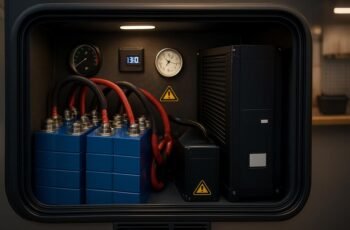
We approach lithium-ion battery care with a precise, methodical mindset, outlining safe handling, proper charging, and regular checks. We’ll power devices down, remove bulky cases if needed, and inspect for swelling or damage before every use. We’ll rely on manufacturer-approved chargers and maintain charging temperatures between 0–40°C, avoiding high-rate bursts. If you want longevity and safety, stay consistent with storage at 3–40% SOC and monitor voltage and temperature—there’s more to this routine than meets the eye, and it all starts with disciplined habits.
Key Takeaways
- Monitor charging current, voltage, and temperature; use manufacturer-approved chargers and avoid high-rate bursts to protect longevity and safety.
- Store Li-ion batteries at 3–40% SOC in a cool, dry environment and avoid full discharge before storage.
- Calibrate gauges after major temperature swings or firmware updates; perform a full charge–discharge cycle for accuracy.
- Regularly inspect for swelling, leaks, or damage; perform controlled charge–discharge tests and log results for trends.
- Maintain a consistent charging cadence aligned with usage; minimize unnecessary top-offs and ensure proper cooling during charging.
Start Here: Quick Li-ion Battery Care Routine
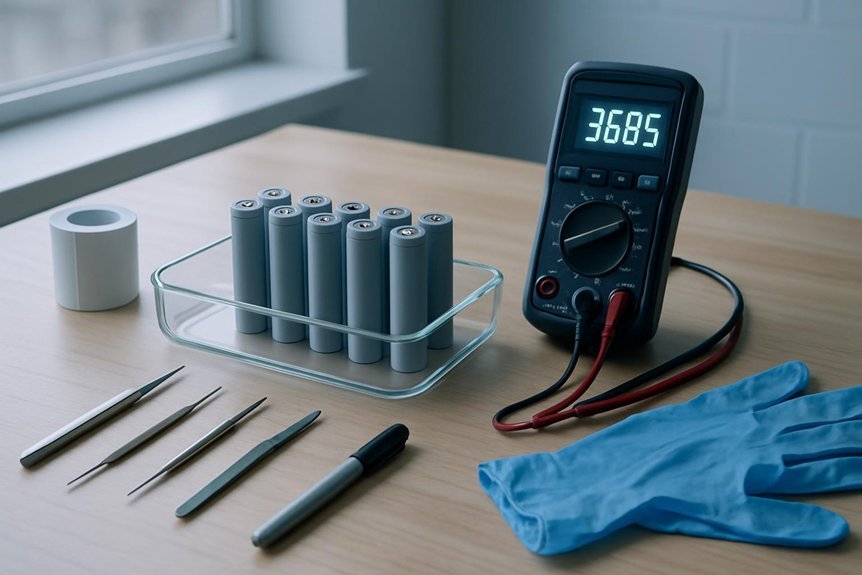
Starting a quick Li-ion battery care routine begins with a clean baseline: ensure the device is powered off, remove any case if it interferes with cooling, and inspect for visible damage or swelling. We then verify ambient conditions—stable temperature, dry environment, away from direct heat. Our process emphasizes battery ecology: we minimize exposure to environmental contaminants and unnecessary charging cycles, preserving core materials and performance. We proceed with evidence-based steps: disconnect from power when not in use, avoid charging on soft surfaces, and utilize manufacturer-approved chargers. We document any anomalies and perform routine visual checks weekly. Charge etiquette remains central: avoid full discharges, and favor partial top-offs to maintain voltage balance. This disciplined approach reduces stress on cells, enabling predictable behavior and safer operation over time.
How Charging Affects Longevity and Safety
How does charging affect lithium-ion longevity and safety, and what practices minimize risk? We examine how charging behavior shapes degradation pathways and safety margins. We begin with current, voltage, and temperature controls during charging, since each factor governs the rate of SEI growth, Li plating risk, and thermal runaway potential. We optimize charging by using manufacturer-recommended profiles, avoiding high-rate bursts, and ensuring balanced charging across cells. Temperature should remain within 0–40°C during charging; excessive heat accelerates chemical aging and can trigger safety events. We monitor state of charge with precise gauges to prevent overvoltage, depth-of-discharge extremes, and charge-discharge cycling where feasible. The result involves charging safety and longevity tradeoffs: faster charging reduces downtime but increases aging and risk, requiring deliberate planning.
Best Practices for Storing Li-ion Batteries
What are the essential steps we follow to store Li-ion batteries safely and maintain their capacity over time? We plan controlled charging, avoid full discharge, and store at mid-level voltage. Target 3–40% state of charge for long-term storage and use a cool, dry environment, away from direct heat. Inspect terminals, keep original packaging, and prevent physical damage. Use a calibrated charger when reconnecting, and update storage practices if capacity or health indicators change. Respect storage myths and avoid charging myths that promise shortcuts; rely on measured protocols. Beware storage pitfalls like high humidity, leakage, and temperature swings.
| Column A | Column B |
|---|---|
| SOC targets | Environmental controls |
| Periodic checkups | Protective measures |
| Lead time | Monitoring cadence |
| Surface protection | Documentation |
| Battery condition | Safety briefing |
How Temperature Impacts Performance and Life
Temperature affects capacity and efficiency, with colder operation reducing usable energy and hotter conditions accelerating degradation. We examine how temperature bounds the operating range and how thermal stress influences lifespan and safety margins. We’ll discuss practical controls to maintain stable temperatures, minimize stress, and extend overall performance.
Temperature Effects on Capacity
Operating temperature markedly governs lithium-ion battery capacity and lifespan: at high temperatures, degradation accelerates due to accelerated side reactions, while cold conditions raise internal resistance and reduce usable capacity. We examine how temperature influences usable capacity during operation and storage. Elevated temperatures increase diffusion rates, hasten electrolyte decomposition, and amplify SEI growth, all diminishing available ions for work. Conversely, sub‑optimal cold reduces electrode kinetics, lowering instantaneous capacity and prolonging charge transfer times. Temperature fluctuations introduce cycles of expansion and contraction, stressing interfaces and potentially creating microcracks that further degrade capacity over time. We control storage humidity and keep exposure brief to minimize moisture‑driven reactions that compromise voltage stability. Our approach emphasizes monitoring ambient and device temperatures, avoiding rapid thermal swings, and maintaining consistent conditions to preserve capacity integrity.
Operating Range Impacts Lifespan
How does the temperature range you expose a lithium-ion battery to shape its lifespan? We examine how operating range influences chemical stability and degradation rates. Within tolerable limits, charge/discharge efficiency remains high and calendar aging slows; outside those limits, side reactions accelerate and SEI growth increases, reducing capacity faster. We quantify the lifespan impact by correlating temperature to internal resistance rise and electrolyte viscosity, noting optimal bands around moderate temperatures where impedance growth is minimized. Extreme cold hampers ion mobility, while excessive heat accelerates electrolyte decomposition and cathode loss. We emphasize controlled cycling within the manufacturer-specified operating range and avoid prolonged exposure to drift temperatures. In practice, we monitor runtime temperature profiles and implement cooling or heating as needed to preserve consistent performance.
Thermal Stress and Safety
When a lithium‑ion battery experiences thermal stress, performance and life hinge on how heat and cold alter reactions inside the cell. We observe temperature shifts drive rate changes, diffusion limits, and impedance growth, collectively reducing capacity and cycle life. Thermal shock accelerates SEI instability and cracking, while rapid cooling or heating disrupts electrode kinetics, increasing failure risk. In our protocol, venting safety becomes critical: excessive internal pressure prompts venting, electrolyte leakage, or thermal runaway if unmanaged. We implement cooling strategies and thermal monitoring to mitigate these risks, preserving safety margins and data integrity. By controlling exposure, we sustain performance and extend lifespan.
- Monitor temperature gradients and respond before thresholds are breached
- Validate venting safety mechanisms and pressure relief accuracy
- Calibrate charging/usage to minimize rapid thermal excursions
Simple At-Home Battery Health Checks
What quick checks can we perform at home to gauge a lithium-ion battery’s health? We perform a structured onset assessment: measure voltage with a calibrated multimeter, compare to nominal values for the cell chemistry, and record open-circuit voltage after a 15-minute rest. Inspect for physical deformation, swelling, and leakage, noting any heat during gentle handling. Use a controlled charge-discharge cycle at manufacturer-recommended currents, logging time, voltage, and current to detect abrupt deviations. Monitor charger behavior—consistent charging current and termination voltage indicate healthy cells; anomalies may reflect calibration errors in internal circuitry. Observe runtime performance during typical use, noting capacity loss or rapid voltage drop. Be mindful of drain wire energy signatures and avoid deep discharges. Document results and correlate with baseline diagnostics for trend analysis.
Debunking Common Li-Ion Myths
Despite common beliefs, many Li-ion myths mislead users more than they help. We, as practitioners, engage in systematic myth debunking to illuminate real battery basics. We outline evidence, separate fact from folklore, and ground recommendations in tested behavior rather than anecdotes. Our approach emphasizes transparency, reproducibility, and clarity for readers seeking dependable maintenance guidance.
Practical myth-busting for Li-ion: transparent, data-driven, and maintenance-focused.
- Battery basics: capacity fade is gradual, not abrupt, and temperature, charge rate, and cycle count influence it.
- Myth debunking: full charge always extends life is false; shallow cycles and appropriate SOC ranges preserve health.
- Safety myths: storage, handling, and charging practices must align with manufacturer specs and verified data.
Optimizing Daily Charging for Your Devices
Optimizing daily charging starts with disciplined practice: we align charging behavior with real-world usage patterns to minimize stress on the cell while preserving usable capacity. Our approach emphasizes a consistent charging cadence that matches discharge profiles, avoiding full-cycle swings whenever practical. We prioritize energy efficiency by selecting approaches that reduce unnecessary top-offs and heat generation. Implementing targeted cooling strategies during charging mitigates impedance rise and helps maintain stable voltage, especially under higher ambient temperatures. We document cycle counting to track wear over time, enabling data-driven adjustments to charging windows. By pairing device usage forecasts with tailored charge stops, we sustain longer runtimes and healthier cells. This methodical routine promotes durable performance without compromising convenience or safety.
When to Calibrate Battery Gauges and How
Calibrating battery gauges at the right times improves accuracy and reliability in remaining容量 estimates. We approach calibration as a controlled procedure, not a guess. We perform it after major temperature swings, firmware updates, or when gauge drift is observed during discharge tests. Use a full charge–discharge cycle as a reference point, following manufacturer guidance for cycle counts and termination thresholds. Record start and end values to verify gauge consistency, then recheck after a full cycle. Consistency across multiple calibrations reinforces gauge accuracy and reduces estimation error in critical applications.
Calibrate after major temperature shifts or firmware updates, using a full cycle to validate gauge accuracy.
- Calibration timing tied to temperature, firmware, and observed drift
- Full-cycle reference measurements for validation
- Documentation of results to confirm gauge accuracy
Quick Fixes for Common Battery Issues at Home
We’ll start with quick battery troubleshooting, outlining practical steps to identify common issues safely and efficiently. We’ll cover safe home handling, basic diagnostics, and when to escalate to professional service. We’ll also align charging best practices with routine maintenance to minimize future problems.
Quick Battery Troubleshooting
Have you ever wondered why a battery won’t hold a charge or drains unusually fast? We approach quick troubleshooting with a disciplined sequence, ensuring measurements, not guesses. We focus on diagnosing symptoms, then applying calibrated steps like battery calibration and load tests to verify capacity retention. Precise data collection lets us distinguish between health loss and usage patterns, preventing unnecessary replacements. Our method minimizes risk and directs actions efficiently.
- Inspect charge cycles and resting voltage before calibration
- Run controlled load tests, logging voltages and currents
- Reassess with a fresh calibration to confirm stable capacity
Safe Home Handling
Ever wondered how to handle common battery issues at home without risking damage or injury? We approach Safe Home Handling with systematic checks and strict controls. When a device overheats, power down, unplug, and move to a cool, ventilated area before inspecting for swelling, leaks, or unusual odor. If you notice swelling, avoid pressing the casing; isolate the item and place it in a non-flammable container away from combustibles. For exposed terminals, clean with dry non-conductive wipes and reassemble only after verifying no moisture. Document edge cases for future reference and consult manufacturer guidelines for disposal. Prioritize recycling ethics by using certified e-waste services and recycling programs. Never attempt DIY repairs beyond basic resets; seek professional help for damaged cells or compromised packs. Dispose responsibly; prevent risk, preserve safety, and maintain performance.
Charging Best Practices
Charging best practices: to minimize risk and extend life, we’ll outline quick, actionable checks you can perform before and during charging. We approach methodically, prioritizing safety and data-driven decisions. Before plugging in, verify charger compatibility and rating alignment to avoid rapid degradation or rare corrosion. During charging, monitor temperature, airflow, and state-of-charge thresholds to prevent overstress and heat buildup. We emphasize quick compatibility checks to ensure the supply matches the battery chemistry and capacity, reducing impedance shifts and potential damage. If anomalies appear, pause charging and re-evaluate connections, while consulting manufacturer guidelines. Consistent monitoring supports long life and performance.
- Confirm charger specification matches battery requirements
- Observe temperature and voltage behavior during early and final charging stages
- Inspect connectors for corrosion, looseness, or debris asap
Create a Simple, Keepable Maintenance Routine
A simple, keepable maintenance routine centers on consistent, repeatable checks that protect battery health without adding complexity. We, together with you, implement a minimal cadence: weekly voltage and temperature spot checks, monthly capacity trend reviews, and quarterly health summaries. We track charge-discharge cycles to observe drift in performance, ensuring SOC window remains within recommended limits. We document electrolyte temperature rises, insulation integrity, and connector cleanliness, promptly addressing any anomalies. Our routine emphasizes battery chemistry awareness, recognizing that minor deviations can foreshadow longer-term issues; early action minimizes impact. We monitor electrode degradation indicators via resistance changes and cell balance where applicable, calibrating expectations against manufacturer guidelines. Finally, we maintain a concise log, update procedures as data accumulates, and avoid unnecessary interventions while preserving reliability.
Frequently Asked Questions
Do Li-Ion Batteries Have Memory Effects Like Nicd?
Yes, li-ion batteries don’t have a true memory effect like NiCd. We mitigate capacity drift with proper use and occasional battery calibration, ensuring accurate state-of-charge readings and reliable performance across cycles.
Can I Use a Laptop Charger for Phones and Tablets?
We can’t reliably use a laptop charger for phones and tablets; compatibility varies. We recommend a USB C charger with appropriate power delivery and amperage, ensuring device compatibility, cable quality, and proper safety features before charging.
Do Fake or Counterfeit Batteries Cause Faster Degradation?
Yes, fake batteries accelerate counterfeit degradation, and we observe faster capacity loss and instability. We systematically verify with resistance checks, voltage consistency, and cycle tests to protect devices, warn users, and prevent unsafe failures.
How Often Should I Replace a Swollen or Damaged Cell?
We should replace a swollen or damaged cell promptly, since swelling signals failure risk and safety concerns. Swollen cell risks escalate quickly; Replacement timing must be conservative and immediate if swelling is detected, to prevent thermal runaway and system damage.
Can Solar Chargers Harm Li-Ion Battery Longevity?
Solar charging effects can degrade Li-ion longevity if not managed; we monitor voltage drift and use proper regulation. We assess charger compatibility, temp rise, and balance charging to minimize stress, ensuring safe, controlled solar charging effects on cell health.
Conclusion
We’ve tested the theory that diligent, routine care can indefinitely extend Li‑ion life, and the truth is more nuanced. Regular charging discipline, temperature awareness, and periodic checks slow capacity fade, yet chemistry mutes promises of perfection. By following a precise maintenance routine—safe handling, calibrated gauges, and consistent storage—you reduce risks and maximize usable life. So yes: disciplined practices matter, they just don’t defy physics. Stay methodical, document changes, and adjust as your devices evolve.