We understand safe lithium battery storage reduces fire risk and equipment damage, so we assess environment, charging, and containment with clear criteria. We’ll keep temps steady, humidity controlled, and ventilation sufficient, while using flame-retardant packaging and labeled state-of-charge targets. We monitor for swelling, odors, and temperature spikes, logging data to drive improvements. If our practice falters, costs rise and hazards increase; that consequence keeps us focused on the specifics that follow.
Key Takeaways
- Maintain a stable storage environment: 15–25°C with 20–50% relative humidity and minimal temperature fluctuations to reduce stress on cells.
- Use fire-rated, puncture-resistant packaging with clear labeling and tamper-evident seals aligned to transport and storage requirements.
- Implement disciplined charging practices, SOC targets, and voltage limits to prevent deep cycling and overcharging.
- Ensure proper ventilation and regular vent/pathway inspections to prevent gas buildup and enable safe venting if needed.
- Conduct routine monitoring and documentation of sensors, venting events, and corrective actions for continuous improvement.
Why Safe Lithium Battery Storage Matters
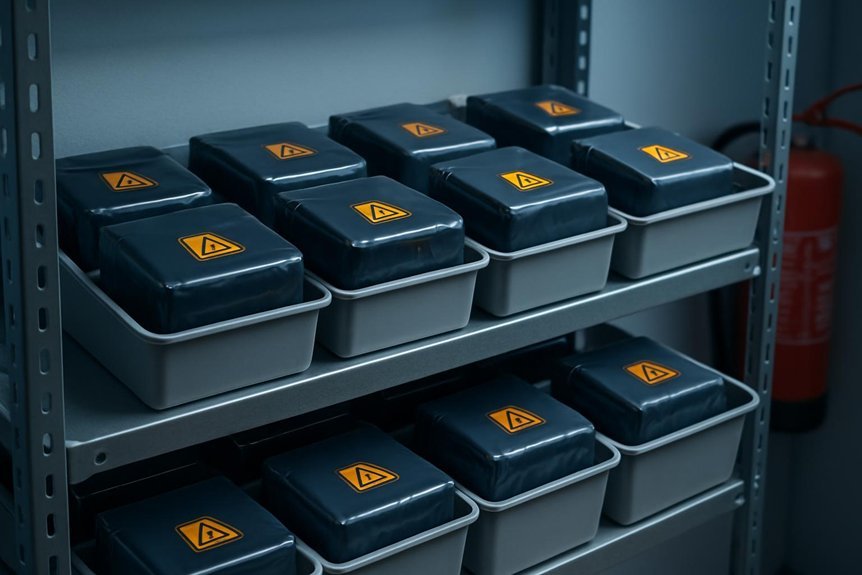
Safe storage reduces the risk of thermal runaway, fires, and toxic emissions. We understand that storing lithium batteries improperly can trigger safety incidents, especially when packs are damaged or exposed to heat. The consequences extend beyond loss of equipment to injuries, environmental harm, and costly downtime. By prioritizing safe handling, we limit exposure to short circuits and physical damage that accelerate degradation. We also consider transport considerations, ensuring batteries are secured, insulated, and protected from impact during movement. Clear labeling, documented battery health, and segregation of damaged units reduce cross-contamination risks. Our approach combines supplier guidance, organizational policies, and routine inspections so risks are identified early. Consistent practices protect people, assets, and operations while meeting regulatory expectations.
Optimal Storage Environment: Temperature, Humidity, and Ventilation
What temperature, humidity, and ventilation levels truly minimize risk for lithium battery storage, and how can we achieve them consistently? We guide readers with clear, evidence-based targets. Maintain temperatures between 15–25°C (59–77°F) and avoid rapid fluctuations that stress cells. Keep relative humidity low enough to prevent condensation, typically around 20–50%, and ensure dry storage with moisture control to reduce corrosion and dendrite formation. Ventilation should meet ventilation standards that prevent gas buildup without creating drafts that chill packs; use passive or mechanical ventilation to avoid stagnant air. Regularly monitor sensors, log readings, and respond to deviations promptly. Prioritize safe compartments, segregated from incompatible materials. By adhering to these practices, we reduce risk, improve reliability, and align with optimal storage humidity and ventilation standards.
Safe Charging Practices and State of Charge Targets
Are we charging lithium batteries in a way that minimizes risk while preserving capacity? We aim for disciplined charging practices that align with evidence on longevity and safety. We keep a consistent SOC target range to avoid deep cycling and overcharging, which stresses cells. Adhering to charging targets helps manage heat and reduces thermal runaway risk. We use defined voltage limits to prevent overvoltage, which damages separators and accelerates degradation. We verify charger compatibility, enable balance charging when needed, and monitor pack temperature during charging. If ambient conditions are extreme, we delay charging or adjust targets accordingly. We document occasional drift in state of charge estimates and recalibrate as necessary. In short, safe charging combines strict voltage limits, clear charging targets, and vigilant monitoring to sustain performance.
Choosing Safe Containers and Packaging
How can we minimize failure risk by selecting robust containers and proper packaging? We turn to evidence-based choices that reduce leakage, thermal runaway initiation, and transport damage. Our focus is on robust materials, secure seals, and clear labeling to support safe handling and storage. We avoid fluff by prioritizing concrete, verifiable controls and practical routines.
- Choose packaging materials with flame retardancy, puncture resistance, and chemical compatibility.
- Ensure container sealing is tested, tamper-evident, and rated for expected temperatures and shocks.
- Implement labeling systems that communicate hazard class, state of charge, and handling instructions.
- Align packaging with transport storage requirements, including segregation, ventilation, and spill containment.
Recognizing Swelling, Odor, and Other Warning Signs
We’ll help you spot warning signs like swelling, unusual odors, and other changes that indicate a battery is stressed or damaged. Early swelling, sharp or sweet odors, and surface deformities raise the risk of thermal runaway and fire, so we’ll highlight what to check and how quickly to act. By acknowledging these indicators, we can reduce hazards and protect people, property, and environments.
Swelling Indicators Early
Swelling is one of the earliest and most telling signs a lithium battery may be failing, so monitoring for changes is essential. We act on swelling indicators and pursue early detection to minimize risk and protect people and property. By recognizing subtle expansion, we reduce chance of sudden failure or thermal走 events. We stay consistent with evidence-based guidance and translate it into practical steps you can follow today.
- Monitor regularly for any outward distortion or pouching, noting changes over time.
- Compare current size to known-good baselines and document discrepancies.
- Check for surface bulges near terminals or seams, which often precede larger swelling.
- Prioritize safe handling and relocation if growth exceeds a small, measured threshold.
Odor and Hazard Signs
Odor and hazard signs are critical early indicators of lithium battery issues, and recognizing them promptly can prevent hazardous outcomes. We monitor swelling, odor signals, and other warning cues to protect people and property. If any sign emerges, we act: isolate the battery, ventilate if safe, and contact appropriate responders. Swelling indicators suggest internal gas pressure; odor signals may indicate decomposition or venting. We compare symptoms with established thresholds, document timing, and reduce energy input to prevent escalation. Preventive measures include proper storage temperature, separation from flammables, and routine inspections. Quick, decisive steps reduce risk and support safe outcomes.
| Visual cue | Recommended action |
|---|---|
| Swelling | Isolate and remove |
| Odor | Ventilate and assess |
| Heat spike | Stop use and inspect |
Home Storage Guidelines vs. Workplace Storage Guidelines
Home storage and workplace storage guidelines for lithium batteries differ in scale and risk management, but both share core priorities: minimizing fire and thermal runaway risk, controlling temperature and ventilation, and preventing physical damage. We approach each setting with evidence-based controls to protect people and property while maintaining performance.
1) Storage density: balance pack count with spacing to limit heat buildup and allow inspection.
2) Enclosure materials: choose non-combustible, ventilated enclosures that resist puncture and corrosion.
3) Temperature control: monitor ambient and surface temps, maintain consistent ranges, and avoid rapid swings.
4) Access and segregation: separate charged, damaged, and recalled cells; restrict access to trained personnel.
Emergency Procedures: Fire Prevention and Response
We start with a clear fire risk assessment to identify ignition sources, storage conditions, and potential heat buildup. We’ll outline emergency venting protocols that minimize pressure rise and help control gas release during a thermal event. By focusing on these points, we align safety measures with evidence-based risk reduction for responders and users.
Fire Risk Assessment
Fire risk assessment for lithium battery storage is not guesswork—it’s a structured, proactive process that identifies ignition sources, thermal runaway pathways, and confinement risks to prevent fires and manage emergencies.
We, as stewards of safety, evaluate likelihoods and consequences using evidence-based criteria. We focus on how battery chemistry influences failure modes, and how thermal runaway can propagate through packs and enclosures. Our assessment informs controls, response plans, and training to minimize incident severity and downtime.
- Map likely ignition sources and high-risk activities, accounting for charging, storage arrangement, and access controls.
- Assess thermal runaway pathways within modules, cabinets, and system integration.
- Evaluate confinement and venting adequacy, detection systems, and automatic shutoffs.
- Review incident data, drills, and corrective actions to close gaps.
Emergency Venting Protocols
Effective venting protocols are essential because, when thermal events occur, controlled release of gases and heat minimizes pressure buildup, reduces the risk of enclosure rupture, and provides actionable warning to responders. We, as practitioners, emphasize emergency venting to prevent escalation and protect nearby personnel. We inspect vent integrity routinely and prioritize clean, unobstructed pathways. In incidents, we initiate immediate isolation, but maintain venting only within established safety limits; containment is secondary to controlled release. We monitor pressure, temperature, and gas composition, documenting deviations and corrective actions. This approach reduces thermal runaway risk and supports rapid responder access. Table below highlights key steps and evidence-based checks for emergency venting and vent integrity.
| Step | Key Checks |
|---|---|
| 1 | Verify vent pathways are clear |
| 2 | Confirm sensors calibrated |
| 3 | Initiate protocol when thresholds reached |
| 4 | Record venting duration and outcomes |
Frequently Asked Questions
How Should I Dispose of Damaged Lithium Batteries After Storage?
We should never dispose of damaged lithium batteries ourselves; contact local hazardous waste or a certified recycler for safe disposal, following disposal procedures and post storage disposal guidelines to minimize fire risk and environmental harm. We’ll help coordinate next steps.
Can I Store Lithium Batteries Near Other Hazardous Materials?
Yes—we avoid storing lithium batteries near other hazardous materials. For storage safety, ensure hazard separation, keep them away from chemicals, heat, and ignition sources, and follow manufacturer guidance to minimize risk and potential thermal events.
Do Different Lithium Chemistries Require Different Storage Rules?
We’re not guessing—different chemistries require different storage rules. Like gears in a clock, each chemistry has specific safe temps, moisture limits, and venting needs, so we tailor storage to minimize risk and maximize safety for everyone.
How Long Can Stored Batteries Remain Safe Before Use or Disposal?
We can store lithium batteries safely for months if you control storage temperature and humidity; optimize humidity control, monitor battery lifespan, and track shelf life, because poor conditions rapidly degrade performance and raise risk until use or disposal.
What Are Signs of Hidden Thermal Runaway in Storage Boxes?
We see hidden thermal indicators as early signs, and we insist on robust battery box containment; we monitor temperature, odor, smoke, swelling, and venting, and we act quickly to prevent thermal runaway in storage.
Conclusion
We’ve seen that safe lithium battery storage protects people, property, and performance. Picture a calm, controlled shelf—temperatures steady, humidity held, seals intact, and labels clear. When charging, we stay within voltage limits and monitor heat and SOC like a careful watch. Swelling and odors become warning flags we don’t ignore, and we separate home from workplace setups with disciplined practices. In emergencies, we act quickly, log data, and respond with planned containment and communication.