Did you know that proper RV lithium sizing can improve cycle life by over 20% with just a few disciplined steps? We’re going to map daily energy use, choose usable capacity in Ah and Wh, and balance series/parallel configurations to meet voltage needs safely. We’ll size inverters and chargers with headroom, account for real-world constraints like weight and space, and align chemistry with longevity goals. Stay with us as we build a robust, data-driven plan.
Key Takeaways
- Calculate daily energy use by listing each device’s wattage, hours used, and summing to find total watt-hours; convert to amp-hours at system voltage (12–24 V).
- Compare Ah vs Wh to size the bank, accounting for inverter losses and real-world voltage windows; track pack-level Ah and convert to Wh.
- Consider DoD impact on usable capacity and cycle life; target moderate DoD to balance longevity and availability.
- Choose series vs parallel configuration to balance voltage, capacity, and safety margins; plan balance strategies and interlocks.
- Size inverter and charger with 20–30% headroom, factor aging and temperature, and plan modular, ventilated layouts for cooling and safety.
Calculate Your RV Daily Energy Use
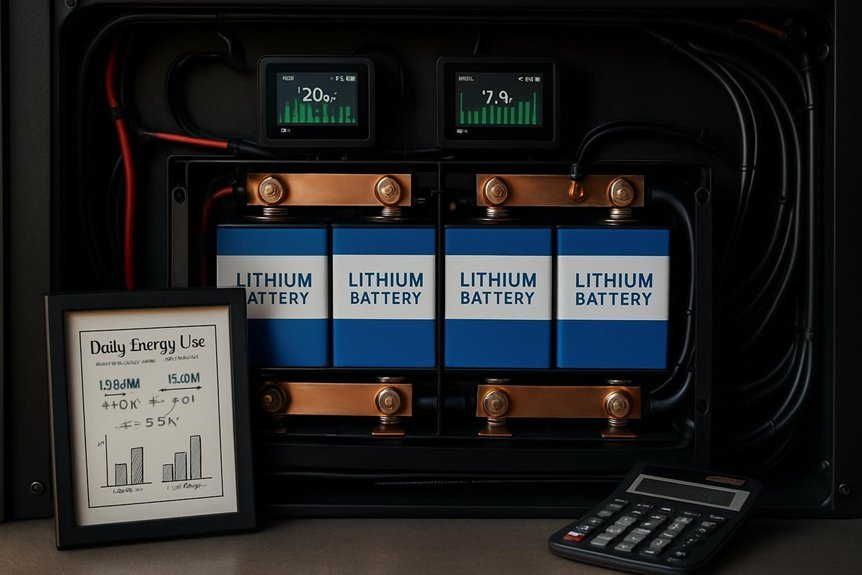
Calculating your RV’s daily energy use is the first step to sizing your lithium battery bank accurately. We approach this with a data-driven method: list each device, note wattage, and multiply by daily usage hours. We sum the total watt-hours, then convert to amp-hours at the system voltage you’ll use (typically 12–24 V). We factor peak loads, efficiency losses, and seasonal variance to avoid under-sizing. We document baseline consumption, then simulate typical and high-demand scenarios to build a robust reserve. We compare pricing among reliable options, emphasizing pricing comparisons without sacrificing safety margins. We also assess brand reliability, warranty terms, and service networks to minimize risk. With these inputs, we establish a conservative daily energy target that guides battery bank sizing decisions.
Usable Capacity: Amp-Hours vs. Watt-Hours
We’ll start by clarifying Usable Capacity basics and how Ah and Wh relate, so you can compare battery chemistries on a common footing. We’ll convert between Amp-hours and Watt-hours to ensure accurate sizing for your RV loads and inverter losses, while accounting for real-world discharge limits. Finally, we’ll discuss how Depth of Discharge impacts usable capacity, safety margins, and lifecycle performance.
Usable Capacity Basics
Usable capacity is the practical energy you can extract from a battery bank before needing a recharge, and understanding it in both amp-hours (Ah) and watt-hours (Wh) helps you size systems accurately. We quantify usable capacity by applying a recommended depth of discharge (DoD) that respects cycle life, temperature, and load profiles. Ah focuses on storage quantity at a given system voltage, while Wh translates energy under varying inverter and efficiency conditions, aiding cross-chemistry comparisons. We emphasize consistent measurement points, temperature compensation, and real-world derating factors to avoid overestimating performance. This frame supports safe operation, predictable runtimes, and informed component choices. Our guidance also considers battery safety and shipping regulations to ensure compliance across designs, transport, and field use.
Ah vs Wh Conversion
How do amp-hours translate into watt-hours in a practical battery bank? We explain it with a simple relation: Wh = Ah × V (average system voltage). In practice, our usable capacity depends on actual installed voltage and an agreed usable fraction. We track Ah at the pack level, then convert to Wh to compare across chemistries, temperatures, and load profiles. Our design uses nominal voltage for sizing, then applies a real-world voltage window to estimate energy. Two word discussion ideas: voltage normalization, efficiency accounting. We account for inverter and controller losses, typically 85–95% round-trip efficiency, which reduces usable Wh. We also consider state of charge boundaries, cautioning that aggressive DoD increases risk and reduces cycle life. This approach yields consistent, data-driven capacity planning aligned with safety margins.
Depth Of Discharge Impact
Depth of discharge (DoD) directly shapes usable capacity in both amp-hours and watt-hours, because the energy you can extract depends on how far you push the cells from full to empty. We quantify DoD to compare AH and WH outcomes under identical loads, revealing that higher DoD reduces effective cycle life unless cells are rated for deep cycling. In practice, we assess depth discharge to model the cycling impact on bank hours and safety margins. Data show that cycling impact grows nonlinearly with deeper DoD, increasing heat generation and potential impedance rise. We translate this into sizing guidance, emphasizing conservative DoD targets for safety and longevity. For robust systems, we design around moderate DoD, balanced with required runtime, to optimize both usability and battery health.
Series vs. Parallel: Bank Configuration Basics
We’ll start by outlining how series wiring increases system voltage while keeping capacity constant, and how that voltage rise affects inverter sizing and safety margins. We’ll also cover how parallel wiring boosts overall capacity without changing voltage, improving runtime and fault tolerance. Together, these basics set the framework for choosing the right configuration for our RV loads and safety limits.
Series Voltage Impacts
Series voltage determines the total pack voltage and directly influences charger settings, inverter compatibility, and overall system safety. We’ll quantify how series connections raise the nominal pack voltage by stacking cells or modules, changing voltage per cell string and the required safety clearances. In our bank configuration analysis, higher series counts increase voltage stress on cables, fuses, and protection devices, demanding precise conductor sizing and short-circuit protection. We’ll pair series voltage with required balance strategies, ensuring each cell string remains within safe operating limits under load and during charging. We’ll document how higher pack voltage changes charging algorithms, efficiency losses, and heat generation, and how these factors guide system design, warning margins, and safety interlocks for a robust, reliable RV lithium setup.
Parallel Capacity Benefits
Parallel capacity is where the real trade-offs show up: adding strings in parallel increases usable current capacity without changing nominal pack voltage, so we can support higher load profiles and longer runtimes without elevating voltage-related safety margins. In practice, parallel capacity lets us balance demand spikes and rolling loads typical of RV use, improving runtime predictability without extra insulation or BMS complexity tied to voltage. When bank sizing, we profile cradle-to-load current curves, account for surge requirements, and ensure collective resistance stays within safe limits. We also examine aging effects, where capacity degrades differently across parallel strings, and we plan margins accordingly. This approach yields robust fault tolerance, clearer maintenance schedules, and data-driven confirmation of safe, scalable, parallel-capacity configurations.
Size Your Inverter and Charger to Your Loads
Sizing the inverter and charger to your loads means selecting equipment that can continuously handle the worst-case power draw while providing a margin for startup surges and future growth. We start by listing continuous wattage and peak surge requirements for all essential loads, then apply a safety factor to account for aging and temperature. For inverter sizing, we target a continuous rating at or above the total continuous load, plus a headroom margin (typically 20–30%). For charger sizing, we match or exceed the maximum charging current required by the battery chemistry and daily usage patterns, ensuring acceptable recharge times without overheating. We document efficiency losses, acceptance criteria, and thermal constraints. We emphasize inverter sizing and charger sizing as core design decisions, not afterthoughts, to maintain system reliability and safety.
Real-World Constraints: Weight, Space, and Charge Speed
Weight, space, and charge speed increasingly constrain how we implement a lithium battery bank in a mobile or stationary setup. We assess weight constraints by comparing pack mass to vehicle GVWR and chassis limits, then quantify payload impact with conservative margins. Our design prioritizes modular, well-ventilated assemblies that minimize center-of-gravity shift and vibration risk. Space optimization guides layout: we map available cavities, consider serviceability, and plan for thermal management routing. Charge speed is bounded by controller capabilities, cabling, and thermal envelopes, so we select compatible BMS and chargers that preserve safety margins during high‑amp events. We document weight and volume tradeoffs, analyze impact on endurance, and verify compliance with safety standards. This disciplined approach yields repeatable, maintainable sizing that aligns performance with real-world constraints.
RV Lithium Chemistry: Life, Longevity, and Fit
What’s the practical lifespan we should expect from RV lithium chemistries, and how does that reality shape our fit decisions? We quantify life as cycles and calendar aging, not just capacity loss. Our lithium chemistry selection drives usable energy, voltage stability, and thermal resilience over time. Data show typical cycle counts exceed 2,000 for high-grade cells when operated within recommended depths of discharge and temperatures, while calendar aging reduces usable capacity even with light cycling. We compare chemistries by cycle-life curves, internal resistance growth, and safety margins under full-time RV use. This informs fit by balancing initial pack size, weight, and cooling needs with replacement intervals. Always plan for realistic degradation, including battery aging consequences on performance, to prevent underpowered trips and unsafe charging scenarios.
Monitoring, Maintenance, and Reliability
How do we keep a high-performing RV lithium system reliable over time? We approach monitoring, maintenance, and reliability with disciplined data gathering and proactive safeguards. We track state of charge, temperature, and voltage per cell using a defined monitoring cadence, flagging deviations before they escalate. Regular data reviews reveal aging patterns, informing cell balancing needs and inverter-charger behavior adjustments. Our maintenance routines emphasize gasket integrity, thermal management, and fuse/connector inspections to prevent heat build-up and electrical faults. We document every anomaly, response time, and corrective action to build traceable reliability metrics. Safety remains central: we design fault trees, implement fail-safe shutdowns, and verify venting and insulation comply with standards. Through disciplined monitoring and disciplined upkeep, we sustain performance, extend life, and reduce sudden failures.
Frequently Asked Questions
How Do Temperatures Affect Lithium Battery Performance in RVS?
Temperature effects include slower chemistry at cold temps and accelerated degradation at high temps; we observe reduced capacity and power, plus safety risks. We monitor cells, limit exposure, and mitigate battery degradation through thermal management and strict operating ranges.
What Is the Long-Term Total Cost of Ownership for Lithium vs. Lead-Acid?
We estimate the long-term total cost of ownership favors lithium, with higher upfront but lower operating costs. Lithium economics shows lower replacement, maintenance, and efficiency losses; Lead acid comparisons reveal higher lifecycle costs and safety considerations.
Can You Mix Battery Chemistries in a Single RV Bank?
We’ll answer directly: mixing chemistries in a single battery bank is ill-advised due to compatibility concerns, efficiency losses, and uneven aging across battery banks. Battery banks must be matched for performance, safety, and long-term reliability.
How Often Should You Cycle Lithium Batteries for Longevity?
We recommend moderate cycling: aiming for roughly 80% depth of discharge and 1–2 cycles per week for longevity, balancing availability and efficiency. We monitor cycling frequency for longevity and peak discharge rate management to maintain safety.
What Are Best Practices for Off-Grid Charging From Solar and Generator?
We optimize off grid charging with strict control: prioritize solar first, monitor SoC daily, and implement generator integration only when alerts trigger. We ensure safety margins, use MPPT efficiency data, and log temps, currents, and voltage for diagnostics.
Conclusion
We’ve laid out a data-driven, safety-conscious path to sizing RV lithium banks, from daily energy use to bank configuration and real-world constraints. Truth-seeking note: the theory that “more capacity always equals better performance” ignores DoD, pace of charging, and thermal limits. In practice, optimize for usable Ah/Wh, appropriate DoD, appropriate voltage window, and headroom for peaks. With rigorous monitoring and disciplined maintenance, you’ll achieve reliable, safer operation without overbuilding or underperforming.