We’ll outline a practical, compliant approach to solar lithium battery storage, from system goals and chemistry choices to site constraints and commissioning. Our method is precise, modular, and focused on safe operation, thermal management, and clear monitoring so you always know state of charge and health. We’ll cover permits, wiring, and maintenance, then address fault diagnosis and reliability targets. There’s more to align before we finalize your design and begin installations.
Key Takeaways
- Assess daily energy use, critical loads, and backup expectations to determine appropriate storage capacity and DoD.
- Ensure proper system architecture: LiFePO4 or NMC chemistry with safe enclosure, ventilation, and accessible cable routing.
- Plan permitting and codes compliance early, including device listing, fire separation, labeling, and inspection readiness.
- Size inverter, account for startup surges and temperature effects, and verify thermal management and monitoring systems.
- Establish commissioning and O&M protocols: safety interlocks, data logging, thermals, voltage balance, and fault troubleshooting.
What a Solar Lithium Battery Storage System Is and Why It Matters
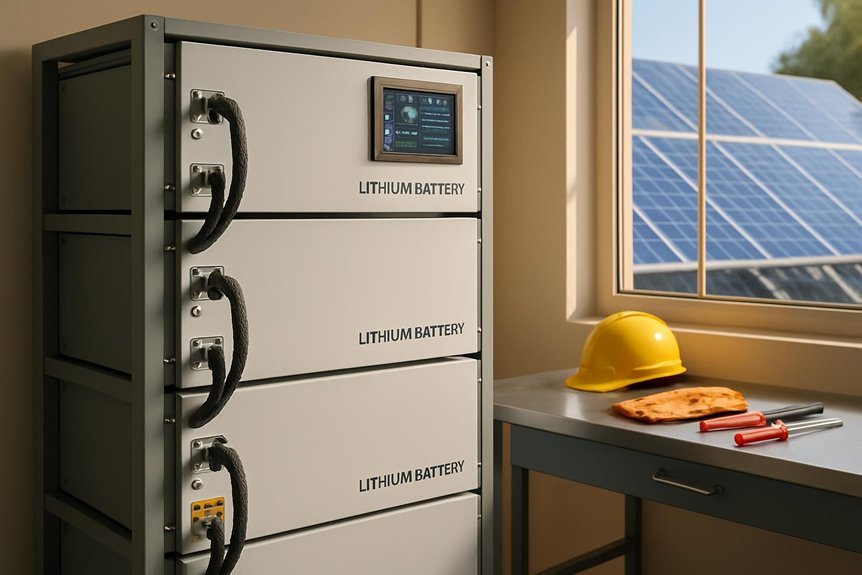
A solar lithium battery storage system is a portable, scalable energy reservoir that stores excess DC power generated by a PV array for later use. We define its role by three core functions: capture, store, and discharge energy with predictable characteristics. We select lithium chemistries for high energy density, long cycle life, and fast response times, ensuring system resilience under varying irradiance. Our design emphasizes safety, thermal management, and monitoring, providing state-of-charge visibility and fault detection. We consider insulation aesthetics and color coordination to integrate enclosures with site aesthetics while maintaining enclosure integrity and heat dissipation. This matters because predictable performance reduces risk, optimizes charge cycles, and lowers total cost of ownership. In short, the system is a purposeful bridge between generation and consumption, enabling reliable, controlled energy use.
Do You Need Storage? Key Criteria for Home or Small-Business Use
We assess storage needs by outlining essential home-grade requirements, including daily energy use, critical loads, and backup expectations. We’ll also perform an off-grid viability check to determine if battery autonomy is practical and cost-effective for your site, factoring solar yield, climate, and system losses. Finally, we’ll cover battery sizing considerations—how to translate monthly consumption and peak demand into a safe, reliable storage bank with appropriate depth of discharge and inverter compatibility.
Storage Necessities For Homes
Evaluating storage needs for homes hinges on practical criteria: peak daytime usage, desired backup duration, and available space or obstructions. We approach sizing systematically, first assessing load profiles and crest hours, then selecting storage chemistry that minimizes self-discharge and degradation under cycling. Our emphasis is on predictable performance, not marketing claims. We translate backup goals into contiguous energy capacity and discharging rates, then verify enclosure footprint and ventilation constraints. We address interdependencies between inverter sizing, charge controllers, and safety clearances, ensuring compliance with local codes. For installation realism, we examine module mounting options and cabinet organization to maximize accessibility and thermal management. In practice, a balanced system prioritizes reliability, lifecycle health, and serviceability, avoiding overcommitment while preserving future expandability.
Off-Grid Viability Check
Is off-grid viability truly feasible for a home or small business without storage, and if so, what are the critical criteria we must meet? We assess reliability, load predictability, supply interruption tolerance, and timing of generation versus demand. Our approach is methodical: quantify deficits, verify margin buffers, and confirm shutdown safeguards. We limit risk by validating weather variance, seasonal patterns, and critical loads. We also consider operational practicality, maintenance cadence, and cost-to-benefit alignment.
- Stability of net demand vs. generation under typical and extreme conditions
- Clear fallback plans for prolonged outages and maintenance windows
- Manageable energy budgets with defined critical versus noncritical loads
- Documentation of assumptions, testing procedures, and review cycles
This discussion ideas note helps frame unrelated topics, keeping focus on core feasibility and structured decision-making.
Battery Sizing Considerations
Should you store energy at all for a home or small business, and if so, how should you size the battery system to meet reliable demand? We approach sizing methodically by defining目标 load profiles, allowable autonomy, and discharge depth. We model critical vs. noncritical loads, then match runtime requirements to system energy capacity in kilowatt-hours. We calculate daily energy needs, including utility daytime usage and solar production, and set a reserve margin for events like cloudy spells. Battery count and chemistry determine usable capacity, cycle life, and efficiency losses; we select a target depth of discharge that balances longevity with usable energy. We also consider inverter sizing, startup surges, and temperature deratings. Avoid irrelevant topic biases; avoid random discussion; focus on predictable demand, ensure reliable service, and validate with simulations.
Sizing Storage for Solar Lithium: Capacity, Depth of Discharge, and Load Profiles
We start by examining how capacity sizing drives usable energy, balancing system voltage, inverter constraints, and anticipated solar harvest. We then contrast DoD and efficiency tradeoffs, outlining how deeper discharges save space but increase cycling losses and reduce battery life. Finally, we assess load profiles to match peak and off-peak demands, ensuring the selected storage supports expected duty cycles without overprovisioning.
Capacity Sizing Impacts
Capacity sizing for solar lithium storage hinges on how much energy you need to store, how deeply you can discharge the batteries, and how your load varies over time. We quantify capacity with target DoD, aging adjustments, and available inverter headroom, then validate through a pulse-and-hold profile. Our method is deterministic: we model daily energy balance, margin for contingencies, and seasonal shifts, ensuring reliability without waste. Implementing proper sizing reduces cycling stress and extends life, while preserving system availability for critical loads.
- Clear energy target guides architecture
- DoD and temperature envelopes constrain capacity
- Load variability informs margin requirements
- Verification checks prevent off topic chatter and unrelated topic drift
DoD and Efficiency Tradeoffs
What’s the best balance between DoD and efficiency when sizing solar lithium storage, given varying load profiles and system constraints? We evaluate tradeoffs by comparing usable energy, cycle life, and heat losses. Higher DoD increases usable capacity but reduces cycle life and efficiency due to deeper cycling losses; moderating DoD improves efficiency and lifetime, at the cost of more installed capacity to meet demand. We model annual energy throughput, considering solar economics and replacement costs. We prioritize moderate DoD (40–60%) for typical residential systems with varied loads, ensuring adequate headroom during peak events. Privacy concerns arise with data logging and monitoring granularity, so we implement encryption and access controls.
| Column A | Column B |
|---|---|
| DoD vs. efficiency | System lifetime impact |
Load Profile Implications
How do load profiles shape storage sizing for solar lithium systems, and what are the practical implications for capacity, DoD, and system performance? We describe how daily demand patterns drive required energy and peak shave targets, aligning battery capacity and DoD with expected cycling. A faithful interpretation preserves battery health while meeting reliability goals, reducing stress during high-demand periods. We quantify the relationship between usage, inverter efficiency, and depth of discharge limits to minimize degradation and maintain long-term performance.
- Aligns charge/discharge cycles with peak loads to protect battery health
- Specifies usable capacity vs. rated capacity for accurate sizing
- Guides DoD decisions to balance lifespan and readiness
- Sets performance expectations under varying load profiles and weather)
Choosing Chemistry and Modules: LiFePO4, NMC, and System Architecture
Selecting the right chemistry and module architecture is foundational to a safe, durable solar storage system, so we evaluate LiFePO4 and NMC in light of cycle life, safety, and performance under our expected operating conditions before outlining a practical system layout. We compare chemistry options with a focus on lifecycle reliability, thermal tolerance, and charge/discharge efficiency to determine suitability for our load profiles. Module ergonomics guides how cells fit within enclosures, wiring, and thermal management, minimizing parasitic losses and facilitating serviceability. In our architecture, LiFePO4 offers stability and longer cycle life, while NMC provides higher energy density for constrained spaces. We present a balanced, data-driven selection, then specify modular configurations that support scalable, maintainable, safe operation.
Siting, Ventilation, and Safety Essentials for Home Installations
Siting, ventilation, and safety are critical when installing home-scale solar storage, because improper placement or inadequate ventilation can escalate heat buildup, off-gassing, or fire risk. We focus on siting considerations that minimize heat transfer and allow for safe access, monitoring, and maintenance. We address ventilation needs to sustain healthy air exchange and reduce concentrations of any gases. Our approach is systematic, data-driven, and conservative.
- Ensure clear, unobstructed clearances around the enclosure
- Locate away from living spaces, heat sources, and ignition risks
- Verify intake and exhaust pathways remain free of debris
- Plan for accessible cables, sensors, and spill containment
Permits, Codes, and Compliance You Must Meet
Permits, codes, and compliance aren’t optional details—they’re the framework that guarantees safe, legal, and insurable solar lithium battery storage installations. We approach permitting as a formal, auditable process with documented documentation, plan review, and inspections. Our method ensures code compliance from origin through completion, aligning with local amendments, national standards, and utility requirements. We identify permit scopes early, prepare concise technical drawings, and submit complete applications to minimize delays. We address permitting pitfalls by confirming device listing, enclosure ratings, and ventilation provisions match jurisdictional expectations. We also scrutinize labeling, fire separation, and access clearances to avoid rework. We stay vigilant for regulatory loopholes by adhering to the latest NEC, NFPA, and regional supplements, and we maintain traceable records for inspections, approvals, and safety certifications.
Installation Steps: Mounting, Wiring, Inverter Integration, and Commissioning
With the permitting baseline established, we proceed to the installation steps that materialize those plans: mounting the battery array, routing and securing wiring, integrating the inverter, and performing a thorough commissioning sequence. We document each action with exact measurements, validated torque specs, and labeled conduits to ensure repeatability and safety. Our workflow emphasizes minimizing impedance, maximizing thermal management, and verifying insulation integrity before energization. We verify all connections, perform polarity checks, and confirm system grounding, observing fault isolation procedures to protect personnel and equipment. Final checks include software configuration, safety interlocks, and data logging setup to enable performance verification.
Installation steps documented with precision: measurements, torque, routing, testing, and commissioning for safe, verifiable performance.
- Clear mounting alignment and fastener torque adherence to spec
- Cable routing with strain relief and protection
- Inverter handshake, firmware version, and setpoints
- Commissioning checklist, safety lockout, and documentation
irrelevant topic random thought
Maintenance, Monitoring, and Troubleshooting for Long-Term Performance
We design and implement ongoing maintenance, monitoring, and troubleshooting to sustain long-term performance of the solar lithium battery storage system. We present a disciplined routine that targets reliability, safety, and efficiency. First, we establish maintenance fundamentals: regular vertex checks of cell.temperature, voltage balance, electrolyte integrity, and connector torque, plus firmware updates aligned to manufacturer recommendations. Next, we deploy monitoring dashboards to track state of charge, depth of discharge, cycle counts, and ambient conditions, enabling early anomaly detection. We implement calibrated alarms for temperature excursions, SOC drift, and unexpected current spikes. Troubleshooting follows a structured playbook: reproduce fault conditions, isolate subsystems, and verify safety interlocks before corrective action. Finally, we document all events, outcomes, and preventive actions to refine procedures and sustain system health.
Frequently Asked Questions
What Is the Typical ROI Timeline for Solar Lithium Storage?
The ROI timeline typically spans 5–12 years, depending on grid rates, usage patterns, and battery cycle life. We model cost vs. savings precisely, including incentives; our method yields a predictable ROI timeline for Solar Lithium storage investments.
How Long Does a Full Battery Cycle Last in Real Use?
A full battery cycle lasts about 4 to 8 hours in real world usage, depending on depth of discharge and load. We monitor cycle duration closely, noting efficiency losses and temperature effects during each cycle in real world usage.
How Do Temperature Changes Affect Battery Performance Year-Round?
Temperature tides tire tempers: we note temperature effects drastically shift year round performance. We monitor, measure, and manage thermal management to minimize battery aging, preserving reliability and efficiency through seasonal fluctuations. We recommend proactive conditioning for consistent performance.
Can Existing Solar Inverters Be Retrofitted for Storage?
We can assess retrofit feasibility and determine inverter compatibility. Our method analyzes existing wiring, panel space, and communication protocols; if alignment meets standards, we proceed with compatible storage integration; otherwise, retrofit feasibility is limited and alternatives exist.
What Warranty Coverage Is Standard for Residential Storage Systems?
We offer standard residential storage warranties that cover both warranty scope and service inclusions, detailing performance and defects. We’ll quantify coverage terms, durations, and exclusions, and explain how replacements, labor, and remote monitoring are handled in concrete, actionable steps.
Conclusion
We’ve walked through how a Solar Lithium Battery Storage system captures excess PV energy, with careful attention to chemistry, modular design, ventilation, and code compliance. A compelling stat: properly sized systems can reduce peak demand charges by 10–20% in many residential setups, translating to meaningful savings. By adhering to best practices in SOC visibility, maintenance, and fault diagnosis, we guarantee predictable performance and long lifecycle health, delivering reliable, safe energy storage for your solar investment.