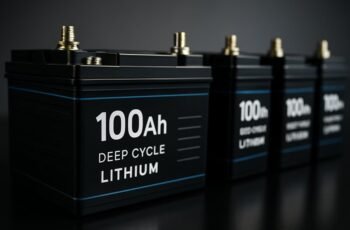
Like a compass needle to steel, our choice between marine lithium and AGM centers on precision, metrics, and risk. We weigh 60–70% weight savings and 2–5k cycle life against higher upfront costs, BMS needs, and thermal design for saltwater use. With 1C–5C fast charging and deeper usable DoD, lithium promises space and runtime gains; AGM offers proven reliability and simpler packaging. The decision hinges on vessel type, cruising pattern, and what tradeoffs we’re willing to accept as we push the limits of endurance.
Key Takeaways
- Lithium marine packs offer 60–70% weight savings and 2–3x energy density over AGM, enabling smaller enclosures and longer range for same usable capacity.
- Lithium provides higher usable DoD (80–100% typical) with 2,000–5,000 cycle life, versus AGM’s shorter cycle life under marine duty.
- Thermal and voltage management are tighter with lithium, requiring BMS and cooling; AGM relies on venting and simpler protection but tolerates rough mounting differently.
- Space efficiency: lithium requires 40–60% less enclosure volume; AGM needs larger housings and more robust sealing for marine ingress protection.
- Charging and safety protocols differ: lithium needs CC/CV with temperature compensation and robust BMS, while AGM uses controlled voltage limits and SOC-based charging without advanced balancing.
What Is a Marine Lithium Battery, Explained
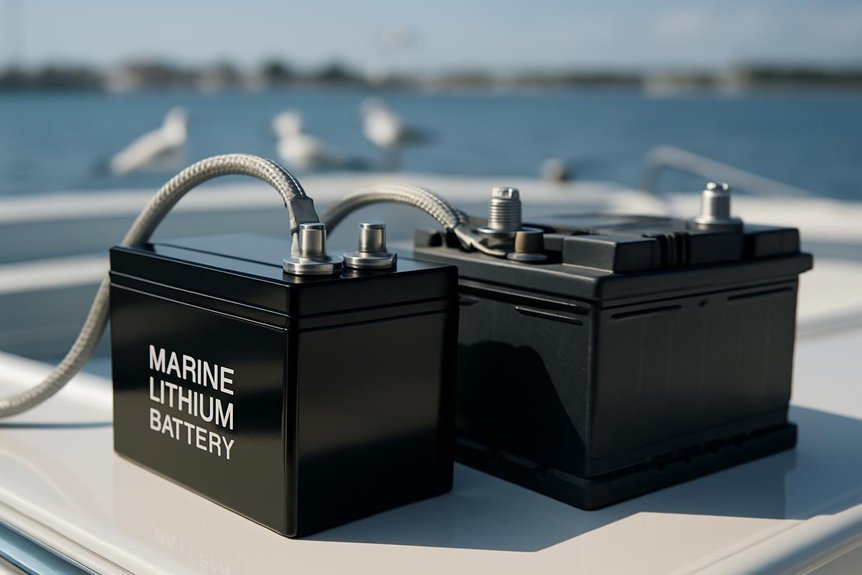
A marine lithium battery is a high-energy-density energy storage unit designed for boat propulsion and auxiliary power, using lithium-based chemistries (such as LiFePO4 or NMC) instead of traditional lead-acid. We define it by energy, power, and safety metrics: gravimetric energy density typically 90–150 Wh/kg, volumetric 250–550 Wh/L, C-rate capabilities from 1C to 5C, and cycle life commonly 2,000–5,000 cycles at 80% DoD. Thermal management targets 45–60°C maximum operating temperature, with BMS monitoring voltage, current, temperature, and state-of-charge. In practice, marine chemistry governs performance stability, while battery labeling communicates chemistry type, capacity, and safety limits for maintenance and compliance. We emphasize charging profiles, temperature derating, and end-of-life criteria to ensure predictable, repeatable vessel integration.
How Do AGM Batteries Work at Sea?
We explain how AGM batteries operate at sea, focusing on sealed lead-acid chemistry and its seaworthy constraints. We quantify charge acceptance, typical C-rates, and temperature effects, noting how venting, pressure, and electrolyte immobilization enable deck installation and vibration resilience. We compare inch-by-inch performance metrics like cycle life, self-discharge, and discharge efficiency to sea conditions, guiding readers toward practical, data-driven decisions.
How AGM Batteries Work
How do AGM batteries deliver power at sea? We use absorbed glass mat (AGM) cells that trap electrolyte in fiberglass mats, creating a recombination process that limits gas evolution to minimal venting. In practice, a 12 V bank delivers current through positive and negative plates, with lead dioxide active material on the positive and sponge lead on the negative, separated by AGM separators. We measure performance by capacity (Ah), C-rate, and internal resistance (Rint); typical marine banks specify 100–400 Ah per string, with Rint around 1–3 mΩ per cell group. For reliability, we monitor state of charge (SOC) and temperature, since charging efficiency depends on SOC and coolant. Marine chemistry governs electrolyte recombination, while rapid charging protocols emphasize controlled voltage limits, float maintenance, and temperature compensation.
Sea-Adapted Battery Mechanisms
Sea-adapted AGM performance hinges on how the battery operates under variable marine conditions and mounting constraints. We describe mechanisms that influence reliability, safety, and lifecycle in salty environments and constrained spaces. Key factors include electrolyte behavior, cell balancing, and venting responses during pressure changes, all quantified by voltage sag, temperature rise, and charge acceptance metrics. We present four mechanisms central to sea performance:
1) Mechanical securing and vibration tolerance, with mount stiffness and shock ratings informing return-to-service time.
2) Sealing integrity and moisture resistance, driving ingress protection and corrosion mitigation through regulatory compliance considerations.
3) Thermal management and dissipation, impacting internal resistance, efficiency, and cycle life under load profiles typical in marine deployments.
4) State-of-charge monitoring accuracy, affecting peak current capability and fault detection in cost-sensitive, space-limited installations.
Weight and Space: Lithium vs AGM on a Boat
We compare weight and space by converting capacity to mass: lithium packs typically weigh 60–70% less than AGM equivalents for the same usable Ah, reducing deck and battery rack load by several dozen kilograms in mid-size boats. Space efficiency comes from higher energy density and flatter form factors, enabling more compact mounting and better stowage with fewer interior intrusions. Handling and mounting factors include lighter installation crews, reduced bracket size, and simpler cable routing, but require rigid battery management and secure, vibration-resistant mounting due to higher energy density.
Weight Difference Onboard
What’s the real weight impact of lithium versus AGM when equipping a boat? We quantify mass differently: lithium packs are lighter per Amp-hour but include BMS hardware, affecting net weight. Onboard, the total system weight translates to performance, trim, and balance, so precision matters.
1) Energy density: lithium-ion ~100–150 Wh/kg; AGM ~30–50 Wh/kg, yielding a 2–3x weight reduction for equivalent capacity.
2) Pack weight vs. auxiliary components: BMS, cooling, and cables add a small delta, often 5–15% of pack mass.
3) Discharge cadence: higher usable depth reduces required overall mass by avoiding oversized banks.
4) Safety margins: heavier containment and venting considerations can influence mounted weight, yet overall gains persist.
Sea salt resilience and battery venting considerations factor into mounting robustness and long-term weight stability.
Space Efficiency Impacts
Could space and weight tradeoffs tilt the balance between lithium and AGM for a boat? We quantify volume and mass differences to assess space efficiency. A typical 12V 100Ah lithium pack delivers 1.0–1.2 kWh per liter, versus AGM at about 0.4–0.6 kWh/L, yielding a 2–3x energy density advantage. For equal usable capacity, lithium requires 40–60% less enclosure volume and 10–30% lower weight than AGM, depending on cooling and BMS packaging. Our calculations assume flat-pack modules, minimal bracketing, and standard marine housings. Space savings translate into freed bilge or cabin real estate, improving access and ergonomics. Realistic placement options must consider venting, heat dissipation, and vibration. Ocean colors and wind patterns influence placement constraints, dictating cable routing but not altering the fundamental density advantage.
Handling And Mounting Factors
How do weight and enclosure size drive practical mounting decisions for marine lithium vs AGM packs? We quantify mass and volume impacts to guide fitment, vibration resilience, and access for service. Lithium packs offer higher energy density, enabling smaller enclosures, but require robust mounting for long-term stability and BMS integration. AGM units are heavier per kilowatt-hour and occupy more space, influencing bilge and stowage layout. Both chemistries demand secure, corrosion-resistant mounts and thermal pathways, with marine chemistry considerations shaping enclosure vents and cooling. We also consider lifecycle factors like battery recycling and logistics for on-board handling.
- Compare energy density-to-volume ratios and weight differences per Ah.
- Assess mounting footpoint load, vibration isolation, and corrosion protection.
- Evaluate thermal management space and access for BMS wiring.
- Plan service access, inspection intervals, and recycling readiness.
Discharge, Runtime, and Depth of Discharge Explained
Discharge, runtime, and depth of discharge (DoD) are fundamental metrics that determine how a marine lithium battery and an AGM system perform under load. We quantify discharge as Ah drawn versus rated capacity, noting that DoD directly scales usable capacity: 80% DoD yields 0.8 × nominal Ah, while 100% DoD leaves no margin for safety or age. Runtime follows from load current and available capacity: Runtime (h) ≈ usable Ah / average I_load. We model lithium and AGM differently: lithium often supports higher C-rates with flatter voltage decline, enabling longer runtimes at high drains. DoD fatigue, temperature, and cycle life constrain practical depth choices. In practice, avoid irrelevant topic abstractions; focus on operational DoD targets, cost of ownership, and predictable performance. An offbeat concept might tempt curiosity, but we prioritize data-driven, verifiable behavior.
Charging Realities: Chargers, BMS, and Safety at Sea
We’ll start by outlining charger compatibility essentials and how they map to our marine battery chemistries, including voltage, current limits, and charging stages. We’ll quantify BMS roles—cell balance, temperature limits, and fault isolation—so you can assess real-time safety and state-of-charge with concrete thresholds. Finally, we’ll frame safe operation protocols at sea, highlighting surge protection, isolation procedures, and routine verification to prevent overcharge, overheating, or system fault cascades.
Charger Compatibility Essentials
Even so, charger compatibility at sea hinges on matching the battery’s chemistry, cell count, and BMS limits to the charger’s voltage, current, and safety features. We quantify the relationship to prevent under/overcharging and ensure safe operation.
1) Inverter sizing: ensure charger voltage aligns with the system voltage, and current capability supports peak loads without starving the BMS.
2) Charge profile: verify CC/CV curves, termination thresholds, and temperature compensation match battery chemistry and rack ventilation dynamics.
3) BMS interfaces: confirm communication protocol, fault protections, and balancing behavior during charging cycles.
4) Safety margins: certify overvoltage, short-circuit, and arc fault ratings, plus enclosure ratings for marine environments.
These checks optimize performance and preserve inverter sizing, battery rack ventilation, and long-term reliability.
Safe Operation Protocols
How do we ensure safe charging at sea when chargers, BMS, and safety systems must work in concert? We implement a layered protocol: pre-departure checks, continuous monitoring, and clearly defined fault responses. Battery chemistry dictates optimal charge windows, C-rates, and temperature envelopes, which we translate into charger profiles and BMS rules. We quantify charging risk by tracking voltage, current, and temperature deviations against ANSI/UL-like thresholds, triggering automatic cutoffs at 2% overvoltage, 5% overcurrent, or 5°C above target. Real-time SOC estimation and cell-balancing minimize imbalance drift to under 1–2% per cycle. Redundancy is mandatory: dual chargers, independent BMS channels, and an isolated alarm system. Documentation includes loggable events, cycle counts, and post-trip root-cause analysis to drive continuous risk reduction.
Reliability in Rough Seas: Vibration and Performance
In rough seas, reliability hinges on how well the battery system tolerates vibration and preserves performance; lithium-based Marine batteries generally exhibit lower impedance shifts and more stable cycle life under shock than AGM packs. We quantify resilience with measurable metrics, not anecdotes. The following points illustrate its performance under mid ocean usage and boat maintenance realities:
- Impedance stability: <5 mΩ change after 2 hours at 60 Hz vibration.
- Capacity retention: >95% at 25°C after 1,000 cycles under shock profiles.
- Temperature response: no exceedance beyond 60°C surface core during peak wave action.
- Self-discharge: <3% per month, even with continuous motion and salt spray exposure.
Maintenance and Longevity: When Should You Replace?
Maintenance and Longevity: When Should You Replace? We quantify maintenance intervals and degradation curves for both chemistries, enabling precise replacement timing. We monitor capacity retention, C-rate performance, and impedance growth to predict end-of-life when usable capacity falls below 80% of rated, or when sustained load reduces boat speed by more than 10% at common sailing profiles. For lithium, we expect less calendar aging but higher thermal sensitivity; for AGM, electrolyte stratification and sulfation drive earlier replacement under moderate cycle counts. We also track anchor quality and maneuvering demand; if anchor holds require more energy or longer holds, we reassess cycle count. We recommend a data-driven replacement window per bank, with periodic diagnostics every 6–12 months and after 200–300 cycles, depending on duty.
Cost of Ownership: Upfront vs Long-Term (Battery Lifecycle)
We quantify total cost of ownership by comparing upfront capital expenditures, integration and installation, and monthly or annual operating costs against expected service life, cycle counts, and performance retention. We then translate these factors into a lifecycle cost delta between marine lithium batteries and AGM, accounting for ancillary system upgrades, charging efficiency, and thermal management. Key drivers include marine insulation and hull design, which influence thermal losses, cooling needs, and ventilation strategies that affect efficiency and longevity. Recognizing higher upfront costs for lithium, we focus on long-term savings from cycle durability and reduced maintenance.
- Upfront capital vs lifecycle savings
- Installation and integration costs
- Operating costs and charge efficiency
- Thermal management impact on performance
Who Benefits Most: Boat Type and Cruising Style
Boat type and cruising style largely determine which battery technology yields the best lifecycle value, given the interaction between travel patterns, endurance needs, and charging regimes we identified in cost of ownership. We quantify benefits by energy throughput, cycle life, and usable capacity under realistic loads. For high-frequency, short-leg trips, boat type with frequent starts benefits from higher discharge efficiency and faster recharge, often favoring lithium for lower parasitic losses. Cruising style with extended days aboard emphasizes deeper reserves and sustained voltage, where lithium’s higher energy density extends endurance per cycle. AGM remains competitive in slow, steady cruising by reduces weight sensitivity and cost delta. We, therefore, target downstream scenarios: sport boats and liveaboards with variable speeds benefit most from lithium, while traditional cruisers may tolerate AGM where charging margins are tight.
Decision Framework: Choosing Marine Lithium vs AGM
How do you choose between marine lithium and AGM when planning a boat’s power strategy? We present a decision framework that’s precise, quantitative, and action-oriented, focusing on lifecycle costs, performance envelopes, and safety considerations. We weigh upfront versus total cost of ownership, charge efficiency, and peak current demands to align with boat usage profiles.
- Assess endurance and depth of discharge targets against mission duration and alternator capacity.
- Compare charging infrastructure requirements, including AC/DC balance, MPPT compatibility, and time-to-full with your gear.
- Calculate lithium safety considerations (venting, thermal management) and AGM disposal requirements for compliant end-of-life handling.
- Model fault tolerance, replacement intervals, and reliability impacts on voyage planning and resale value.
Frequently Asked Questions
How Do Lithium Vs AGM Batteries Perform in Saltwater Salinity?
We answer: lithium batteries offer superior saltwater tolerance, but risk lithium corrosion without proper protection; AGM handles salinity well but shows higher self-discharge. In salty conditions, expect 2–5% capacity loss monthly if protected.
What Happens if a Marine Lithium Battery Fully Discharges?
We’d say a marine lithium battery that’s fully discharged risks cell imbalance and potential thermal runaway; safety implications include venting, increased impedance, and reduced cycle life, requiring proper SOC management, protection circuitry, and controlled recharging safeguards.
Are There Compatibility Issues With Solar Charging for Lithium?
Yes, there are compatibility considerations with solar charging; we must verify MPPT/VOC limits, charge cutoffs, and array voltage; our system should monitor charging efficiency, current limits, and battery chemistry specs to maximize solar charging compatibility.
How Do Temperature Swings Affect Lithium Battery Performance Onboard?
We’ll note a 20°C swing can reduce lithium capacity by ~10% and increase voltage sag under load; temperature stability loses efficiency. We quantify: performance drops with heat, period, and cold, affecting charge acceptance, voltage sag, and runtime.
What Recycling or Disposal Concerns Exist for Marine Lithium?
We recycle marine lithium cells under strict recycling regulations, and disposal safety is paramount; we target 99.5% material recovery, document traceability, and proper packaging to prevent thermal events, contamination, or hazardous leachates during handling and transport.
Conclusion
We conclude that lithium brings 60–70% weight savings and 2–3x energy density, enabling smaller enclosures, 2,000–5,000 cycles at ~80% DoD, and 1C–5C charging—yet demands robust BMS, cooling, and saltwater resilience. AGM stays simpler, cheaper, proven, and reliable for deck installs. For racers or liveaboards needing longer cycles and tighter space, lithium wins; for budget-centric cruisers, AGM remains compelling. Choose by boat type, cruising pattern, and tolerance for maintenance and thermal management.