One practical example: a residential system switches from lead-acid to lithium and cuts cycling costs by roughly a third while boosting usable energy by about 20–30%. We’ll compare DoD, efficiency, cycle life, and lifecycle costs to see what truly matters for grid-ready storage. With upfront costs higher, the payoff hinges on long-term performance, maintenance, and safety. Curious how these trade-offs play out in real projects as we weigh options for your budget and goals.
Key Takeaways
- Lithium batteries offer higher energy density, longer cycle life, and better DoD, enabling smaller, lighter, and longer-lasting solar storage than lead-acid.
- Lead-acid systems have lower upfront cost but shorter lifespan and fewer cycles, increasing replacement needs over time.
- Lithium round-trip efficiency is typically 85–95%, versus 70–85% for lead-acid, reducing real-world energy losses.
- DoD: lithium supports ~80% for optimal life, while lead-acid commonly 50–60%, influencing usable storage capacity per cycle.
- Safety, warranties, and end-of-life protocols are more stringent and modern for lithium, impacting total cost and sustainability.
Deciding Factors for Solar Storage: What to Compare Between Lithium and Lead-Acid
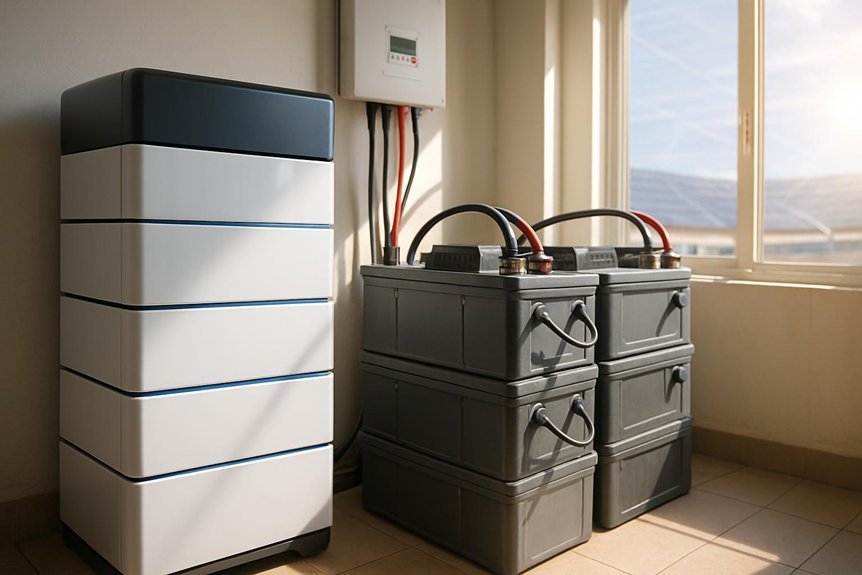
When choosing between lithium and lead-acid for solar storage, we start by comparing metrics that matter in a system’s daily use: energy density, cycle life, depth of discharge, efficiency, safety, cost, and maintenance. We quantify: lithium offers 2–3x energy density and 3–5x cycle life vs. lead-acid, yet costs 2–3x upfront; efficiency runs 95–98% for lithium and 85–92% for lead-acid, with longer usable ranges per cycle. Thermal safety and venting risk favor lithium in well‑vented spaces, while lead-acid hate high temperatures. Maintenance demands differ: equalization, fluid checks, and sulfation risks. We watch for solar betrayal in misrepresented warranties or unknown degradation. Aesthetics matter, too—battery aesthetics influence installation confidence and perceived reliability, though performance governs long-term value.
Key Performance Metrics: Depth of Discharge, Efficiency, and Real-World Use
We’ll start by clarifying how depth of discharge, cycle life, and real-world efficiency shape usable energy and long-term costs. In practice, lithium systems typically tolerate higher DoD with better round-trip efficiency, translating to more energy delivered per kWh stored. We’ll also compare real-world performance metrics to see how guidance translates into system effectiveness for solar storage.
Depth Of Discharge Impacts
How does depth of discharge (DoD) shape battery performance and real-world use? We quantify DoD as a percentage of rated capacity, linking it to usable energy per cycle. At 80% DoD, our lithium options deliver higher cycle life and consistent efficiency, yet practical limits emerge: deeper discharges reduce available cycle counts and increase degradation rates. In contrast, lead acid shows noticeably steeper capacity loss as DoD rises, and its cycle life drops more quickly under frequent high-DoD cycling. For both chemistries, we measure trade-offs between energy throughput and longevity. We optimize system design by aligning target DoD with expected cycling patterns, balancing available storage, replacement costs, and overall lifecycle energy cost. In practice, modest DoD levels extend real-world usability without sacrificing needed energy reserve.
Real World Efficiency Metrics
Real-World Efficiency Metrics hinge on three interlinked factors: depth of discharge (DoD), round-trip efficiency, and actual energy delivered per cycle. We quantify DoD as a percentage of rated capacity utilized per cycle, with lithium systems typically operating above 80% DoD for optimal life vs lead acid that often stays around 50–60%. Round-trip efficiency measures energy in divided by energy out, with lithium chemistries delivering 85–95% and lead acid 70–85%. Real energy delivered per cycle combines DoD and efficiency, yielding usable energy per cycle ≈ rated capacity × DoD × efficiency. In practice, solar efficiency and system losses (inverter, cabling, temperature) reduce delivered energy by 5–15%. We track performance over 1–3 daily cycles, noting battery chemistry influences aging, capacity fade, and energy return profiles.
Lifespan, Warranties, and Durability: How Long Will It Actually Last?
What lifespan can you actually count on for solar lithium battery systems compared with lead-acid? We present a concise, numbers-forward view on durability, warranties, and total lifecycle costs. We focus on practical expectations, not marketing claims, so you can plan with confidence.
- Lithium systems: typical cycle life 3,000–7,000 cycles, depending on chemistry and depth of discharge
- Lead-acid deep-cycle: roughly 500–1,500 cycles under similar use
- End-of-life thresholds: lithium often 80%+ capacity, lead-acid around 60–70%
- Warranty window: lithium 10–15 years with performance guarantees; lead-acid 3–5 years
- Total cost of ownership: higher upfront for lithium, lower replacement risk over time due to longer lifespan and better degradation resistance
Lifespan comparison and warranty considerations guide smart purchases and ongoing maintenance.
Charging Speed and System Compatibility: How Quickly Can Each Refill?
Charging speed and system compatibility are immediate next considerations after durability and warranties, because faster, compatible charging reduces downtime and total cost. We compare 12V and 24V systems, DC fast charging, and inverter load limits to quantify refill rates. Lithium packs typically accept higher C-rates than lead acid, but real-world charge times depend on SOC, temperature, and BMS limits. In practice, a full refill for lithium may take 1–2 hours at 0–80%, whereas lead acid often requires 4–6 hours to avoid damage. Compatibility matters for solar ramp, charge controllers, and generator coupling. Irrelevant topic, extraneous consideration aside, our focus stays on usable recharge speed and system design.
| Factor | Impact |
|---|---|
| Battery chemistry | Determines max C-rate |
| System hardware | Controllers, inverters, wiring limits |
Maintenance, Safety, and Operating Conditions You Should Know
How should we approach upkeep to minimize failure risk? We approach this with strict maintenance reliability metrics and clear safety protocols, treating every check as data. Lithium systems require tighter temperature control, charged-only operation windows, and documented fault logs to prevent degradation. Lead-acid needs venting and water top-offs, but both share protection against overcurrent, short-circuits, and thermal runaway. We’ll adhere to OEM guidelines, maintain consistent SOC bands, and monitor cycle aging to forecast replacements. Electrical isolation, proper grounding, and alarm thresholds are non-negotiable. Regular insulation checks reduce leakage risks, and performance tests verify capacity vs. rating. Preventive tasks reduce downtime and extend life, while documented incident reviews sharpen operational readiness.
- Regular temperature and voltage monitoring with thresholds
- Confirmed venting, electrolyte checks, and corrosion control
- Consistent SOC bands and calendar/usage-based service
- Verified safety protocols, PPE, and lockout/tagout
- Fault logging, incident reviews, and data-driven maintenance reliability
Total Cost of Ownership: Upfront, Replacement, and End-of-Life Costs
Total Cost of Ownership (TCO) for solar lithium battery storage versus lead-acid hinges on concrete math: upfront capital, replacement cycles, and end-of-life handling. We quantify upfront costs per kilowatt-hour installed, then compare expected replacement intervals for each technology, translating cycles into 20-year expenditure projections. Lithium systems typically last longer, reducing replacement frequency and associated labor, while lead-acid often demands earlier refreshes at lower per-unit price but higher total cost over time. We assess operating efficiency, depth of discharge, and degradation to refine annualized costs. Warranty nuances matter: lithium warranties often cover capacity retention longer, impacting risk-adjusted TCO. We present a cost comparison that highlights sensitivity to usage patterns, temperatures, and cycling, delivering a concise, data-driven conclusion.
Safety, Recycling, and Environmental Impact: End-of-Life Choices
We’ll start by comparing end-of-life recycling rates and infrastructure for lithium batteries versus lead-acid, with a focus on salvage percentages and processing energy. We’ll quantify environmental impacts using metrics like lifetime emissions, mineral throughput, and waste-to-recovery ratios, and show how each chemistry stacks up on toxicity, recyclability, and transport risks. By framing clear, actionable targets, we invite you to evaluate safety protocols, regulatory compliance, and recycling options for your system.
End-of-Life Recycling
End-of-life recycling for solar lithium battery storage systems must be handled with rigor: safer disassembly, recovery of critical materials, and minimal environmental impact are non-negotiable. We quantify feasibility by standardizing teardown times, material yields, and impurity limits, then compare to recycling feasibility benchmarks. Our approach prioritizes certified facilities, documented chain-of-custody, and traceability of cobalt, nickel, lithium, and electrolyte remnants. We measure process safety, worker protections, and emissions, ensuring compliance with regulations and EPR programs. Costs are itemized per kWh removed, with sensitivity analyses for variable feedstock quality. Data-driven decisions guide reuse, repurposing, or proper disposal. End-of-life considerations drive logistics, inventory, and long-term sustainability, aligning with responsible stewardship for grid storage and community health.
- Rigorous disassembly protocols and safety clearance
- Certified sorting and material recovery efficiencies
- Quantified emissions, waste streams, and containment
- Transparent recordkeeping and compliance documentation
- Economic feasibility and lifecycle cost tracking
Environmental Impact Metrics
Environmental impact metrics for solar lithium battery storage systems hinge on concrete safety, recycling, and end-of-life outcomes. We quantify risk as incident rate per 1,000 operating hours, with safety thresholds set at ≤0.5 and containment success at ≥98%. Recycling efficiency targets are 90% material recovery and 95% hazardous-waste diversion, driving lower long-term environmental burden. End-of-life choices matter: we estimate landfill risk at 3% for mixed-Li systems versus near-zero for documented recycling streams. Supply chain transparency enables traceable sourcing and contaminant control, improving environmental ethics scores by measurable margins. We compare lead-acid (recycling rate ~60%, longer toxic waste exposure) to lithium systems, highlighting reduced transport emissions when modules are reclaimed locally. Clear metrics guide policy, procurement, and investment toward safer, cleaner, and more accountable energy storage.
System Design and Grid Interaction: Sizing, BMS, and Integration
How do we guarantee solar lithium battery storage integrates smoothly with the grid while meeting reliability and safety targets? We design for defined C-rate, voltage windows, and state-of-charge limits, then validate through simulations and real-world tests.Sizing aligns to load profiles, with headroom for peak events and ancillary services. BMS architecture monitors cell balance, fault isolation, and thermal shutdown, ensuring safe operation across temperatures. We specify batteries chemistry and thermal management strategies upfront to minimize degradation and ensure predictable performance. Grid interaction is quantified via SOC-dependent discharge ramps, inverter needs, and communication protocols. The result is a repeatable, auditable path from commissioning to ongoing operation, reducing risk and improving reliability.
- Defined C-rate, voltage, and SOC targets
- Realistic load and peak-event sizing
- BMS fault isolation and thermal shutdown
- Inverter compatibility and grid codes
- Monitoring, data logging, and commissioning metrics
Decision Framework: Which Storage Path Best Fits Your Budget, Grid, and Goals
So, which storage path best fits our budget, grid, and goals, and how do we pick with confidence? We evaluate cost per kWh, round-trip efficiency, lifecycle, and safety—quantified metrics that guide decision. We contrast lithium vs lead-acid on upfront capex, replacement cycles, maintenance, and performance under grid imports. Align with goals: self-consumption, backup reliability, or demand charge avoidance. We also weigh system complexity, BMS requirements, and warranty terms. Beware irrelevant topic distractions and unrelated concept red herrings; stay data-driven. Use a simple scoring rubric: 0–5 for cost, efficiency, longevity, risk, and scalability. Table helps visualize tradeoffs quickly.
| Criterion | Lithium (kWh) | Lead Acid (kWh) |
|---|---|---|
| Cost/kWh | 0–5 | 0–5 |
| Efficiency | 0–5 | 0–5 |
| Longevity | 0–5 | 0–5 |
Frequently Asked Questions
Which Storage Type Is Better for Rapid Grid Outages?
We’d opt for lithium for rapid outage resilience, delivering faster recharge and higher depth of discharge. Lifecycle cost comparison favors lithium over time, though upfront costs are higher; overall, reliability and return on investment justify the switch to lithium.
How Do Temperature Swings Affect Performance in Both Chemistries?
Temperature swings degrade both chemistries, but lithium generally shows better temperature stability than lead acid. We see faster cycle aging when temps spike or drop, while chemistry performance falls sharply near extremes, with annualized capacity loss increasing noticeably.
Are There Hidden Maintenance Tasks for Lithium Systems?
We can’t hide maintenance—there aren’t secret tasks beyond standard care. We caution that hidden maintenance is not expected; end user responsibilities center on monitoring temperature, voltage, and SOC, plus regular inspections and firmware updates for lithium systems.
Can Lead-Acid Systems Be Fully Recycled Economically?
Yes, lead-acid systems can be recycled economically, with established flows for recovery costs around $0.30–0.50 per pound and high reuse rates. We, however, emphasize economic recycling and lead acid reuse as core goals.
How Do Warranties Handle Third-Party Component Failures?
We can say: warranty implications hinge on third party components; if a failure stems from those parts, coverage typically excludes or reduces claims, requiring documentation and proof of installation, compatibility, and component origin before any remediation or replacement.
Conclusion
We’re comparing two paths side by side: lithium delivers higher DoD and cycles, but at a higher upfront cost; lead‑acid rests cheaper now, yet wears out faster. Lithium’s 85–95% efficiency and 3,000–7,000 cycles outlast lead’s 70–85% and 500–1,500 cycles. The choice isn’t abstract—it’s a budget vs. longevity balance. If you need long-lived, grid-ready performance, lithium wins; if cash today and simple safety nets matter most, lead‑acid stays viable. Your goals determine the trade‑off.