We’ll cut to the chase: the choice between LiFePO4 and AGM isn’t just about upfront price, it’s about lifecycle risk, density, and safety envelopes. We assess stability, charge acceptance, and resilience under real use, then weigh total cost of ownership across cycles, temperatures, and duty cycles. The right pick hinges on your application, from daily cycling to backup reliability. Stay with us as we map the trade-offs and practical implications.
Key Takeaways
- LiFePO4 offers longer cycle life, better thermal safety, and stable voltage, vs AGM’s lower upfront cost and simpler maintenance.
- LiFePO4 handles higher charge acceptance and lighter weight for energy density, while AGM is heavier but often rugged and forgiving.
- AGM uses absorbed glass mat for acid management; LiFePO4 uses a non-acid chemistry with safer thermal profile.
- Temperature and charging: LiFePO4 tolerates surges better; AGM is more sensitive to temperature swings and longer absorption phases.
- Total cost of ownership factors: LiFePO4 may cost more upfront but often lowers replacement and maintenance costs; AGM can be cheaper initially but may incur more frequent replacements.
Lifepo4 vs AGM: Core Chemistry Differences Explained
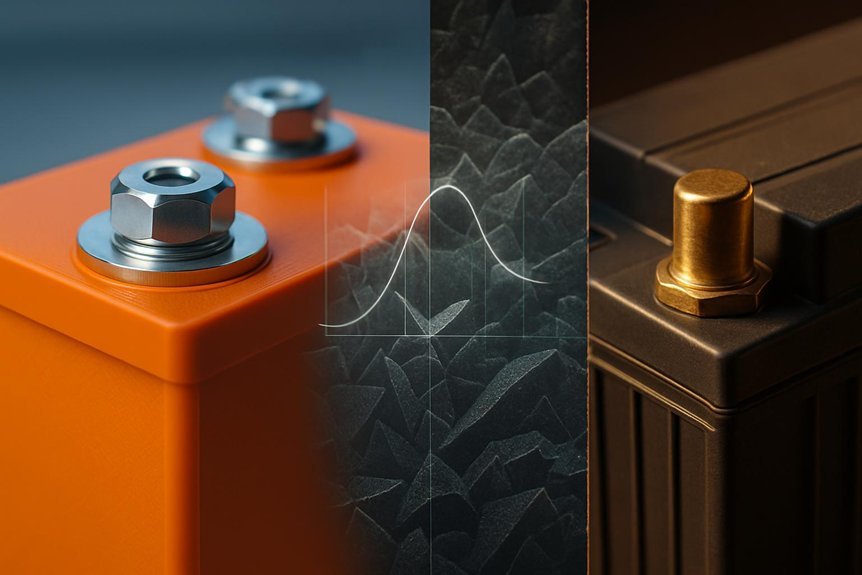
When comparing LiFePO4 and AGM batteries, the core chemistry is the defining difference shaping performance and use cases. LiFePO4 cells use iron phosphate, delivering stable voltage, flat discharge, and high thermal safety, while AGM uses lead-acid chemistry with absorbed glass mat separators that manage acid more tightly but can suffer quicker capacity fade under heavy cycling. LiFePO4 offers longer cycle life, robust thermal tolerance, and better charge acceptance, translating to durable, low-maintenance packs. AGM delivers lower upfront cost and simpler recycling streams but shorter lifespan and higher weight for similar capacity. These chemistry choices also influence durability aesthetics, as LiFePO4 enclosures tend to emphasize reliability and longevity, while AGM systems stress cost-per-watt and serviceability. Recycling ethics favor LiFePO4 due to non-toxic constituents and clearer end-of-life handling.
How Weight and Energy Density Affect Real-World Use
We’ll start by weighing how weight affects vehicle range and how that shifts real-world planning. We’ll compare energy density differences between LiFePO4 and AGM chemistries to explain why weight isn’t the only factor, but it tightly couples to usable capacity. In practice, we’ll examine tradeoffs like payload, acceleration, and infrastructure needs to show how weight and density shape everyday performance.
Weight Impact On Range
Weight is a critical variable in electric powertrains, linking energy capacity to range through energy density and vehicle mass. We quantify tradeoffs by comparing weight impact across chemistries, noting that higher energy density often comes with added mass penalties or mounting considerations. In practice, modest weight reductions improve propulsion efficiency and extend real-world range, while excessive weight shifts alter handling and braking dynamics. We present two concise observations: first, niche applications benefit from tailored weight strategies that optimize duty cycles; second, odor concerns around certain electrolyte formulations can influence packaging constraints and overall mass budgets.
| Factor | Effect on Range |
|---|---|
| Energy density vs mass | Net range delta per kg |
| Vehicle architecture | Weight distribution impact |
Energy Density Differences
How do energy density and weight interact to shape real-world use? We compare LiFePO4 and AGM packs by energy per kilogram and total system mass. Higher energy density means longer run time for a given weight, but real-world performance also hinges on temperature sensitivity, voltage sag, and pack management. LiFePO4 typically offers steadier discharge and longer cycle life, enabling lighter packs to deliver comparable usable energy; AGM often requires heavier packs to match peak currents. Heavier weight increases vehicle load, reducing efficiency and range nonlinearities as speed and terrain change. We must consider disposal considerations and recycling logistics early in design, since end-of-life handling affects total lifecycle costs. In sum, energy density differences drive sizing, thermal strategy, and economic tradeoffs as we optimize performance and sustainability.
Real-World Usage Tradeoffs
Real-world usage shows how weight and energy density translate into practical performance. We weigh LiFePO4 and AGM against real load profiles, noting how higher energy density improves usable capacity without proportionally increasing mass. In practice, trips, cycles, and accessory loads reveal tradeoffs: LiFePO4’s lighter footprint can extend range per cycle, yet its higher power demands during acceleration may affect instantaneous availability. AGM’s heavier pack dampens peak currents but preserves fundamental resilience in harsh environments. Our discussion ideas focus on cycle life, thermal behavior, and tolerance to shallow discharges, clarifying expectations for autonomous systems and mobile setups. We confront battery myths about one-size-fits-all energy, underscoring context-driven choices. Ultimately, weight-driven efficiency and chemistry-specific constraints shape real-world usability more than nominal capacity.
What Cycle Life Really Means in Daily Practice
What cycle life means in daily practice isn’t just a number from a brochure; it’s about how many full depth-of-discharge (DoD) cycles a battery can endure under real usage patterns before its capacity drops to a defined threshold. We assess cycle life by monitoring usable capacity after repeated full DoD events, not abstract lab tests. In practice, variability comes from discharge depth, rest periods, temperature, and load—factors that shift the usable life curve. We compare cycle life vs cost by weighing replacement intervals against upfront price, while accounting for efficiency losses and degradation risk. Safety myths vs reality matter here, too, since sustained cycling can alter thermal behavior and safety margins. Our conclusion: meaningful comparisons hinge on real-world duty cycles, not nominal cycle counts.
Charging Behavior: What to Expect From Each Battery
Charging behavior varies by chemistry and management strategy, and our practical view from cycle-life tests helps predict how each battery responds under typical use. We compare LiFePO4 and AGM profiles to identify clear charging behavior differences. LiFePO4 typically accepts higher charge currents early, with a stable voltage plateau and fast taper as it nears full state, enabling shorter bulk phases when managed properly. AGM often requires gentler, multi-stage charging with more pronounced absorption periods to limit electrolyte and grid stress, which can extend charge times. The comparison tradeoffs center on precision of voltage termination, temperature compensation, and state-of-charge accuracy. Overall, robust BMS tuning and charging algorithms improve reliability, but the downstream effects on life, efficiency, and safety hinge on disciplined adherence to each chemistry’s charging behavior.
Temperature Resilience: How Lifepo4 and AGM Perform
How do LiFePO4 and AGM batteries stand up to temperature stresses, and what does that mean for performance and longevity? We compare resilience through operating ranges, voltage stability, and degradation rates. LiFePO4 cells tend to tolerate higher current surges with less thermal runaway risk, but extreme heat accelerates capacity fade and can stress the electrolyte interface. AGM canvasses broader ambient tolerance, yet performance drops more noticeably with temperature swings, especially at low temps where internal resistance rises. Our assessment emphasizes clarity vs bias: data interpretation matters, and small test variations can skew conclusions. When ambient temp shifts, we expect LiFePO4 to retain capacity longer at high temps, while AGM may suffer faster impedance growth. Both chemistries benefit from thermal management to preserve cycle life and consistent power delivery.
Total Cost of Ownership: Upfront Price to Long-Term Value
When sizing LiFePO4 versus AGM on a total cost of ownership basis, the upfront price is only part of the equation: long-term value hinges on durability, replacement frequency, and performance consistency under real-world usage. We weigh lifecycle costs, including charging costs and EV economics, to reveal true value. Our view emphasizes predictable cycles, degraded capacity, and maintenance needs that affect total spend over years.
- Durability and cycle life parity under typical load profiles
- Replacement frequency and docked charging costs over time
- Performance consistency impacting efficiency and charging speed
Safety, Maintenance, and Debunked Myths
We’ll examine safety considerations and maintenance essentials for LiFePO4 and AGM systems, highlighting how chemistry, charging practices, and thermal behavior influence risk. We’ll separate myths from data, address common misconceptions with technical evidence, and outline practical maintenance steps to minimize failure modes. If you’re evaluating reliable operation, this framework keeps safety and upkeep front and center.
Safety Considerations
Safety considerations for LiFePO4 batteries and AGMs center on avoiding hazards, ensuring reliable operation, and debunking common misconceptions. We assess risk factors, demonstrate proper protection strategies, and call out persistent Safety myths. Our focus stays on early detection, correct charging behavior, and clear labeling, while we avoid delving into Maintenance Essentials here. We also address finite-state condition indicators and safe storage parameters, keeping the discussion technical and concise.
- Hazard identification and immediate mitigation
- Correct charging, discharging, and protection circuits
- Debunking Safety myths and closing Maintenance gaps with rigorous documentation
Maintenance Essentials
What essential safety, maintenance, and myth-busting practices should guide LiFePO4 and AGM battery care to guarantee longevity and reliable performance? We answer with disciplined care: monitor temperature, voltage, and charge cycles; follow manufacturer guidance; perform gentle charging, avoid deep discharges, and store at partial state of charge. Regular inspections detect corrosion, swelling, or venting signs early. We debunk myths: not all high currents boost lifespan; aggressive cycling accelerates wear. Table below highlights core practices and metrics.
| Practice | Metric | Bypass/Action |
|---|---|---|
| Monitoring | Temperature/SoC | Log weekly, act on spikes |
| Charging | Voltage limits | Use correct charger |
| Storage & Debris | Residual charge | Store mid-SOC, clean terminals |
Disposal ethics and recycling challenges shape end-of-life planning.
Choosing by Use Case: EVs, Home Backup, or Portable Gear
Choosing by use case means matching battery chemistry and form factor to how you’ll rely on it: EVs demand high energy density and rapid discharge, home backup favors reliability and long-duration cycles, while portable gear benefits from light weight and compact size. We’ll outline how to think through applications with EVs vs home backup, portable gear vs long term storage, so you pick the right balance of chemistry and form factor without overpromising performance.
1) EV-focused packs require high energy density, fast response, and robust cycle life in a compact footprint.
2) Home backup prioritizes reliability, long cycle life, and steady, predictable discharge for extended outages.
3) Portable gear seeks lightness and small form factors, tolerating lower energy density for on-the-go versatility.
A Practical Framework to Decide: Pick Lifepo4 or AGM With Confidence
Is there a clear, practical way to choose between LiFePO4 and AGM for your application? Yes, and we’ll frame it as a decision matrix rather than intuition. Begin by listing constraints: cost, cycle life, depth of discharge, and operating temperature. LiFePO4 excels in longevity, safety, and stability under high cycle counts, while AGM offers lower upfront cost and simpler maintenance for short to medium runtimes. Next, map requirements to performance envelopes: airflow cooling for heat-sensitive packs, and shelf stability for long-term storage. Evaluate thermal management, charging compatibility, and warranty terms. Weigh lifetime cost over expected use, then stress-test with worst-case scenarios. Our framework guides you to a confident pick by balancing energy needs, maintenance, and long-term reliability.
Frequently Asked Questions
Can Lifepo4 Handle Deep Cycling in Extreme Cold Reliably?
Yes, we can, but heavy cold degrades LiFePO4 performance; deep cycling in extreme cold reduces capacity and increases impedance, risking voltage drops. We design controls to mitigate, monitor temps, and limit depth of discharge for reliability.
Which Battery Lasts Longer Under Frequent High-Current Demands?
Yes—our data shows lifepo4 delivers longer battery longevity under frequent high-current demands. We outperform AGM in high drain performance, and we’ll quantify cycles, efficiency, and heat to guide your choice with precise, technical confidence.
Do Lifepo4 and AGM Require Different Inverter/Charger Settings?
We require different inverter settings and charging profiles; LiFePO4 and AGM differ in voltage thresholds and temp compensation, so we tailor inverter settings and charging profile accordingly for optimal performance and longevity.
How Do Phase Change Temperatures Affect Each Battery’s Performance?
Phase change sharpens performance for both, yet Lifepo4 and AGM differ: Lifepo4’s phase change is milder, battery chemistry stays cooler; AGM heats more, efficiency drops. We monitor temps, adjust charge profiles, ensure safe operating ranges.
Is End-Of-Life Recycling Easier for Lifepo4 Versus AGM?
End-of-life recycling is easier for LiFePO4 than AGM, thanks to simpler chemistry and fewer hazardous components. We assess durability testing, recycling endpoints, and extreme cold effects to optimize processes, reduce contaminants, and improve overall end-of-life efficiency.
Conclusion
We’ve laid out the trade-offs clearly: LiFePO4 offers steadier voltage, longer life, and better charging efficiency, while AGM keeps initial costs lower and simpler recycling. In practical terms, your choice hinges on total cost of ownership and demand stability. We lean toward LiFePO4 for high-cycle, space- and weight-sensitive uses; AGM for budget-first, moderate cycling. If you rise to the challenge, the decision becomes a brushstroke across your priorities—clear, concise, and within reach. It’s a compass, not a crystal ball.