We want to quantify how fast a lithium battery can charge by chemistry, not just by rating labels. Nickel-rich NMC/NCA and lithium-rich variants typically support higher C-rates (1–3C) with 3.6–4.2V windows, while LiFePO4 offers better safety but slower practical fast charging due to polarization. Solid-state promises, but real-world constraints remain decisive. Temperature, impedance, and heat management often decide the actual speed more than chemistry alone, guiding our comparison toward concrete performance metrics that matter in practice.
Key Takeaways
- LiFePO4 offers robust thermal stability and safety at moderate C-rates, enabling reliable fast charging with long cycle life.
- NMC and NCA chemistries provide good energy density and balanced fast-charging performance at 1–3C under proper thermal management.
- High-rate charging is constrained by temperature rise, so chemistries with lower impedance and better heat handling charge faster safely.
- Solid-state chemistries promise faster charging with reduced interfacial resistance and improved thermal management, though real-world limits remain.
- Real-world fast-charge speed depends on cell design, electrolyte, SEI stability, and cooling, not chemistry alone.
Fast-Charging by Li-Ion Chemistry: A Practical Overview
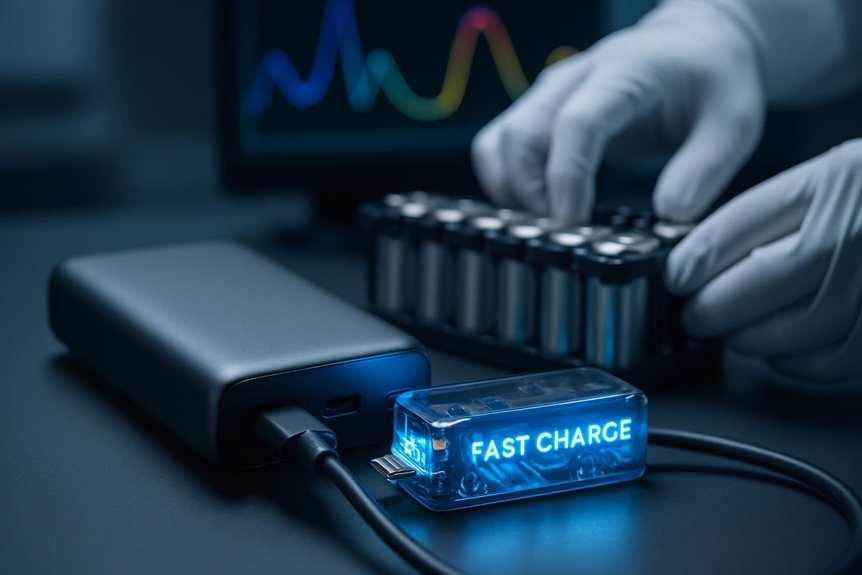
Fast-charging performance in Li-ion chemistries hinges on the tradeoffs between ionic mobility, electrode architecture, and thermal management. We compare practical mechanisms that enable rapid charge without compromising safety or cycle life, focusing on observable metrics and quantifiable constraints. In this overview, we examine how surface charge distribution at interfaces modulates charge transfer resistance and diffusion pathways, influencing initial voltage sag and charging efficiency. Electrode kinetics govern reaction rates at the active material–electrolyte boundary, dictating current acceptance under high-rate protocols. We emphasize measurable bounds: typical C-rates, temperature rise limits, and pressure safeguards that constrain fast-charging adoption. Our assessment remains material-agnostic, prioritizing verifiable data from impedance spectroscopy, in-situ studies, and standardized tests to predict real-world performance across common Li-ion chemistries.
How Chemistry Sets the Speed: Battery Charge Rates and Limits
How does chemistry dictate how fast we can charge a battery, and where are the practical ceilings? We quantify charge rates via C-rates, voltage windows, and internal resistance. Li-ion chemistries differ in ion diffusion, electrode aging, and SEI formation, which cap fast charging at specific limits. We balance energy throughput against heat generation, voltage sag, and cycle life to define safe, reproducible rates. In practice, chargers target predefined end-of-charge voltages and taper currents to protect chemistry, materials, and safety. We present a compact comparison below to illustrate expected ranges, risk controls, and performance envelopes.
| Chemistry | Max C-rate (approx.) | Typical Voltage Window |
|---|---|---|
| NMC | 1–3C | 3.7–4.2 V |
| LFP | 1–2C | 3.2–3.6 V |
| NCA | 1–2.5C | 3.6–4.2 V |
Temperature and C-Rate: What Really Accelerates or Slows Charging
We examine how temperature and C-rates interact to set charge speed, noting that each 10°C rise can noticeably alter Li-ion kinetics and the practical upper limit of charging current. We quantify heat generation, electrolyte viscosity, and SEI stability to explain why higher C-rates don’t always translate to faster charging, especially as overcharge risk and capacity fade rise with temperature. By linking measured impedance, temperature rise, and charging curves, we provide a framework readers can use to compare chemistries and charging schemes rigorously.
Temperature Impact On Charging
Temperature strongly shapes charging dynamics, as temperature changes alter lithium-ion reaction kinetics, internal resistance, and electrolyte stability, thereby shifting optimal C-rates and energy efficiency. We observe measurable temperature effects on several metrics: charge time, delivered energy, and cycle life. Elevated temperatures generally reduce electrolyte viscosity, lower charge-transfer resistance, and increase diffusion rates, which can boost short-term fast charging performance but risk insulation degradation and gas formation. Conversely, low temperatures raise impedance, slow interfacial reactions, and decrease reversible capacity, reducing practical C-rates and increasing energy losses. Quantitatively, impedance can rise by tens of percent or more below 0 °C, while near 40 °C, rate constants can improve by notable margins before thermal runaway risk escalates. Across chemistries, optimal fast charging strategies must balance temperature, safety margins, and efficiency to minimize temperature effects.
C-Rate And Charge Speed
What actually governs charging speed when C-rate changes, and how do temperature and chemistry interact to speed or slow the process? We quantify charging rate as C-rate relative to nominal capacity, noting that higher C-rates yield shorter practical charge times but elevate overpotential, polarization losses, and heat generation. The interdependencies are systematic: at a fixed electrolyte and electrode chemistry, charging time scales inversely with C-rate, yet efficiency declines beyond a material-specific optimum due to increased internal resistance and side reactions. Temperature moderates these effects: elevated temperatures reduce resistance and bolster ion mobility, but excessive heat accelerates degradation and safety risks. Fast charging requires precise thermal management to maintain nominal temperature bands, preserving kinetics while limiting thermal runaway risk. Overall, chemistry defines limits; thermal management enables approaching them safely.
Speed, Efficiency, and Longevity: Trade-Offs by Chemistry
We compare fast-charge performance across chemistries by examining trade-offs among speed, efficiency, and longevity, quantifying how higher C-rates affect capacity retention and heat generation. We observe that faster charging often increases rate losses and reduces cycle life, while lower losses improve longevity but slow overall charging; these effects vary by chemistry, electrolyte formulation, and thermal management. By framing these trade-offs with concrete metrics—C-rate, coulombic efficiency, and cycle degradation—we enable a precise, comparative discussion for readers evaluating fast-charging options.
Fast-Charge Trade-Offs
Fast charging involves trade-offs among speed, efficiency, and long-term durability that vary by chemistry. We present quantitative observations across chemistries, focusing on speed limits, energy losses, and cycle-wide health. Fast charge myths often oversimplify outcomes; real benefits depend on impedance, thermal management, and decomposition pathways. Safety considerations remain paramount: overheating thresholds, oxide stability, and electrolyte vulnerability constrain allowable C-rates. Efficiency losses rise with higher currents, while longevity shows nonlinear degradation curves under aggressive charging. We quantify trade-offs with normalized metrics: charge time, coulombic efficiency, and capacity fade per 1000 cycles. Below, a compact matrix contrasts speed versus efficiency across representative chemistries, guiding practical choices. Table illustrates pairs of fast-charge implications for decision-making.
| Speed Emphasis | Efficiency/Durability Impacts |
|---|---|
| High C-rate, LiFePO4 | Moderate losses, good cycle life |
| Moderate C-rate, NMC | Higher efficiency, balanced life |
| Ultra-fast, Li-S | Significant degradation risk |
Rate Capability Variances
Rate capability varies systematically across chemistries because current, voltage, and thermal responses diverge under fast charging. We compare three metrics: charge cycles, energy density, and recharge speed. Lithium iron phosphate delivers high cycle life and stable voltage, but lower energy density, which modestly limits fast-charging energy throughput. NMC-type chemistries offer higher energy density, yet exhibit greater polarization at high current, reducing effective rate in practice. Lithium cobalt oxide achieves rapid surface-limited charging, yet suffers from accelerated degradation and safety concerns under aggressive profiles. Solid-state options promise improved thermal management, enabling sustained high C-rates with less voltage sag, though real-world cyclability and temperature rise remain critical. Overall, rate capability reflects trade-offs among kinetic pathways, impedance growth, and thermal mitigation, influencing how battery packs perform across varying duty cycles and energy density requirements.
Longevity vs Power Loss
How do chemistry choices trade longevity for power loss in fast charging scenarios? We quantify trade-offs by considering cycle life vs. C-rate, internal resistance, and thermal load. Fast chemistry, such as high-Ni NMC or certain LFP variants, typically delivers higher current but sacrifices calendar and cycle life at elevated temperatures. We model capacity fade as a function of depth of discharge, state of charge window, and peak temperature, then separate radiative and ohmic losses to estimate efficiency drop. Heat management directly alters degradation rates: effective cooling reduces impedance growth and extends cycles under high C-rates. Across chemistries, a 10–20°C reduction in hotspot temperature can improve lifetime by 20–40% while maintaining appreciable fast charging. Net: faster charging comes with measurable longevity penalties unless heat management mitigates them.
Real-World Scenarios: Which Chemistry Fits Phones, E-Bikes, and EVs?
Real-world usage demands that each application—phones, e‑bikes, and EVs—aligns its chemistry with constraints like energy density, cycle life, safety, and charging infrastructure. We assess tradeoffs using concrete metrics: gravimetric energy density (Wh/kg), cycle life, C-rate tolerance, and thermal stability. Phones prioritize high energy density and fast but safe charging under compact packaging, accepting modest cycle life. E‑bikes demand robust cycle life, moderate energy density, and wide thermal margins for sustained high-current charging. EVs require the strongest cycle life, scalable manufacturing costs, and rigorous battery safety standards to manage large modules. Differences in fast-charging capability, degradation under high C-rates, and thermal management drive selection. In all cases, battery safety and manufacturing costs shape feasible trajectories and lifecycle economics.
A Practical Framework to Pick the Right Chemistry for Speed
Fast charging is a systems problem, not a single chemistry issue, so we start with a practical framework that translates target speed into actionable chemistry choices. We define metrics: C-rate, round-trip efficiency, thermal rise, and charging endurance. We map these to chemistries by energy density, internal resistance, and electrode kinetics, then quantify battery safety margins and thermal management needs. We compare production costs, capital expenditure for fast chargers, and supply-chain risk, grinding decisions to a scorecard. We require clear constraints: maximum allowable heat, safe degradation limits, and achievable cycle life under fast charge. We finally prioritize chemistries that meet speed targets while controlling cost and risk. In practice, a transparent trade-off analysis guides selection, ensuring reliability, safety, and scalable manufacturing.
Frequently Asked Questions
Do Fast-Charging Chemistries Require Special Chargers or Adapters?
Yes, fast-charging chemistries often require special chargers or adapters. We assess fast charging safety and charger compatibility, measuring voltages, currents, and communication protocols to ensure safe, efficient charging without damaging cells or reducing cycle life.
Which Lithium Chemistries Handle High C-Rates Best Long-Term?
We believe lithium iron phosphate and nickel-rich chemistries handle high C-rates best long-term, though fast charging limitations and thermal management become critical factors we quantify via cycle life, impedance rise, and safe-temp thresholds in real-world usage.
How Do Aging and Cycle Life Affect Fast Charging Performance?
Fast charging durability degrades with aging and limited cycle life, reducing achievable C-rates over time. We quantify losses and define thresholds; thermal management considerations remain critical to preserve performance during aging, influencing safe fast charging and cycle life projections.
Are There Safety Risks Unique to Ultra-Fast Charging Chemistries?
We’ve found that ultra-fast chemistries can trigger higher thermal stress, with a 15–25% efficiency drop at peak rates. Are there safety risks unique to ultra-fast charging chemistries? Yes, demanding careful management of fast charging myths and safety incentives.
What Are Cost and Availability Implications of Fast-Charge Chemistries?
We’ll answer the cost and availability implications: fast-charge chemistries show cost volatility driven by raw materials and manufacturing scaling, and supply chain constraints; we estimate higher upfront capex, but potential long-term savings offset by battery degradation and normalization.
Conclusion
We’ve got the data, and it’s painfully clear: faster charging isn’t free. Nickel-rich NMC/NCA edges ahead on C-rates around 1–3C with 3.6–4.2V windows, while LFP stays cooler but slower to deliver energy. Solid-state promises, then penalties—cost, heat, interface resistance. So, we pick by use: phones lean fast, e-bikes push heat budgets, EVs chase holistic temps and durability. In short, chemistry specs guide speed, but thermal and impedance realities govern the finish line. Ironically, speed rides heat.