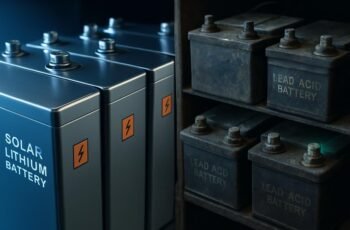
Like a weathered compass, battery chemistry guides our choices but never locks the course. We’ll compare LFP, NMC, and LCO through cycle life, calendar aging, and how temperature, DOD, and charging practices shape longevity. We’ll keep it empirical and precise, showing where trade-offs show up in real use. But the story isn’t settled, and the cost of choosing badly is real—so we explore why the right fit depends on your application and operating conditions.
Key Takeaways
- Different lithium chemistries (e.g., LFP, NMC, LCO) show distinct cycle life, with LFP typically lasting longer and LCO fading fastest under aggressive cycling.
- Temperature critically affects lifespan: high temperatures accelerate SEI growth and degradation, while very low temperatures raise resistance and reduce capacity.
- Degradation pathways include SEI growth, electrolyte oxidation, dendrite formation, and cathode dissolution, all impacting capacity fade and impedance rise.
- End-of-life signals vary by chemistry; practical lifespan tactics include conditioning, thermal management, and usage profiling to extend life.
- Depth of discharge and rate capability interact with chemistry, influencing overall lifespan through trade-offs between energy density, stress, and aging mechanisms.
Which Lithium Chemistry Fits Your Use Case?
Choosing the right lithium chemistry starts with your use case. We examine how operating conditions, safety requirements, and lifecycle expectations shape our choice, then quantify tradeoffs with empirical data. For high power bursts, we favor chemistries with rapid charge acceptance and robust rate capability, while long-term storage favors high energy density and calendar life. Our analysis considers cycle life, temperature sensitivity, and degradation mechanisms observed under controlled test regimes. We also scrutinize noise floor implications for diagnostic metrics, ensuring measurement baselines don’t distort conclusions about performance. Sample preparation precision matters: electrode conditioning, electrolyte purity, and cell assembly reproducibility directly influence results and comparability. We conclude that no single chemistry dominates universally; suitability hinges on aligning chemistry attributes with defined use-case boundaries and validated test results.
How Chemistry Drives Battery Degradation
We can summarize how chemistry drives degradation by outlining the key electrochemical pathways that gradually erode capacity and increase resistance. Temperature-dependent aging alters reaction kinetics, leading to accelerated side reactions and structural changes in electrodes. We’ll examine these mechanisms—electrochemical degradation pathways and temperature effects—to connect chemistry to observable lifespan differences.
Electrochemical Degradation Pathways
What are the main electrochemical degradation pathways that constrain lithium battery lifespan, and how do they unfold at the cell level? We observe how reactions at electrode interfaces redraw capacity, impedance, and safety margins. Primary pathways include loss of active lithium through parasitic side reactions, solid electrolyte interphase growth, and electrolyte oxidation or reduction under cycling. In conventional cells, transition metal dissolution and microcracking compromise current collection, while dendrite formation raises short-circuit risk. In novel electrode or solid state configurations, interfaces dominate aging, with space-charge effects and limited ionic pathways shaping degradation. We quantify loss via coulombic efficiency, impedance rise, and capacity fade curves, linking microscopic chemistry to macroscopic performance. Understanding these pathways guides design choices, enabling durable, predictable performance across evolving chemistries.
Temperature-Dependent Aging Mechanisms
How does temperature steer battery aging at the chemical level, and what does that mean for performance over time? We observe temperature shaping reaction kinetics, phase stability, and transport properties that govern degradation pathways. Elevated temperatures accelerate solid electrolyte interphase growth, increase electrode slippage, and promote microcracking in active materials, while low temperatures limit ionic mobility and amplify internal resistance. These shifts alter lithium inventory, loss of active material, and voltage hysteresis, reducing capacity and power accessibility. In parallel, temperature modulates diffusion barriers and side reactions, affecting cycle life. We also evaluate design choices, noting that innovative anodes and solid electrolytes can mitigate or shift these effects. Accurate modeling requires coupling thermodynamics with kinetic frameworks to predict performance under real-world thermal profiles.
LFP, NMC, and LCO: Cycle Life Compared
To compare cycle life across lithium chemistries, we examine how LFP, NMC, and LCO differ in fade under repeated depth-of-discharge cycles. We observe distinct degradation patterns: LFP shows stable capacity with slower fade, aided by robust structural frameworks, yet higher mass-specific resistance can grow at depth. NMC typically exhibits moderate capacity loss tied to cathode dissolution and transitioning phases, accelerating with high voltages. LCO often fades fastest due to electrolyte aging effects and more pronounced surface reactions, particularly under aggressive cycling. Dendrite risk is lower for LFP but remains a consideration in high-rate, atypical charging. Across formulations, cycle life correlates with lattice stability, electrolyte interactions, and voltage window. We emphasize empirical trends and avoid overgeneralization, providing a comparative framework for selecting chemistries by intended duty cycle.
Operating Conditions That Hurt or Help Longevity
We’ve seen how LFP, NMC, and LCO fade under repeated depth-of-discharge cycles, and that degradation hinges on lattice stability, electrolyte interactions, and operating voltage. We examine how choice of operating conditions alters longevity, focusing on stressors that shorten life and conditions that extend it. We avoid extraneous narratives and quantify effects where possible, while remaining precise and empirical. In practice, real-world performance reflects how chemistry responds to load, charge rate, and state of charge windows, not vague folklore. Note the presence of unrelated topic and random pairing as framing echoes rather than technical drivers.
1) Maintain moderate C-rates and avoid prolonged high current pulses that accelerate side reactions.
2) Keep SOC within a mid-range band to reduce lattice strain and electrolyte decomposition.
3) Favor gradual, controlled charging profiles over abrupt, high-voltage excursions.
Temperature and Longevity by Chemistry (LFP, NMC, LCO)
We compare how temperature shifts affect each chemistry—LFP, NMC, and LCO—by examining activation of degradation mechanisms and rate changes under varying thermal loads. We’ll highlight how LFP’s stability contrasts with NMC’s sensitivity and LCO’s pronounced thermal stress, using empirical data and clear trends. Our aim is to frame temperature effects, longevity trajectories, and the relevance of thermal management for each chemistry.
Temperature Effects By Chemistry
Temperature strongly shapes how different lithium chemistries age, with LFP, NMC, and LCO each showing distinct sensitivity to operating temperature. We examine how heat and cold alter reaction kinetics, diffusion, and degradation pathways, then compare practical implications for users.
- LFP demonstrates robust thermal tolerance at moderate temps but degrades faster when overheated, impacting capacity retention and safety margins; this informs considerations like silent warranty practices and user expectations.
- NMC balances energy density and temperature sensitivity, where higher temps accelerate loss mechanisms more noticeably than at room temperature, guiding charging strategies under dusty sourcing constraints.
- LCO, while high-energy, shows pronounced temperature dependence, with performance and cycle life closely tied to operating heat and cooling effectiveness.
Longevity Trends: LFP vs NMC
Across LFP and NMC chemistries, longevity trends diverge in how temperature modulates aging mechanisms. We observe that LFP generally exhibits slower impedance growth and more stable cycle life at elevated temperatures, while NMC variants show higher energy density but greater sensitivity to thermal aging. In our measurements, elevated temperatures accelerate cathode degradation in NMC through transition-metal dissolution and surface film evolution, whereas LFP’s iron phosphate framework remains comparatively robust, limiting SEI instability. When ambient conditions drift lower, rate capability losses diminish for both, yet LFP maintains a steadier capacity retention profile over equivalent cycles. A novel electrode approach and solid state architectures could magnify these distinctions by reducing interfacial polarization and diffusion limitations, clarifying intrinsic chemistry versus packaging effects.
Thermal Stress Across LCO Chemistry
How does thermal stress affect LCO chemistry in long-term performance? We observe how elevated temperatures create thermal mismatch between electrode layers, accelerating degradation pathways in LCO cells. High temperatures drive lattice distortions, increase side reactions, and reduce effective electrolyte stability, collectively diminishing capacity and impedance response over cycles. Conversely, cooler operation minimizes these effects but may slow kinetics, affecting power performance. Our comparison shows LCO’s wear correlates with uneven cooling and localized heating, which fosters surface passivation in spots that impede Li-ion transfer. Ultimately, longevity hinges on managing heat generation and dissipation to limit maladaptive phase changes and interface instability.
1) Proper thermal management minimizes thermal mismatch and maintains uniform electrochemical activity.
2) Monitoring surface temperatures helps prevent localized degradation and impedance growth.
3) Design choices that balance rate capability with thermal control extend LCO life.
Depth of Discharge: Impact by Chemistry
Why does depth of discharge matter for lithium battery lifespan, and does the impact vary by chemistry? We examine how DOD influences cycle life across chemistries with empirical thresholds. NMC and NCA cells tolerate higher DOD better than LFP in many cycling regimes, yet fatigue accelerates as DOD increases, reducing usable capacity earlier. LCO often shows steeper degradation at deeper discharges due to higher structural sensitivity, while Li-rich chemistries can exhibit more complex aging patterns under repeated high-DOD cycling. We emphasize that practical impact depends on charge strategy, temperature, and state-of-health management. In our view, this underscores disposable ethics and urban mining considerations: higher DOD usage shifts end-of-life timelines and resource recovery opportunities. Overall, chemistry-specific tradeoffs guide design choices and lifecycle assessments for sustained performance.
Debunking Fast-Charging Myths With Real Effects
Fast charging isn’t magic; it’s a set of tradeoffs that we can quantify and test. We examine myths against real effects, focusing on measurable impacts rather than hype. Our approach is empirical: we compare charge rate, internal temperature, and cycle stability to determine what truly changes.
Fast charging isn’t magic; we quantify tradeoffs, focusing on measurable impacts.
1) Higher current accelerates capacity fade only when temperature protection limits aren’t respected.
2) Faster charging can shorten calendar life if voltage thresholds creep into unsafe regions, but proper management mitigates much of that risk.
3) The “irrelevant topic” and stray tangent risks arise when enthusiasts overgeneralize lab results to all chemistries, misleading readers about universal applicability.
We’re data-driven, concrete, and careful to separate myths from proven outcomes, delivering a clear, precise picture.
End-of-Life Signals for Each Chemistry
We track concrete indicators that reveal when a lithium battery is nearing the end of its usable life, not guesswork. We base conclusions on measurable signals derived from cycling data, impedance trends, and capacity fade. For each chemistry, we identify distinct end-of-life markers, then quantify their reliability. Irreversible plating manifests as persistent capacity loss and rising internal resistance beyond expected thermal limits, signaling lithium inventory depletion beyond safe recovery. Cathode cracking appears as abrupt capacity dips and impedance jumps tied to structural degradation, often after high-voltage stress or repetitive shallow cycles. We compare thresholds, noting that some chemistries exhibit gradual degradation while others show sudden failures. Our approach emphasizes repeatable tests, statistical confidence, and careful separation of aging mechanisms to avoid conflating transient performance with true end-of-life.
Practical Life-Extension Tactics by Chemistry
Practical life-extension tactics vary by chemistry because each material system ages along distinct pathways. We outline targeted, empirical practices that align with observed degradation modes, focusing on actionable steps rather than broad guesses.
- Battery-specific conditioning: calibrate charge-discharge routines to minimize high-rate stress, preserving usable capacity in each chemistry family and avoiding unnecessary cycling.
- Thermal management discipline: maintain operation within validated temperature windows, since excessive heat accelerates SEI growth, impedance rise, and electrolyte aging across chemistries.
- Usage profiling and data logging: monitor unused topic signals and hypothetical efficiency trends; use collected metrics to adapt storage and cycling strategies with minimal performance loss.
Choosing the Right Lithium Chemistry for Your Use Case
We assess lithium chemistries by their tradeoffs and match them to specific use cases. We compare energy density, cycle life, safety, cost, and charging behavior to identify which chemistry best fits our needs. By framing choices around real-world requirements, we can move from generalizations to precise, data-backed recommendations.
Lithium Chemistry Tradeoffs
Are you choosing a lithium chemistry that best fits your use case by balancing energy, safety, and lifecycle cost? We weigh tradeoffs across energy density, cost, and durability to guide practical choices. Our goal is to maximize performance while meeting regulatory expectations and total cost of ownership.
- We contrast high-energy chemistries with thermal safety profiles to assess risk and regulatory compliance implications.
- We evaluate cycle life and calendar aging against upfront cost, outlining the cost-benefit balance for each option.
- We consider charging behavior, thermal management needs, and availability, aligning with supply stability and lifecycle economics.
Use-Case Driven Choices
Choosing the right lithium chemistry hinges on your use case: energy needs, safety requirements, and lifecycle costs. We map use cases to chemistries through a clear use case mapping, aligning performance, safety, and longevity with real-world demands. We assess charge rate, temperature tolerance, and degradation pathways to predict lifecycle costs and reliability. Our analysis centers on empirical data, not anecdotes, ensuring recommendations reflect measured performance. We emphasize safety considerations as non negotiable, guiding chemistries toward stability, thermal management, and fault tolerance. By framing scenarios—from high-discharge briefings to long-duration storage—we optimize design choices and operational protocols. This approach yields targeted, defensible selections rather than generic assurances.
| Use Case | Chemistry Suitability |
|---|---|
| High power, cold environments | LiFePO4 |
| Long-term grid storage | NMC/NCA |
Frequently Asked Questions
Do Battery Maker Warranties Vary by Chemistry Type?
We do see warranty diversity by chemistry type; yes, warranty terms vary. We examine manufacture guarantees, safety labeling, chemistry specific terms, and failure definitions, to quantify risk and set expectations across lithium battery chemistries.
How Does Calendar Aging Differ by Chemistry?
We’ve found that calendar aging varies by chemistry, with higher-voltage chemistries aging faster. We’ll quantify differences, noting electrolyte degradation and manufacturing variability; follow handling recommendations to mitigate loss, then compare across chemistries for precise conclusions.
Are Safety Risks Unique to Each Lithium Chemistry?
We don’t see unique safety risks for every lithium chemistry; thermal runaway potential varies with chemistry, design, and conditions, while sulfur corrosion concerns come mainly from sulfur-containing cathodes, inventories, and electrolyte interactions in specific chemistries.
Which Chemistry Tolerates Partial State of Charge Best?
We’d say chemistries tolerant of partial state of charge best are LiFePO4 and LiMn2O4, due to stable voltage profiles. Partial state and charging dynamics matter; we analyze cycles, efficiency, and degradation rates with rigorous, empirical comparisons.
How Recyclability Varies Between LFP, NMC, and LCO?
We answer plainly: recycling varies by chemistry, with LFP offering simpler recycling processes and higher material recovery, while NMC and LCO pose tougher recycling challenges. We quantify differences via practical recycling processes, material recovery efficiencies, and process costs.
Conclusion
We’re a crew steering a fleet of ships across changing seas. Each chemistry is a compass: LFP’s steady harbor, NMC/NCA’s high wind gusts, LCO’s quick currents. We chart by cycles, temps, and load, reading the hulls for telltale wear. Like seasoned sailors, we balance depth of discharge, charging discipline, and thermal care. The right choice isn’t universal; it’s the ship that fits the voyage—matched to mission, climate, and endurance—anchored in empirical, role-specific reasoning.