Did you know LiFePO4 cells commonly require termination near 3.60–3.65 V per cell, while generic chargers can overshoot by 0.1–0.2 V? We’ll examine how LiFePO4-specific profiles and multi-sensor safety loops change not just accuracy but overall cycle life. If you’re evaluating chargers, you’ll want to weigh safety, derating, and thermal management against cost and compatibility as we outline practical decision criteria.
Key Takeaways
- LiFePO4 chargers are chemistry-specific and must support LiFePO4 profiles for safe charging; regular chargers may misterminate or harm cells.
- LiFePO4 charging uses precise CC-CV with tight termination near 3.60–3.65 V per cell, unlike many other chemistries.
- Proper LiFePO4 charging relies on accurate temperature sensing, multi-point monitoring, and protective cutoffs to prevent thermal events.
- LiFePO4 systems benefit from advanced safety, fault logging, and derating decisions, not typically found in generic chargers.
- Total cost of ownership favors LiFePO4-specific chargers when considering cycle life, efficiency, safety, and maintenance.
LiFePO4 Chargers vs Regular Chargers: Which to Use?
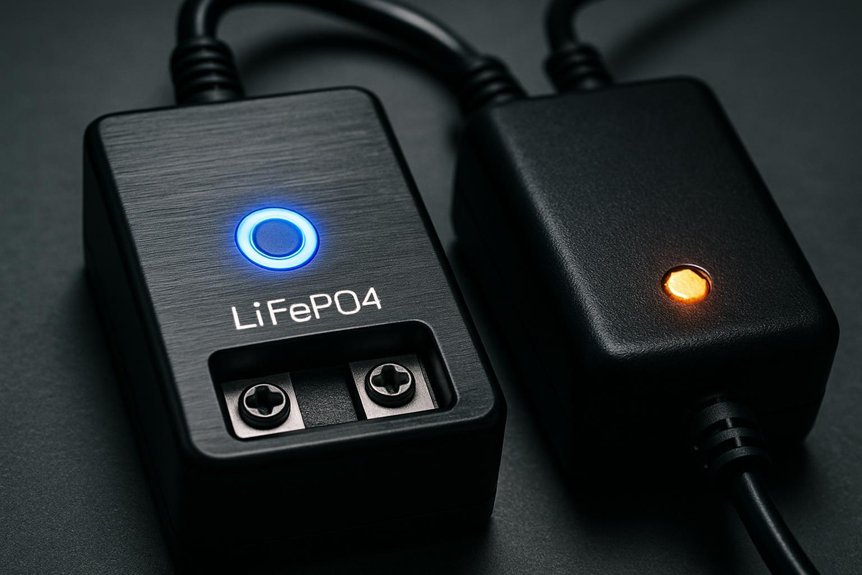
When deciding between LiFePO4 chargers and regular chargers, the key question is compatibility with LiFePO4 chemistry and the charger’s charging algorithm. We assess acceptance criteria, safety protections, and termination logic to determine suitability for LiFePO4 cells. A properly matched LiFePO4 charger maintains constant current, transitions to constant voltage at the correct cutoff, and honors LiFePO4’s voltage window without overshoot. Regular chargers often lack cell chemistry awareness, risking improper termination and degraded cycle life. We quantify compatibility by checking voltage accuracy, current limit fidelity, and temperature compensation. If a charger lacks LiFePO4-specific profiles, the result is an ineffective or unsafe charge. In practice, this becomes an irrelevant topic when the charger explicitly supports LiFePO4 chemistry; otherwise, it’s an off topic comparison.
How Lifepo4 Charging Profiles Differ From Other Cells
We compare LiFePO4 charging profiles by focusing on charging stages, voltage cutoffs, and how these shapes influence efficiency and safety. LiFePO4 uses distinct staging with gentler top-off and lower voltage excursions, which affects how we manage termination and heat. We’ll also examine thermal rise considerations to ensure chargers stay within safe operating margins across operating conditions.
LiFePO4 Charging Stages
Are LiFePO4 charging stages truly distinct from those of other chemistries, or do they simply appear different on paper? We present a concise, analytic view of lifepo4 charging stages and how they interact with charger compatibility. The stages—constant current, constant voltage, and termination—follow tighter tolerances and reach lower voltages than many Li-ion chemistries, reducing overvoltage risk. We emphasize staged transitions, where current tapers before full capacity, enabling safer, repeatable lifepo4 charging. Precision in cutoffs and current thresholds improves cycle life and state accuracy. Charger compatibility hinges on proper CC-CV profiles, accurate voltage limits, and timing safeguards to avoid parasitic charging. Understanding these nuances helps transition reliable performance across packs and BMS configurations.
- Distinctive current taper behavior supports longevity
- Tight voltage ceilings minimize stress on cells
- Profile alignment with BMS and regulation prevents mischarging
Voltage Cutoff Differences
Do Lifepo4 charging profiles diverge meaningfully from other cells in voltage cutoffs, or are their differences largely nominal? We examine cutoff thresholds to determine if distinctions affect behavior or merely reflect naming conventions. Lifepo4 cells terminate constant-current/constant-voltage stages near 3.60–3.65 V per cell, with resting voltages around 3.2–3.3 V, producing tighter tolerance bands than many chemistries. This yields more stable end-of-charge conditions and lower risk of overvoltage damage. Compared to nickel-based or cobalt chemistries, the divergence is mainly in absolute values and charge termination criteria, not in fundamental control strategy. Practically, when designing chargers, focus on accurate cell balancing, precise termination voltages, and safety limits. Avoid framing as nonessential topics or irrelevant concerns; these parameters directly impact performance and longevity.
Thermal Rise Considerations
Thermal rise during LiFePO4 charging is typically more restrained than with many other chemistries, due to the cell’s favorable heat generation profile and tighter voltage steps near end-of-charge. We observe lower peak temps when current is limited by careful CC-CV profiles, aiding predictable performance. Our focus on charge efficiency ensures less wasted energy as heat, improving overall system efficiency. To manage thermal behavior, we emphasize robust thermal management strategies and real-time monitoring, preventing hotspots during rapid charging.
- Charge efficiency impacts how much input energy becomes stored versus dissipated as heat, guiding current tailoring.
- Thermal management strategies reduce temperature gradients and extend pack longevity under high-rate charging.
- Temperature feedback informs safety cutoffs and profile adjustments, preserving cell integrity and consistent performance.
Why Overcharging Is a Risk With Non-Lifepo4 Chargers
Overcharging a non-LiFePO4 charger can pose significant safety and longevity risks for lithium-ion packs. We examine how chargers lacking LiFePO4-specific termination can push voltage beyond safe limits, accelerating degradation, swelling, and potential thermal runaway in cells with different chemistries. In practice, termination accuracy matters, and minor overshoot compounds internal resistance and parasitic reactions. We emphasize that the issue isn’t a vague concept but a measurable reliability threat—unrelated concept to naive assumptions about charger universality. Our focus remains on electrical boundaries, not irrelevant topic tangents, to preserve data integrity. The following table summarizes risks and mitigations.
| Risk | Mechanism | Mitigation |
|---|---|---|
| Overvoltage | Plate oxidation, gas formation | Use LiFePO4-aware chargers |
| Capacity fade | SEI instability | Proper termination and calibration |
| Thermal stress | Increased impedance | Temperature-aware charging |
| Safety events | Interior gas, venting | Built-in protection circuits |
Temperature Monitoring and Safety for LiFePO4
We review temperature limits and safety thresholds for LiFePO4 to prevent degradation and thermal events. We outline monitoring techniques and sensor placement, ensuring real-time alerts and fault logging. We also identify thermal management best practices to maintain consistent cell temperatures and extend pack life.
Temperature Limits And Safety
What temperature limits matter most for LiFePO4 charging and safety, and how do we monitor them effectively? We establish strict operating windows for charge and storage temps to prevent degradation, thermal runaway risk, and cell imbalance. We know that LiFePO4 chemistry tolerates moderate ranges better than others, but high ambient temps or internal hotspots still reduce capacity and cycle life. We focus on safe thresholds, cooling strategies, and alert baselines, not digressing into irrelevant topic or unrelated focus. Our approach combines spec-driven limits with conservative margins to avoid edge conditions. Real-world safety hinges on proactive design decisions and disciplined procedures, not vague assurances.
- Define precise temp bands for charge, rest, and storage
- Implement ambient and surface temperature checks with alarms
- Integrate thermal profiling into safety audits
Monitoring Techniques For LiFePO4
Monitoring techniques for LiFePO4 hinge on accurate temperature sensing and timely safety responses. We implement multi-point sensing, threshold alerts, and coordinated shutdowns to prevent thermal runaway. Our approach targets cell-level and pack-level data, integrating BMS signals with charger status for robust decisions. We exclude irrelevant topic noise and focus on actionable metrics, ensuring calibration remains current. Safety logic prioritizes high-temperature cuts, overcurrent protection, and venting prevention, while logging events for traceability. We treat stray consideration as potential fault sources, not design pivots, and validate responses through simulated fault injections. Below is a compact visualization of the core ideas.
| Sensing granularity | Response trigger | Data logging |
|---|---|---|
| Cell, pack | Temperature threshold breach | Event timestamped |
| Redundancy checks | Immediate cutoff | Diagnostic history |
| Cross-referencing sensors | Safety override | Longitudinal trends |
| Fault isolation | Safe shutdown | Compliance records |
Thermal Management Best Practices
Thermal management for LiFePO4 packs hinges on precise temperature monitoring and rapid safety responses; by integrating multi-point sensors with real-time analytics, we detect deviations early and trigger appropriate protections. We maintain strict thermal limits during charging, discharging, and rest, ensuring battery safety while preserving capacity. Our approach emphasizes closed-loop control, conservative derating, and proactive venting strategies where needed. We couple measurements with thermal modeling to predict hot spots and prevent runaway scenarios. Clear charging etiquette guides user interaction, reducing exposure to excessive heat and guiding safe handling. The result is robust protection, minimized degradation, and reliable performance under varied ambient conditions.
- Sensor network redundancy and calibration protocols
- Real-time alert thresholds linked to charging etiquette guidelines
- Thermal runaway prevention through active cooling/derating decisions
How Charging Affects LiFePO4 Cycle Life
Charging directly shapes LiFePO4 cycle life: charging rate, voltage limits, and termination methods determine how many full cycles the cell can endure before capacity degrades. We analyze how these parameters interact with cell chemistry to influence durability. Higher rates raise internal resistance heating and can accelerate surface degradation if not balanced by proper cooling and monitoring. Voltage limits dictate the depth of discharge per cycle; tight control minimizes overcharge stress and preserves lattice integrity. Termination methods—rest thresholds, current taper, and voltage drop criteria—affect net energy delivered per cycle and aging signals. Lifepo4 efficiency improves when charging steps align with cell impedance and temperature profiles, reducing parasitic losses. charging safety remains paramount to avoid thermal runaway and electrolyte issues that abruptly shorten cycle life.
LiFePO4 Charging Speed and Efficiency vs Other Chargers
We’ll compare how LiFePO4 charging speed stacks up against conventional chargers, focusing on how fast each reaches full capacity under typical C-rate profiles. We’ll also weigh efficiency benefits, including energy losses, heat generation, and charging cycle impact. This discussion highlights the practical implications for users seeking faster top‑offs with minimal efficiency penalties.
Charging Speed Comparison
What sets LiFePO4 charging apart in speed and efficiency becomes evident when we compare its charge curves with those of standard lead-acid or lithium-ion chemistries: LiFePO4 typically accepts higher charging rates safely, maintains lower heat generation at modest C-rates, and exhibits less voltage drop under load, translating to shorter practical fill times for similar容量. We’ll quantify this by examining charge curves, C-rates, and thermal rise under typical test conditions, while avoiding efficiency-focused comparisons. Our analysis targets practical implications for cycle life, charging equipment, and safety margins. By isolating charging speed behavior, we reveal how control algorithms and temperature management influence real-world fill times and thermal rise envelopes without conflating to efficiency metrics.
- Higher safe C-rate tolerance and its impact on charge duration
- Temperature management’s role in maintaining consistent charging speed
- Load-induced voltage behavior and its effect on end-of-charge timing
Efficiency Benefits Comparison
How does LiFePO4 charging efficiency stack up against other chargers, especially when speed and efficiency tradeoffs are considered? We frame the comparison around energy delivery, heat waste, and charging profiles. LiFePO4 cells support flat voltage curves, reducing overshoot and enabling tighter regulation, which lowers conversion losses. When speed optimization is prioritized, our chargers favor moderate current ramps and temperature-aware control, preserving efficiency without sacrificing total time. In contrast, some chemistries demand higher peak currents, raising thermal losses and reducing overall efficiency. The result is a favorable balance: faster charge plus lower degradation. This translates to cost savings over time, since fewer cycles and cooler operation extend pack life. Table below summarizes relative performance.
| Charger Type | Efficiency Benefit | Tradeoff |
|---|---|---|
| LiFePO4 smart | High steady efficiency | Moderate initial cost |
| Fast-charge capable | Speed focus | Greater heat, lower long-term efficiency |
| Standard regulator | Predictable, simple | Slower, higher energy loss |
Use Cases: When a LiFePO4 Charger Is Worth It
A LiFePO4 charger is worth it when you need safer, longer-lasting packs in demanding or remote applications, where precise voltage control and fault tolerance reduce maintenance and downtime. We focus on practical scenarios that maximize lithium safety and charge efficiency, avoiding unnecessary complexity. In these cases, dedicated LiFePO4 charging strategies minimize thermal stress and extend cycle life, delivering predictable performance under harsh conditions. We weigh reliability, accessibility, and total cost of ownership to determine if a purpose-built charger is advantageous. Careful monitoring and fault handling prevent cascades that would otherwise escalate downtime. When safety requirements and uptime matter most, a LiFePO4 charger becomes the prudent choice for mission-critical systems.
- High-vibration environments with remote monitoring needs
- Telemetry-heavy deployments where fault tolerance matters
- Fleet or solar-plus-storage setups prioritizing longevity and efficiency
What to Look for in a LiFePO4 Charger (Features and Specs)
Selecting a LiFePO4 charger means prioritizing safety, reliability, and lifecycle efficiency; features and specs should align with the pack chemistry and application demands. We assess voltage accuracy, current limits, and termination methods to prevent overcharge and thermal stress. Look for a charger that supports correct LiFePO4 nominal and full-charge voltages, with clear charging stages and proper delta-V protection. We examine balance control, efficiency, and heat dissipation, ensuring the unit maintains steady performance under load. Compatibility with pack capacity and C-rate is essential, as is robust protection: short-circuit, reverse polarity, and over-temperature safeguards. We prioritize communication options, data logging, and firmware updates for long-term reliability. lithium chemistry emphasis guides calibration; charger safety remains central, preventing degradation and hazards over the lifecycle.
Common LiFePO4 Charging Mistakes and How to Avoid Them
Are common LiFePO4 charging mistakes costing you efficiency or longevity, and how can we prevent them? We identify missteps that erode capacity and cycle life, then fix them with disciplined practices. Improper termination voltages, excessive trickle charging, and ignoring temperature guidance introduce stress, imbalancing, and faster degradation. We also see users conflating irrelevant topic chatter with true charging science, muddling decisions, and fueling an unrelated debate about benchmark results. By standardizing charge timelines, using correct voltage bands, and adhering to temperature-compensated profiles, we preserve performance. We avoid overengineering and focus on repeatable routines that translate to real-world gains. Consistency beats spectacle when protecting LiFePO4 chemistry and system reliability.
- Set appropriate end voltage and current limits
- Monitor temperature and apply compensation
- Maintain balanced cells and routine checks
Total Cost of Ownership: Chargers for LiFePO4
What does the total cost of ownership look like for LiFePO4 charging solutions, and how does it affect long-term performance? We assess upfront hardware costs, efficiency, cycle life, and maintenance against operational savings. LiFePO4 chemistry offers lower degradation rates under proper charging, reducing replacement frequency, but initial adapters, BMS, and sense circuitry still drive capex. We compare charger topologies, regulation quality, and thermal management, since inefficiencies or overheating inflate energy costs over time. A disciplined approach to charging profiles extends cycle life, influencing total cost curves. Discretized safety, fault handling, and material tolerances set reliability margins, yet add design complexity. By quantifying energy losses, downtime, and warranty risk, we reveal true ownership cost across lithium chemistry implementations.
Frequently Asked Questions
Can Lifepo4 Chargers Handle Other Chemistries Safely?
We can’t safely charge non-LiFePO4 chemistries with a LiFePO4 charger. Lifepo4 safety demands chemistry-specific profiles, and charging compatibility is limited; using the wrong charger risks damage or unsafe conditions. We recommend dedicated or compatible multi‑chemistry chargers.
Do Lifepo4 Batteries Require a Cooling Fan During Charging?
We can’t ignore the rhythm of a storm: LiFePO4 batteries don’t require a cooling fan during charging under normal conditions. We monitor temperature, ensure lithium safety, and optimize charging efficiency with proper BMS and current limits.
How Often Should Lifepo4 Charger Batteries Be Recalibrated?
We should recalibrate every 3 to 6 months, depending on usage and charger quality. Regular calibration checks ensure accuracy; this calibration frequency supports charger maintenance and, ultimately, optimal LiFePO4 performance and safety for our system readings.
Can I Use a Lifepo4 Charger With Inverters or DC-DC Converters?
We can use a LiFePO4 charger with inverters and DC-DC converters, provided it’s designed for that system and maintains proper charging voltages. We guarantee inverter compatibility and charger safety through correct grounding, isolation, and monitoring during operation.
What Indicators Show a Lifepo4 Charger Is Counterfeit?
Counterfeit indicators strike early: we’ll warn you—ide appropriate? not used, battery safety. We notice inconsistent voltage readings, missing certification marks, vague specs, swollen components, and unreliable temperature sensors. We’ll verify with calibrated tests before use.
Conclusion
We’ll keep steering you toward LiFePO4-aware chargers, not generic models, for safer, longer service life. A proper CC-CV profile, 3.60–3.65 V termination, and multi-point, calibrated temperature sensing are non-negotiable. Redundant sensors, real-time alerts, and active thermal management prevent trips and degradation. When you see a charger that ignores these safeguards, you’re inviting trouble. In short, choose purpose-built gear; it’s the difference between flatlining and a longer, more reliable cycle life. It’s a no-brainer.