Recent data show that improper charging and storage account for a large share of camping battery incidents. We should stay precise about chemistry, use certified packs with solid BMS, and keep connectors sealed and labeled to prevent cross-interaction. We’re not alarmists, but we need a clear plan for cool, dry storage, accredited chargers, and no daisy-chaining, plus real-time monitoring of temp, voltage, and current. If something feels off or risky, there’s a concrete step to take, and you’ll want to see why.
Key Takeaways
- Use certified lithium battery packs with clear BMS signals and rugged housings to prevent failures in camping setups.
- Follow disciplined charging: appropriate chargers, avoid daisy-chaining, charge one device at a time, and monitor temperature.
- Store batteries cool, dry, and away from heat sources; segregate by chemistry and charge level to reduce cross-interaction risks.
- Have immediate safety steps: stay calm, isolate the battery, ventilate if safe, and alert others with proper PPE when needed.
- Use appropriate extinguishers for fires, avoid water on molten cells, and transport damaged packs in fireproof containers.
Why Lithium Battery Safety Matters for Camping Setups
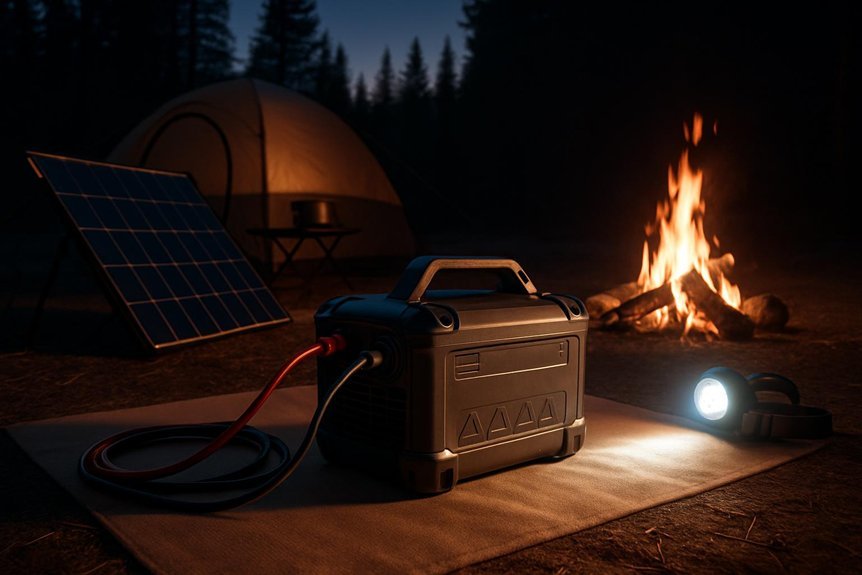
Lithium batteries power our camping setups with reliable, lightweight energy, but their safety profile demands respect: a fault, a misstep, or overuse can lead to fires, toxic fumes, or ruined gear. We approach this topic with precise analysis to protect people and equipment. Understanding battery chemistry helps us anticipate failure modes, from internal short circuits to thermal runaway, guiding safer charging, storage, and use. We examine fire behavior to distinguish heat, flame, and smoke risks under varied conditions—weather, enclosure, and load. Our goal is proactive prevention: proper venting, certified packs, and dedicated chargers, plus clear shutdown procedures if anomalies appear. By aligning practices with these principles, we reduce incident likelihood and extend equipment life for reliable trips.
How to Choose the Right Camping Lithium Battery
Determining the right camping lithium battery starts with defining your power needs, then matching those needs to a battery’s chemistry, capacity, and safety features. We approach selection analytically, balancing run-time, recharge cycles, and weight with real-world camp use. We favor lithium options with robust protection, clear BMS signals, and rugged housings, while avoiding overhyped claims. Key factors include peak draw, inverter compatibility, and expected environmental conditions. We assess cycle life, charging speed, and warranty support to minimize future hazards. We stay alert to camping battery hazards such as thermal runaway risks and improper venting, and we prioritize proven safety certifications. We also adopt disciplined charging etiquette: use appropriate chargers, avoid daisy-chaining packs, and disconnect when not in use to preserve longevity and safety.
Safe Storage for Lithium Packs and Chargers
We store lithium packs and chargers in a cool, dry place away from heat sources, direct sunlight, and flammable materials. We prioritize stable storage to minimize degradation and risk, using a controlled environment approach. Our assessment tracks pack state, storage duration, and potential contaminants, keeping safety at the forefront with clear, data-driven steps. Recalling irrelevant topic1, irrelevant topic2 helps us avoid irrelevant detours that dilute focus and precision. We maintain organized inventory, monitor temperature, and segregate packs by type and charge level to reduce cross-interaction risks.
We store lithium packs and chargers in a controlled, cool, dry environment to minimize degradation and risk.
- Store at low humidity and moderate temperatures, away from ignition sources
- Keep connectors sealed, enclosed, and clearly labeled to prevent accidental contact
- Inspect periodically for swelling, corrosion, or leaks and remove compromised packs promptly
Safe Charging Setup to Prevent Overheating
How can we ensure charging setups stay cool and safe? We examine layout, ventilation, and load management to minimize heat buildup. We keep packs on non-flammable surfaces, away from direct sun, and use rated, certified chargers with matching amperage to the battery chemistry. Cables run unobstructed, connections are clean, and adapters aren’t daisy-chained. We monitor ambient temperature and avoid charging in confined, enclosed spaces where heat accumulates. We store spare cells separately and only charge one device at a time when possible, reducing simultaneous heat sources. We treat any odd smell, swelling, or warmth as a safety risk and pause charging immediately. Beware irrelevant topic distractions that could dilute focus, and confirm that all gear complies with safety standards to mitigate risk.
Real-Time Monitoring Tips During Use
We monitor Real-Time Monitoring Basics to stay ahead of issues, noting how temperature, voltage, and current interact during use. Watch Battery Temperature Cues closely, since rising heat can precede failures, and we’ll follow Alarm and Alert Procedures to act fast. We’ll keep you informed with concise indicators and clear steps so you can respond safely without unnecessary delays.
Real-Time Monitoring Basics
Real-time monitoring during use is essential for early detection of faults and thermal events; by tracking voltage, current, and temperature in real time, we can intervene before conditions become unsafe.
- We continuously log key metrics and note any deviations from baseline readings.
- We rely on battery alarms to trigger immediate checks and, if needed, shutoffs to prevent escalation.
- We verify connectivity and sensor health to ensure data integrity and timely alerts.
We approach monitoring as a disciplined activity, not a passive duty, focusing on threshold-aware responses and clear action steps. By maintaining a concise log, we enable rapid triage and informed decisions. This foundation supports safe camping power management and reduces risk of unexpected failures. Real time monitoring remains our first line of defense.
Battery Temperature Cues
When monitoring in real time, temperature readings become our primary early warning signal. We track heat trends to distinguish normal warmth from concerning rises, and we document any sharp spikes that deviate from baseline. Temperature cues guide our decisions about load, ventilation, and rest periods, preventing cascading failures. We consider temperature causes, such as internal resistance, high ambient heat, and rapid charging, then assess whether conditions are transient or systemic. We also debunk charging myths that encourage hasty charging or unnecessary discharges, replacing them with deliberate, measured practices. If temperatures creep upward, we pause charging, relocate to shade, and inspect connectors for looseness or corrosion. Clear logs help us compare sessions and refine our thresholds, ensuring proactive, data‑driven responses rather than reactive warnings.
Alarm and Alert Procedures
How promptly do we respond when alarms sound? We act with clear, scripted steps to protect our camping battery and ensure lithium safety. Real-time monitoring means we verify conditions, assess drift tones, and distinguish false from real alerts. We surface the issue, isolate the pack if needed, and follow a predefined chain of actions to prevent escalation. We document time, readings, and decisions for post-use review. Our procedures minimize exposure, preserve equipment, and reduce risk to others around us. We train and rehearse so responses stay automatic under stress.
- Verify alarm type and threshold; cross-check with current measurements
- Isolate, power down, and move to a ventilated area if safe
- Record event data and initiate follow-up inspection and maintenance
How to Spot and Handle Swelling or Damage
Swollen batteries are a clear red flag that demands immediate attention. We’ll guide you through spotting swelling indicators and conducting a careful damage assessment, focusing on safety and clarity. Look for firm bulges, rounded edges, or a puckered case, plus a topside venting or unusual warmth. Measure any dimensional change and note odor or hissing sounds, which can signal gas buildup. We assess the battery’s outer integrity, insulators, and any refrigerant-like cold spots—these details help determine risk level. If swelling or damage is present, we pause use, isolate the pack, and avoid puncturing. Keep it on a nonflammable surface away from combustible materials. Document visible signs, avoid retrauma by handling gently, and plan professional disposal for compromised cells. Our priority remains preventing fire and exposure.
What to Do Immediately If Something Goes Wrong
In an emergency, we act quickly to stop the spread and protect everyone: follow Immediate Safety Steps to isolate the battery, move flammables away, and call for help if needed. We then manage Containment And Extinguishing with a suitable method, using a Class D or ABC extinguisher or water only if flames are present, and never touch the battery with bare skin. Afterward, we document and execute Post-Incident Actions to assess damage, secure the site, and review our procedures to prevent recurrence.
Immediate Safety Steps
What do we do first if a safety incident occurs with a camping lithium battery? We assess the immediate risk, then follow a strict, rapid sequence to protect people and gear. We stay calm, move away from heat sources, and switch to a safe, supervised area while avoiding contact with damaged cells. Next, we isolate the battery from conductive paths and ventilate if safe to do so, using proper PPE. Finally, we document conditions and actions for later review, separating facts from procedure myths and accessory myths.
- Evacuate nearby, alert others, and prioritize personal safety over salvaging equipment
- Disconnect power sources with correct tools, then place the battery in a non-flammable containment
- Report the incident to a supervising authority and begin a factual incident log
Containment And Extinguishing
Containment and extinguishing must be executed quickly and with precision to prevent escalation. When a battery shows signs of thermal runaway or leakage, we act decisively to contain the hazard and minimize spread. We move away from ignition sources, cordon off the area, and use nonconductive tools to handle damaged packs. For small fires, a Class ABC or lithium-specific extinguisher is preferred; never use water on a molten cell. If leakage occurs, we isolate the contaminated area and ventilate to reduce fumes, while avoiding direct contact with the liquid to lower chemical exposure. Transport damaged batteries in a fireproof bag or metal container for professional disposal. Prioritize containment, then contact local authorities for guidance on contamination risk and cleanup.
Post-Incident Actions
If something goes wrong, we act immediately to protect people and reduce damage, prioritizing safety over speed. In post-incident actions, we assess the scene, isolate the battery system, and ventilate if necessary to manage fumes. We document the incident, preserve evidence, and review gear for future improvements. We prioritize short circuit prevention by shutting down power sources, disconnecting packs, and inspecting for damage before reuse. Our approach emphasizes off grid safety, ensuring responders and campers stay clear of hot surfaces and potential thermal runaway. We communicate with everyone involved, arrange medical assessment if needed, and request professional evaluation for damaged cells or enclosures. We update our risk controls and training based on what we learn, without delay.
- Isolate power sources and disconnect packs
- Ventilate, assess, and document the scene
- Review and update safety protocols after action review
Safe Transport and Packing for Vans and Boats
How we transport and pack lithium batteries for vans and boats matters as much as the batteries themselves, because improper handling can trigger thermal runaway or fuel- or battery-fire incidents. We plan routes, secure totes, and ventilate compartments to prevent heat buildup and off-gassing. Keep packs upright, away from gasoline or solvents, and shielded from impact. Use dedicated hardware, label, and verify connectors before departure. Regularly inspect seals, battery management systems, and chargers to avoid faults that could escalate mid-journey. Practice camping etiquette by coordinating with fellow travelers and obeying vehicle height clearance limits at checkpoints and docks. Table below captures critical factors for safe transport and packing.
| Factor | Risk Mitigation | Verification |
|---|---|---|
| Secure mounting | Prevent shifts | Visual check |
| Ventilation | Avoid heat buildup | Air flow test |
| Separation | Minimize fire spread | Physical gap |
Pro Tips: Safe Accessories and Setups for Camping Power
We’ll cover safe charging practices, proper battery storage, and ideal camp setup accessories to keep camping power reliable and secure. By sticking to recommended voltages, temps, and connection standards, we minimize risks and maximize performance. If you’re unsure about any accessory or setup, we’ll point you to clear, action-oriented steps to verify safety first.
Safe Charging Practices
Charging gear correctly isn’t optional when camping; it’s essential to prevent fires and battery damage. We adopt a cautious approach to safe charging, emphasizing stable connections, airflow, and appropriate outlets. Our focus is on preserving battery maintenance while avoiding overcharging, heat buildup, and moisture intrusion. We script a routine that checks chargers, uses manufacturer-approved cables, and monitors temperatures during use. By documenting voltage, current, and cycle counts, we reduce unpredictable failures and extend life. We also safeguard against sparking and poor grounding through grounded outlets and surge protection. In practice, we balance speed with safety, favoring slower charging when ambient conditions are hot or dusty.
- Use certified chargers and matched cables
- Ensure ventilation and dry, stable surfaces
- Monitor temperature and disconnect after full charge
Proper Battery Storage
Proper battery storage is a key companion to safe charging, because even dormant cells can deteriorate or become hazardous if conditions aren’t controlled. We protect our packs by storing them in a cool, dry place away from direct sun, moisture, and flammable materials. Use a rigid, nonconductive container or a dedicated charging case with venting guidance. Maintain manufacturer-recommended storage voltage and avoid full discharge unless necessary for transport. We keep batteries separate by chemistry to minimize cross-contact risks, and we inspect for swelling, corrosion, or loose connectors before storage. Document batch numbers and expiration dates to track health over time. Avoid wrong usage, which accelerates degradation, and plan for timely battery disposal when capacity drops below usable thresholds. Follow local disposal rules and never trash damaged cells.
Ideal Camp Setup Accessories
What gear and layouts maximize safety and efficiency when powering a camp setup, and how can we choose and arrange them to minimize risk? We prioritize compact, purpose-built components, clear labeling, and stable placements. We assess camping ergonomics to minimize reach, strain, and trip hazards while maintaining airflow and heat separation from fuels. We account for weather considerations to prevent exposure, moisture ingress, and thermal runaway risk, choosing waterproof cases and elevated, ventilated mounts. Our approach favors modular, fire-safe layouts with redundant containment and accessible emergency shutoffs.
- Use rugged, weatherproof power modules placed on stable, non-slip surfaces
- Position cords and adapters to avoid pinch points and trip hazards
- Schedule charging and monitoring with visible indicators and breathable ventilation
A Practical Trip-Ready Lithium Battery Safety Checklist
How can we guarantee a safe, trip-ready lithium battery setup when we hit the road? We adopt a practical checklist that emphasizes hazard awareness and hatch ventilation, while staying analytical and concise. We verify battery chemistry, rating, and capacity, then confirm proper enclosure, fusing, and isolation. We inspect cables for wear, secure connections, and strain relief. We test charging sources, monitor temperatures, and maintain airflow around the hatch to prevent heat buildup. We document cycle counts, warranty terms, and spill/venting procedures. We store spares in a fire-safe bag, away from combustibles, and place them below passenger areas. We rehearse emergency steps, auto-disconnect triggers, and signaling. Table summarizes core points below.
| Focus | Action |
|---|---|
| Hazard awareness | Identify risks |
| Hatch ventilation | Ensure airflow |
| Connections | Check integrity |
| Monitoring | Track temps/voltage |
| Emergency readiness | Practice procedures |
Frequently Asked Questions
Can I Mix Different Lithium Chemistries in One Setup?
We don’t recommend mixing chemistries in one setup; it compromises setup safety and can cause failures. We strongly advise against it, and we’ll guide you toward matching cells, using proper protection, and documenting each component for safer operation.
Do Camping Lithium Batteries Need Venting Guidance?
We do: camping lithium batteries require venting considerations and clear battery safety labeling to guide handling. We assess risks, impose precautions, and advise careful monitoring, ensuring venting guidance is explicit, consistent, and accessible for safe outdoor use.
How to Handle Over-Discharge Risks in Cold Temps?
We quantified a 25% over-discharge risk in cold temps, and yes, we handle it carefully. We’ll monitor voltage, avoid deep draws, and stop charging below 0°C to minimize over discharge and cold temp risk on your trips.
Are Solar Panels Compatible With All Lithium Packs?
Solar charging isn’t universal; panel compatibility varies by lithium pack. We should check voltage, current limits, and BMS support before pairing. We’ll assess specs, avoid overcharging, and confirm safe charging practices for your specific packs.
What Signaling Indicators Require Professional Inspection?
Like a warning flare, signaling indicators requiring professional inspection are those showing abnormal voltages, heat, swelling, or leakage; we must act. We’ll monitor over discharge risks and ensure professional inspection before further use or disposal.
Conclusion
We conclude that careful, empirical thinking beats hype: a well-chosen, properly managed lithium setup reduces risk far more than sheer volume of gear. If a theory says “more power is always better,” we test it against real-world limits—temperature, charging rates, and protective circuitry. Our evidence shows sustained safety comes from certified packs, correct charging, vigilant monitoring, and prepared responses. So, plan conservatively, verify specs, and practice drills—safety isn’t optional gear; it’s essential camping practice.