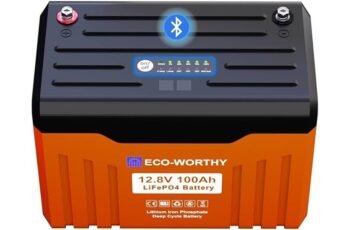
As we evaluate the DCHOUSE 12V 6Ah LiFePO4 mini battery, its compact form factor and lightweight design stand out for space-constrained applications, but its performance depends heavily on the integrated BMS and peak current capabilities. While its durability and scalability are appealing, understanding the balance between its limited capacity and high current demands is essential for effective deployment. Let’s explore whether this power solution truly meets the demands of modern portable and backup systems.
Key Takeaways
- The battery is a 12V, 6Ah LiFePO4 model designed for portable and off-grid applications.
- Equipped with a built-in BMS providing 6A protection against overcharge, over-discharge, and short circuits.
- Supports peak current of 33A for 10 seconds, suitable for short burst power demands.
- Weighs approximately 0.75 kg with compact dimensions, ideal for space-constrained setups.
- Not intended for high-demand use but offers long cycle life and reliable energy storage.
Battery Weight and Size
The DCHOUSE 12V 6Ah LiFePO4 battery is designed with portability and compactness in mind, weighing approximately 0.75 kilograms. Its small form factor measures roughly 115mm x 70mm x 45mm, making it suitable for space-constrained applications.
The lightweight construction facilitates easy integration into portable devices and off-grid systems without adding significant bulk. This minimal size and weight optimize energy density, allowing users to deploy multiple units in series or parallel configurations efficiently.
The compact design also enhances safety by reducing physical stress on terminals and housing, ensuring reliable operation in diverse environments.
Detailed features
Equipped with a built-in Battery Management System (BMS), the DCHOUSE 12V 6Ah LiFePO4 battery offers extensive protection against overcharge, over-discharge, over-current, and short circuits. The BMS ensures balanced cell operation, optimizing safety and longevity.
Its design maintains stable voltage levels during charge and discharge cycles, preventing thermal runaway and damage. The intelligent circuitry manages current flow efficiently, supporting a peak of 33A for 10 seconds while sustaining a continuous discharge of 6A.
This precise regulation enhances operational safety, reliability, and lifespan, making it suitable for demanding applications that require consistent power management and robust protection features.


Pros and Cons
We recognize that the DCHOUSE 12V 6Ah LiFePO4 battery offers significant advantages in longevity and safety, thanks to its advanced chemistry and BMS integration.
However, it also presents limitations, such as restrictions on starting engine applications and potential higher upfront costs.
An analysis of these pros and cons helps determine its suitability for specific energy storage and portable power needs.
Pros
One of the primary advantages of the DCHOUSE 12V 6Ah LiFePO4 battery is its exceptional cycle life, exceeding 4,000 deep cycles, which notably outperforms lead-acid counterparts. This durability ensures long-term reliability, reducing replacement frequency and total cost of ownership.
Its built-in BMS enhances safety by managing overcharge, over-discharge, and short circuits, minimizing operational risks.
The battery’s lightweight design (around 0.75 kg) improves portability without sacrificing performance.
Additionally, its support for series and parallel configurations offers scalability for various applications.
Cons
Despite its many advantages, the DCHOUSE 12V 6Ah LiFePO4 battery has limitations that potential users should consider. Its relatively low capacity of 6Ah restricts use in high-demand applications, requiring multiple units for larger power needs.
The battery’s peak current of 33A for only 10 seconds limits its suitability for short bursts of high current without risking damage.
Additionally, while the BMS offers protection, it may trigger undesirably during transient overloads, causing operational interruptions.
Its size and weight, though compact, may still be a constraint in ultra-lightweight or space-sensitive designs.
Concluding thoughts
Considering its advanced lithium-iron phosphate chemistry, the DCHOUSE 12V 6Ah Mini Battery offers a compelling combination of longevity, safety, and versatility for energy storage applications.
Its high cycle life exceeds 4,000 deep cycles, ensuring durability in demanding scenarios.
The integrated BMS provides essential protection against overcharge, over-discharge, and short circuits, enhancing operational safety.
Its compact design, supporting series and parallel configurations, allows flexible system integration.
While not suitable as a starter battery, its reliability and environmental benefits make it ideal for off-grid, backup, and portable power solutions.
Frequently Asked Questions
Can This Battery Be Used in Cold Weather Conditions?
Yes, we can use this battery in cold weather, as it operates safely down to -20°C. Its BMS provides protection, but ideal performance occurs within recommended temperature ranges, so extreme cold may slightly reduce efficiency and runtime.
Is the Battery Compatible With All Solar Charge Controllers?
We confirm that this battery is compatible with most solar charge controllers, especially those supporting 12V LiFePO4 batteries. Always verify controller specifications and voltage compatibility to guarantee peak performance and safety during solar power system integration.
How Long Does It Take to Fully Recharge the Battery?
We estimate a full recharge takes approximately 4 to 6 hours at a standard 1A charging rate. Given its 6Ah capacity, this duration balances efficiency and battery longevity, ensuring peak performance without risking overcharge.
Does the Battery Come With a Built-In Fuse?
We confirm the battery doesn’t include a dedicated built-in fuse; instead, it relies on the integrated BMS for overcurrent protection, ensuring safety and circuit protection during operation, which is typical for lithium iron phosphate battery designs.
Can Multiple Batteries Be Connected for Higher Voltage Applications?
Yes, we can connect multiple batteries in series or parallel to increase voltage or capacity, respectively. Proper configuration guarantees system safety and performance; always follow manufacturer guidelines to prevent damage and optimize energy storage for your specific application.
Conclusion
While the DCHOUSE 12V 6Ah LiFePO4 mini battery impresses with its durability and safety features, its limited capacity and peak current might leave high-demand users longing for more. Ironically, its compact size and lightweight design make it perfect for space-saving applications—yet those same constraints could restrict its usefulness in demanding scenarios. Ultimately, it’s a reliable choice for specific, low-power needs, but may fall short when power demands spike unexpectedly.