We understand that heat is the silent killer of Li‑ion packs, often arising from poor cooling, fast charging, or harsh loads. We’ll outline practical checks for cooling paths, heat transfer interfaces, and balanced use under ambient conditions. If temperatures creep up, we’ll isolate the pack and switch to safe storage modes while recalibrating sensors after changes. Stay with us as we connect the dots between design, operation, and safe handling to prevent overheating.
Key Takeaways
- Implement robust thermal management with efficient cooling paths to balance heat generation from high C-rates and ambient conditions.
- Use temperature-aware charging: match charger output, avoid overcurrent, and charge in cooler ambient conditions.
- Elevate battery placement for airflow, organize cables, and add vents or fans to prevent hotspot buildup.
- Monitor temperature trends and local hot spots; isolate and ventilate any overheating cell promptly.
- Practice safe storage and handling: store at stable ambient temps, use smart storage, and schedule cooling checks regularly.
Why Li‑ion Overheating Happens: and How to Stop It
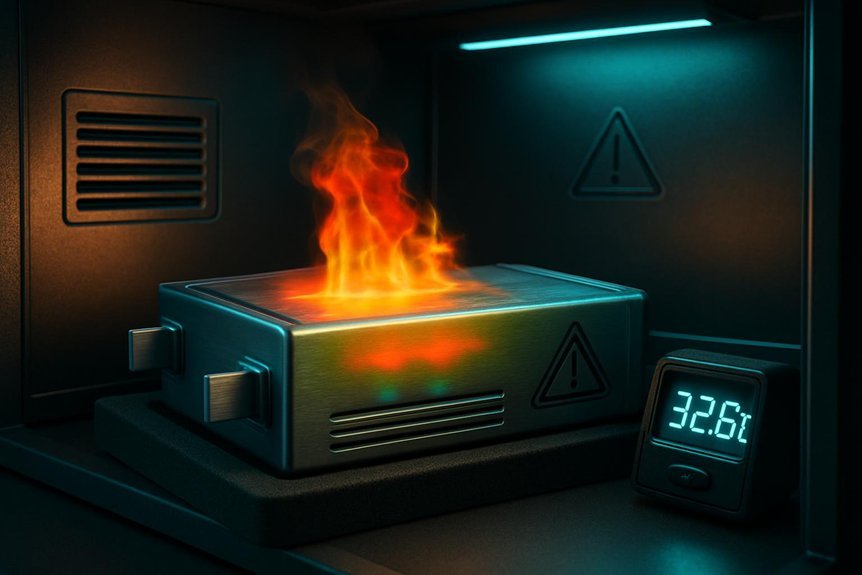
Overheating in lithium-ion batteries stems from an imbalance between heat generation and heat dissipation inside the cell. We explain the core drivers, then outline actionable controls that protect performance and safety. Heat arises from internal resistance, chemical reactions, and high discharge or charging currents, while insufficient cooling raises cell temperature and accelerates degradation. Our focus is on cooling design: selecting materials, geometry, and thermal interfaces that maximize heat removal without compromising energy density. We also address safety thresholds, recognizing that once a critical junction is reached, thermal runaway becomes a risk, requiring prompt mitigation. By balancing charge, discharge, and ambient conditions with robust thermal pathways, we reduce hotspot formation and extend life. Clear design choices translate to reliable, safer operation under typical usage scenarios.
Check Your Charging Setup for Cooler Performance
We’ll start by auditing your charging setup to identify heat sources and optimize cooling. We examine sourcing, placement, and airflow to minimize heat buildup and maximize cooler performance. A disciplined charging setup reduces runaway heat and extends pack life, so we quantify each element and adjust accordingly.
| Component | Potential Heat Source | Optimization Action |
|---|---|---|
| Power supply | Overvoltage/overcurrent | Use included adapters, monitor specs |
| Battery position | Restricted airflow | Elevate, align vents, ensure clearance |
| Cables | Tight routing, exposed heat | Organize, shield, minimize bend radius |
| Enclosure | Insufficient cooling | Add vents, fans, or thermal pads |
This approach yields predictable temperatures, improves safety, and preserves capacity during routine charging.
Choose Safe Chargers and Cables for Li‑ion Batteries
We use only certified chargers to ensure consistent safety margins and performance. We’ll match cable amperage precisely to the battery’s requirements to prevent overcurrent or heat buildup. This alignment minimizes thermal stress and helps maintain stable charging behavior.
Use Certified Chargers Only
Choosing the right charger and cables is essential for Li‑ion safety: using certified chargers reduces the risk of overvoltage, overheating, and degraded cell performance. We emphasize compatibility with device chemistry, proper voltage, and current ratings to minimize stress on cells. Certified units include built‑in protections against overcharging, short‑circuit, and thermal rise, which directly lowers thermal runaway risks. We caution that дешевые noncertified adapters can bypass safeguards, creating misleading indicators and inconsistent current shutoffs. Our review targets chargers meeting recognized standards and manufacturer specifications, ensuring stable charging profiles and traceable fault responses. We address overcharging myths by focusing on verified cutoff logic, not rumors. Ultimately, controlled charging practice preserves cell balance, prolongs life, and reduces peak temperature events during recharge cycles.
Match Cable Amperage Precisely
Are you sure the cable can carry the load? We assess cable and charger compatibility to avoid excess heat and voltage drop. Our approach hinges on amperage precision: selecting a cable whose current rating matches the device’s draw and the charger’s output. Mismatches create resistive heating, undermine safety features, and may trigger protective shutdowns. We prefer low-volt drop paths with appropriate gauge, and we confirm connectors are rated for sustained high current. We document the allowable load, then verify that the match cable traverses the entire circuit without exceeding rating. We recommend keeping charging current within manufacturer guidance and avoiding adapters that inflate amperage beyond design. In practice, precise matching reduces internal heating, extends battery life, and supports consistent performance during high-demand sessions.
Temperature‑Aware Charging Habits That Save Heat
We’ll optimize charging by aligning with temperature, using preheat-free charging, ambient-temp scheduling, and smart charge cues to minimize heat generation. By avoiding unnecessary preheating, charging at moderate ambient temps, and following clear charging cues, we reduce thermal stress and improve safety. This approach sets the framework for practical steps readers can implement to maintain cooler Li‑ion operation.
Preheat-Free Charging
Preheat-free charging relies on temperature-aware habits that minimize heat generation during battery replenishment. We implement a disciplined approach across sessions, enforcing a strict charging discipline to control current, voltage, and duration. By prioritizing gradual current ramps and avoiding peak-rate fills, we limit transient heat peaks that trigger thermal rise. We favor charging windows that align with cooler ambient conditions and battery state, ensuring we don’t push under hot or near-full conditions. Our methodology segments charging into defined phases, monitors internal temperature, and adjusts current responsively to keep the temperature margin stable. We document each cycle to refine thresholds, reducing heat accumulation over time. In practice, preheat free means disciplined, data-informed limits rather than brute-force charging, sustaining performance and safety.
Ambient-Temp Scheduling
Ambient temperatures strongly influence lithium battery thermal behavior, so scheduling charging around cooler conditions reduces heat generation and thermal lag. We emphasize ambient temp awareness to prevent hotspots and extend cycle life. Our approach uses disciplined scheduling logic to align charging with low‑temperature windows, minimizing internal resistance rise and heat buildup. We analyze charge profiles, ambient cycles, and device heat sources to optimize timing without delaying usability. In practice, we favor off-peak, cooler periods for long sessions and moderate, controlled charging during warmer times. This minimizes peak power stress and sustains performance under load.
| Condition A | Condition B |
|---|---|
| Cooler window | Warmer window |
Smart Charge Cues
Smart Charge Cues optimize charging behavior by signaling when to start, pause, or adjust current based on real-time temperature data. We, as analysts, explain how these cues translate thermal information into actionable steps. Charging cues trigger adaptive current profiles, reducing peak heat while maintaining charge efficiency. Thermal triggers manifest as threshold crossings, informing contingency pauses or gradual current reductions to keep cell temperatures within safe bounds. Implementations use temperature sensors, impedance measurements, and voltage response trends to validate decisions. By correlating ambient conditions with pack health metrics, we refine schedules that prevent runaway heating. Readers benefit from predictable charge windows and lower thermal stress. In practice, these cues harmonize charging speed with safety margins, delivering robust performance without compromising longevity.
Smart Storage to Keep Li‑ion Heat Low
Smart storage is key to keeping Li‑ion heat low because temperature, exposure, and cycling history directly affect safety and performance. We, as readers and practitioners, implement disciplined containment and monitoring to support heat management. We propose controlled environments with stable ambient conditions and minimal direct sunlight, avoiding rapid temp shifts that aggravate internal resistance. Pack configurations should optimize thermal paths, distributing heat evenly and preventing hot spots during storage. We emphasize charge levels that reduce self-discharge energy loss and maintain container uniformity over time. Documentation of storage history enables trend analysis and proactive intervention. Materials and packaging must resist thermal runaway catalysts, while seals, vents, and shielding preserve integrity. Effective smart storage reduces baseline stress, enhancing long-term Li‑ion reliability and safety.
Habits That Prevent Heat Spikes in Use
To prevent heat spikes during operation, we establish disciplined usage habits that minimize rapid current changes and thermal loading. We focus on steady power draws, gradual accelerations, and avoiding high-load bursts. Habitual cooling continues between cycles, reducing peak temperatures, while safe handling prevents ancillary heating from external sources. We optimize charging windows to align with ambient conditions, avoiding extreme environments. We monitor pack temperature trends to detect drift and adjust usage patterns proactively. Consistent duty cycles reduce thermal cycling, extending life. We document deviations to refine practices. The goal is predictable thermal behavior through disciplined routine, not reactive fixes.
| Strategy | Expected Benefit |
|---|---|
| Steady current profiles | Lower peak heat |
| Habitual cooling checks | Consistent temps |
| Safe handling practices | Minimized external heat |
Signs Your Li‑ion Is Getting Too Hot
We’re outlining clear heat signals you should recognize, including obvious heat symptoms, rising temperature indicators, and why charging can drive temperatures up. When temperatures climb beyond normal ranges, we’ll note deviations and patterns that point to overheating risks. This helps us identify the relevant signs early and take targeted, safe actions.
Heat Symptoms Noted
Are you noticing a sudden warmth or unusual heat buildup in your Li-ion device? We observe heat symptoms as early warning signs that inform our case studies and risk assessment. A spike in surface temperature, localized hot spots, or rapid warmth during idle or light use indicates abnormal internal activity. We document timing, duration, and device state to differentiate benign warmth from failure precursors. We look for odor, swelling, and keyboard or chassis flex as corroborating indicators. Inconsistent cooling, throttling, and battery-led indicators during charging also inform our risk assessment. We emphasize that anecdotal warmth alone isn’t definitive; we corroborate with measurements and history. Clear thresholds, trend analysis, and documented case studies guide our decisions about immediate cooling or safe shutdown.
Temperature Rise Indicators
Temperature rise indicators offer practical, early warnings that a Li‑ion cell may be approaching unsafe limits. We observe how heat manifests as distinct, measurable signs, enabling proactive steps before failure. Our discussion ideas center on temperature rise indicators and heat symptom taxonomy to classify when a cell’s warmth crosses acceptable thresholds. First, surface temperature increases signal conductive or internal resistance changes; second, abnormal hot spots indicate uneven cell engagement or mechanical stress; third, rapid temperature escalations reveal transport bottlenecks or delivery faults. We assess consistency across cycles, ambient influence, and duty factors to distinguish transient warmth from genuine risk. By mapping symptoms to safe operating envelopes, we equip readers to interpret heat cues objectively, document trends, and trigger appropriate protective actions without overreacting to normal thermal weathering.
Charging Why It Gets Hot
Charging heat often signals inefficiencies or safety limits being reached. We’ll outline why it gets hot and how to assess risk with a data-driven approach. If a cell heats during charging, it reflects internal resistance, charger mismatch, or degraded cells rather than a benign process. Below are key indicators and actions:
- Measure temperature rise rate and voltage drop; sudden changes hint at imbalance or short.
- Verify charger compatibility and cable quality; overcurrent or poor contacts raise heating.
- Inspect pack health, including age and swelling; worn cells amplify safety hazards.
Tips on safety accompany each step, never ignoring abnormal warmth. Debunk charging myths by relying on monitoring metrics rather than assumptions. If heat persists, pause charging and seek professional evaluation.
Cooling and Safe Handling If It Heats Up
When a lithium battery heats up, act quickly to prevent thermal runaway and damage. We implement immediate cooling and safe handling protocols to minimize risk. Our approach emphasizes controlled disconnection, containment, and environment management, prioritizing personal safety and device integrity. We start by isolating the source, removing the battery from the device if feasible, and moving it to a non-flammable, ventilated area. Do not apply water directly to active cells; if available, use a class D fire extinguisher or sand for smothering. Monitor for re-ignition and overcooling, as rapid temperature shifts can cause further harm. We assess oversight gaps and refine training through safety drills, ensuring responders know roles and steps. Documentation and post-incident review prevent recurrence and enhance overall resilience.
Maintenance Tips to Extend Li‑ion Battery Life
What practical steps can we take to extend Li-ion battery life without sacrificing performance? We approach maintenance with precision, focusing on idle maintenance and safety checks to sustain capacity and reliability. Regular, minimal-scope actions prevent performance creep and degradation.
- Schedule idle maintenance windows to verify calibration and voltage stability, ensuring no phantom drains affect runtime.
- Perform concise safety checks: inspect terminals for corrosion, verify case integrity, and confirm temperature remains within spec during idle periods.
- Implement data-driven aging awareness: log cycle counts, normalize usage patterns, and align charging profiles with manufacturer recommendations.
These practices reduce parasitic losses, minimize voltage drift, and keep devices responsive. By embedding routine idle maintenance and safety checks, we preserve health metrics and extend overall Li-ion longevity.
Overheating Prevention: A Quick‑Action Checklist
Remarkably, overheating can be prevented with a focused, quick-action checklist that targets root causes and immediate remedies. We begin with thermal monitoring to establish baselines and detect deviations early. If temperatures rise beyond safe zones, we isolate the pack and disable high-load events to prevent thermal runaway. Inspect connections for looseness, corrosion, or damaged insulation, and verify current pathways match design specifications. Keep charging voltages within manufacturer limits and avoid rapid charging beyond recommended C-rates. Maintain proper cooling—airflow, conductor spacing, and thermal interfaces should remain intact. Log heat trends and correlate with usage patterns to identify overheating causes, then implement targeted mitigations. Regularly recalibrate sensors and revalidate thermal models after any hardware changes. Through disciplined monitoring and prompt actions, we reduce risk and extend safe operation.
Frequently Asked Questions
Can Heat Damage the Battery’s Internal Structure Long-Term?
Heat can damage the battery’s internal structure long-term, especially after repeated heat cycles, raising risks of micro-cracks and impedance growth. We monitor for signs of thermal runaway and implement cooling and safe charging to mitigate degradation.
Do All Li-Ion Chemistries Overheat the Same Way?
Do all li-ion chemistries overheat the same way? No; li ion chemistries vary in overheating patterns, affecting battery safety, thermal management, and thermal runaway risk. We study chemistry-specific heating, impedance, and electrode design to optimize safety.
Should I Remove a Swollen Battery Before Cooling It?
We should remove a swollen battery before cooling it, using a careful cooling procedure. Swollen battery risks rupture; handling carefully minimizes danger. We’ll seal and isolate the pack, monitor temperatures, and follow safety guidelines during the cooling procedure.
Can Room Temperature Storage Still Pose Overheating Risks?
“An ounce of prevention is worth a pound of cure.” We, readers, acknowledge room temperature storage can still pose overheating risks, so we monitor storage safety and thermal stability continually, assessing venting, degradation, and thermal runaway indicators with caution.
How Do Ambient Temperatures Affect Fast Charging Safety?
Ambient heat accelerates degradation, so we caution that high ambient temperatures reduce charging safety during fast charging. We analyze thermal margins, safety thresholds, and cooling capability, ensuring charging safety remains intact as ambient temperatures rise.
Conclusion
We keep our lithium systems cool by treating heat like a stubborn fog we can push back with design, charging discipline, and mindful handling. When batteries heat up, we isolate the pack, swap to safe storage, and recalibrate sensors if needed. Think of thermal pathways as contoured rivers guiding heat to fins and vents. With certified chargers, matched cables, and steady habits, we crown reliability, extend life, and prevent overheating from ever breaking our momentum.