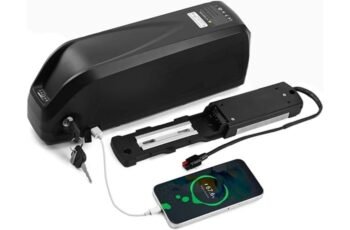
We find this 36V–52V down-tube e-bike battery offers six capacities, from 10Ah to 21Ah, and a compact 360 × 116 × 95 mm format. Before buying, match its voltage, connector, charger, and mounting dimensions to your bike, and keep motor demand within the built-in BMS’s 20A continuous limit. Its protections, LED charge indicator, and security lock add practical features, but don’t assume universal fit or guaranteed range. We’ll explain the specifications, trade-offs, and checks that matter.
Key Takeaways
- Available in 36V, 48V, and 52V versions, with capacities from 10Ah to 21Ah; match voltage to your controller.
- The built-in BMS supports up to 20A continuous discharge, so check that your controller and motor stay within this limit.
- Its 360 × 116 × 95 mm down-tube design includes an LED charge indicator and security lock with two keys.
- Listed for motors up to 1000W, but actual compatibility depends on voltage, connector, wiring, and current demand.
- Before buying, confirm frame clearance and charger compatibility; range varies, and warranty terms should be checked with the seller.
Down-Tube Battery Specifications
This down-tube battery comes in 36V, 48V, and 52V versions, with capacities from 10Ah to 21Ah. We can choose among six capacity options: 10Ah, 13Ah, 15Ah, 17.5Ah, 18Ah, and 21Ah.
Check your bike’s system voltage before selecting a pack; voltage must match the controller’s requirements. For motor compatibility, the battery is listed for motors rated from 0 to 1000W, including common 250W, 500W, and 750W models.
Its battery management system supports up to 20A continuous discharge. We should verify the motor’s current draw and controller specifications stay within that limit to reduce overload risk and support safe operation.
Detailed features
Beyond voltage and capacity, the pack’s built-in BMS guards against overcharging, over-discharging, overload, and short circuits, with a maximum continuous discharge rating of 20A. This BMS protection supports safe operation within that current limit; match the battery to your motor and controller requirements.
A clear LED indicator shows when charging is needed, helping us monitor the pack before a ride. The lithium-ion cells use Grade A materials, and a security lock with two keys helps deter theft.
Before shipment, each battery receives appearance and function checks, including capacitance and short-circuit tests. Use the specified charger, and follow the manufacturer’s charging guidance.
Pros and Cons
We’ll weigh the battery’s broad voltage and capacity options, compact down-tube fit, and built-in BMS protections against its 20A continuous-discharge limit.
We’ll also check charger compatibility and confirm that the battery’s voltage matches your motor and controller before installation.
This comparison will help us identify where its specifications suit your e-bike—and where they may constrain performance.
Pros
For compatible e-bikes, this down-tube battery offers a useful range of voltage and capacity options, plus a built-in BMS rated for up to 20A continuous discharge. We can choose 36V, 48V, or 52V, with capacities from 10Ah to 21Ah, to suit supported systems and riding needs.
Higher-capacity options can provide Extended range, though actual distance depends on the bike, load, terrain, and conditions. Its 360 × 116 × 95 mm format supports easy installation on compatible electric, mountain, and folding bikes, and the compact design makes removal practical.
We also get BMS safeguards, an LED charge indicator, and a keyed security lock.
Cons
Despite its flexible options and built-in safeguards, this battery has compatibility limits we should check before buying. We must match voltage, connector, and dimensions, and keep motor demand within the 20A BMS limit. Charger compatibility also matters: choose the specified voltage for our battery, not merely a matching plug.
| Concern | What we should verify | Potential drawback |
|---|---|---|
| Voltage | 36V, 48V, or 52V match | Wrong voltage risks damage |
| Current | Motor demand stays within 20A | High loads may exceed BMS |
| Fit | 360 × 116 × 95 mm clearance | Frames may not accommodate it |
| Warranty | Seek warranty clarity | Terms aren’t specified |
We should confirm connector details and warranty terms with the seller before installation or charging.
Concluding thoughts
Overall, this down-tube battery offers several voltage and capacity options, a 20A BMS limit, and built-in protection against common electrical faults. We’d match its voltage to your controller and confirm that your motor’s continuous current demand stays within the BMS rating.
For rider suitability, consider the available capacity, 360 × 116 × 95 mm fit, and expected range; don’t assume every option suits every frame. Purchase considerations should include the correct charger voltage, the included 2A charger, and verified warranty terms.
We’d inspect the mount and wiring before use, charge safely, and treat the stated cycle life as a manufacturer claim, not a guarantee.
Frequently Asked Questions
How Can I Confirm Which Voltage Matches My E-Bike Controller?
We can confirm Controller Voltage by checking the controller’s label or manual for its nominal battery voltage. For safe Battery Matching, choose the same voltage; don’t rely on motor wattage or connect incompatible batteries.
Is This Battery Compatible With My Bike’s Existing Mounting Rail?
We can’t confirm compatibility from the listing alone. Compare your rail’s dimensions, mounting points, and connector with this battery’s 360 × 116 × 95 mm case; verify Rail connector alignment and cradle locking mechanism before installation or riding.
Can I Use a Third-Party Charger With This Battery?
Yes, you can use a third-party charger—provided it’s not auditioning for a fireworks show. We’d match charger voltage to your battery: 42V for 36V, 54.6V for 48V, or 58.8V for 52V, then check connector polarity.
What Should I Do if the Battery Indicator Stops Working?
If your battery indicator stops working, we’d first check its connections and wiring for looseness or damage. For Battery gauge troubleshooting and display fault diagnosis, don’t open the pack; contact the seller or a qualified technician.
How Should I Store the Battery During Long Periods of Non-Use?
For long-term storage, we recommend charging the battery to about 50–60%, then disconnecting and storing it indoors. Maintain temperature control: choose a cool, dry place away from sunlight, heat, moisture, and flammable materials. Check monthly.
Conclusion
We’d treat the JCXYL down-tube battery as a flexible replacement option, not a universal fit. Its 36V, 48V, or 52V configuration, 20A BMS limit, dimensions, and connector must match your bike’s motor and controller before purchase. Verify the charger’s voltage and compatibility, too; the included 2A charger isn’t interchangeable across every version. If those details line up, its lock and LED indicator add everyday convenience. Check fit and specifications carefully, and this battery may be a dependable companion for the road ahead.