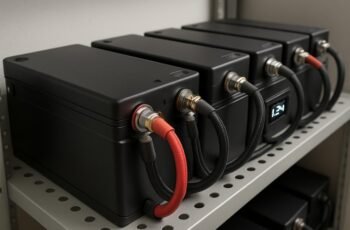
We understand solar lithium battery lifespan hinges on chemistry, usage, and planning. In step with data, we expect about 4,000–8,000 cycles at 80% DoD, with calendar aging adding ±25% under real-world duty cycles and temperatures. Discharge patterns, C-rate, and cycle count drive degradation, while high-nickel chemistries demand tighter controls. Maintenance and monitoring reduce risk, warranties frame expectations, and 25-year outlooks guide replacements. This balance shapes how we design and value a system—so let’s consider the options carefully.
Key Takeaways
- Usable lifespan typically 4,000–8,000 cycles at 80% DoD, with calendar aging and real-world duty cycles potentially shifting life by ±25%.
- Discharge patterns, temperature, and cycle count are the main drivers; high C-rates and poor thermal management accelerate degradation.
- LiFePO4 often offers better calendar life; high-nickel chemistries deliver higher density but require stricter quality control.
- Regular maintenance lowers failure risk and thermal hotspots, while neglect accelerates capacity loss; monitoring should focus on meaningful metrics, not alert storms.
- 10–15 year systems commonly retain 80–90% capacity near mid-life, with a steeper decline afterward; plan with up to 25-year reliability considerations and warranties.
Know Your Solar Lithium Lifespan Range
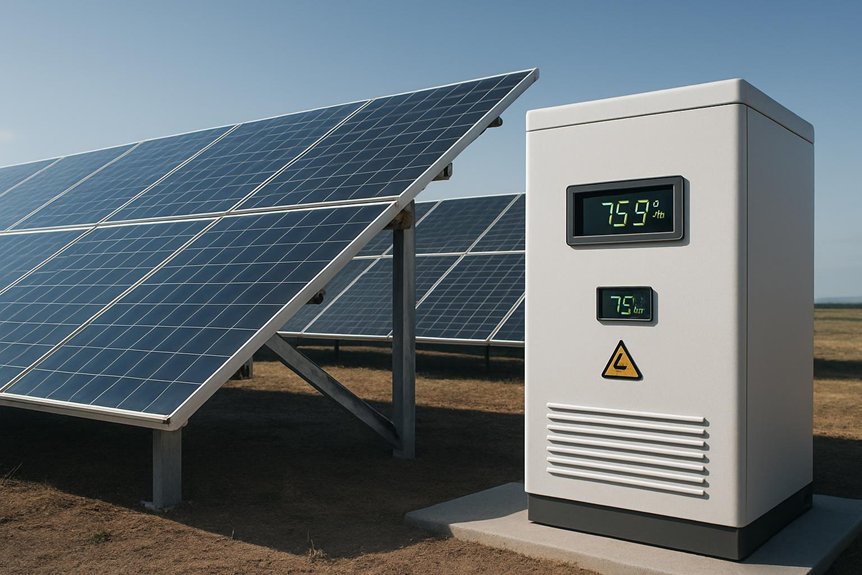
Knowing the exact lifespan range of solar lithium batteries is essential for accurate system planning and cost assessments. We quantify this range by battery chemistry, usage profile, and environmental factors, then translate it into actionable metrics. Our analysis centers on discharge patterns and cycle count as primary drivers of capacity fade and end-of-life timing. Across commonly used chemistries, we observe usable life from roughly 4,000 to 8,000 cycles at standard 80% DoD, with calendar aging adding a gradual baseline decline. In real-world duty cycles, hour‑by‑hour discharge rates, depth of discharge, and average load shape shift the effective lifespan by up to ±25%. We recommend conservative planning bands: a lower bound for replacement planning and an upper bound for financial modeling, calibrated to site-specific discharge patterns and expected cycle count.
What Really Drives Longevity: Discharge, Temperature, and Cycles
What truly sets longevity for solar lithium storage is the trio of discharge patterns, temperature, and cycle count, not a single metric. We quantify degradation with rate constants from accelerated tests, linking C-rate, depth of discharge, and rest periods to capacity loss per cycle. Discharge dynamics determine usable energy fade, where high C-rates accelerate loss nonlinearly, while shallow cycles curb it. Temperature effects, captured by Arrhenius-style factors, modulate diffusion, SEI growth, and impedance rise, with 25–40°C bands showing markedly different lifespans. We examine cycle count as the cumulative stress, noting diminishing returns beyond practical thresholds. In aggregate, the data show that coordinated control of discharge patterns and temperature—within safe cycling ranges—prolongs calendar and cycle life, more than any single parameter alone.
Lithium Chemistry and Cell Quality: Which Choice Lasts Longer?
Different lithium chemistries and cell formats deliver distinct degradation pathways, so we compare energy density, rate capability, and calendar life under equivalent stress tests to reveal which choice lasts longer. We examine nickel–mrom cobalt oxides, lithium iron phosphate, and nickel manganese cobalt variants, focusing on energy density versus cycle stability. Our assessment uses standardized C-rates, 25°C aging, and identical depth-of-discharge to quantify capacity fade and resistance growth. Cell quality emerges as a key predictor: higher manufacturing consistency reduces early failure and mitigates impedance drift. Durability metrics—capacity retention after 1,000 cycles, coulombic efficiency, and thermal stability—show LiFePO4 delivering superior calendar life, while high-nickel chemistries win on gravimetric density but require tighter controls. Reliability hinges on balanced chemistry selection with robust quality assurance.
Maintenance, Monitoring, and Warranties: What Real-Life Lifespan Looks Like
Across lithium battery storage systems, maintenance, monitoring, and warranties shape real-world lifespan as much as chemistry does. We track failure modes with empirical data: calendar aging, depth-of-discharge cycles, and temperature-driven degradation. Maintenance practices reduce thermal hotspots by 10–30% annualized failure risk when performed quarterly, while neglect correlates with accelerated capacity loss. We distinguish monitoring myths from proven metrics: frequent alert storms don’t equal better life; stable state-of-health trends do. Warranty terms translate to real reliability through quantified end-of-life thresholds and derating envelopes; typical 10–15 year systems show 80–90% retained capacity near mid-life, then a steeper decline. Our recommended program blends calibrated SOC/OCV logging, thermal management checks, and vendor-supported diagnostics, aligning maintenance timing with observed degradation rates to extend usable lifespan.
How to Choose a System: Upfront Cost, Warranties, and Proven Durability
Choosing a system hinges on three concrete criteria: upfront cost, warranty structure, and proven durability. We assess total cost of ownership, not sticker price, using reliability benchmarks and failure-rate data. Warranties define replacement risk, coverage, and remaining value after degradation. Proven durability combines cycle life, calendar life, and environmental tolerance under real-world usage. We compare modules, inverters, and balance-of-system components for compatibility, with quantified cost optimization of maintenance intervals and replacement timing. Our approach prioritizes data-driven questions: what is the expected annual energy output, and how does degradation impact 25-year performance? We translate these findings into actionable choices that minimize risk and maximize value across scenarios.
- Upfront cost versus long-term value using reliability benchmarks
- Warranty scope, transferability, and claim processes
- Expected lifetime performance under real-world conditions
- Component compatibility and system-level degradation
- Cost optimization through maintenance and replacement planning
Frequently Asked Questions
How Do Environmental Conditions Affect Long-Term Storage of Solar Lithium Batteries?
We observe environmental conditions matter: extreme temperatures and humidity accelerate degradation, while stable ambient ranges mitigate aging; we quantify risk by environmental stress and storage containment, which together influence capacity fade, cycle life, and thermal runaway probability during long-term storage.
Can Aging Be Accelerated or Slowed by Charging Strategies Beyond Standard Usage?
We can slow aging with charging optimization, but cannot stop it entirely; advanced aging strategies and precise profiling show meaningful gains, while aggressive strategies accelerate degradation. We recommend data-driven, bounded optimization to balance lifespan and performance.
Do All Lithium Chemistries Age at the Same Rate Under Identical Loads?
Yes, they don’t age identically under identical loads. Lithium chemistries differ in capacity fade and impedance growth; identicalizing aging varies by chemistry. We quantify with cycles, DoD, and temperature to assess discharge depths and reliability.
How Do Warranty Terms Handle Performance Degradation Beyond Stated Cycles?
We treat performance degradation beyond stated cycles as covered up to the end of warranty, with depreciation impacts quantified by remaining capacity percentage and time to failure, ensuring data-driven thresholds drive claims and adjustments.
What Maintenance Gaps Most Commonly Reduce Real-World Lifespans?
We see maintenance gaps most reduce lifespans through improper labeling, delayed maintenance, installation errors, battery mismatches, lack of monitoring, and related issues, causing accelerated degradation and higher failure rates—quantitatively increasing end-of-life risk by several percent annually.
Conclusion
We understand our solar lithium lifespan hinges on cycles, DoD, temperature, and C-rate, with 4,000–8,000 cycles at 80% DoD typical and real-world shifts of about ±25%. Lithium chemistry and cell quality set the ceiling, while maintenance, monitoring, and solid warranties protect value. Choose systems with conservative replacement bounds and clear performance data. In short, plan rigorously, back decisions with numbers, and remember: a battery today is a promise kept for tomorrow. Adage: slow and steady wins the race.