We’ve seen a coincidence in how many failures trace back to preventable heat and improper handling, and it reminds us that a Lifepo4 safety program isn’t optional. We’ll outline clear safety goals, robust risk controls, and lifecycle-aware practices that keep packs stable under load, prevent thermal runaway, and provide data-backed margins. If you’re responsible for design, operation, or safety training, we’ll connect the dots between handling, charging, storage, and incident response—and you’ll gain a framework that anticipates faults before they become incidents.
Key Takeaways
- LiFePO4 safety emphasizes robust packaging, secure connections, fault-tolerant BMS, and proactive prevention of thermal runaway under abuse or overcharge.
- Safe handling includes PPE, isolation, containment, controlled cooling, and clear incident documentation to prevent propagation.
- Safe charging uses controlled CC-CV with cell-aware termination, delta-V balance checks, and auto-cutoff with regular charger calibration.
- Seasonal/storage guidance targets mid-capacity SOC (40–60%), 15–25°C, moisture control, and biweekly voltage/temperature checks.
- Heat management relies on layered cooling, real-time temperature sensing, current limits, and rapid fault recognition to minimize thermal risks.
Lifepo4 Safety Goals: What You Need to Achieve
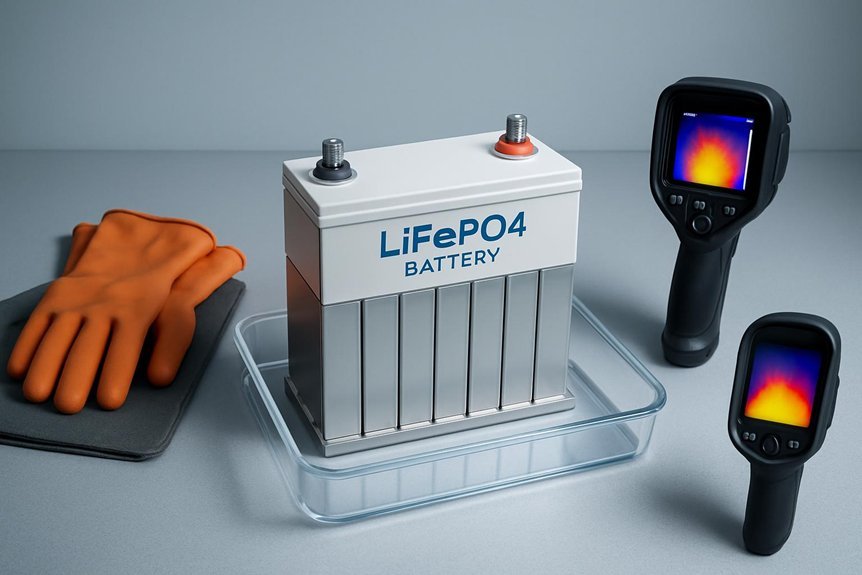
What safety goals should we aim for with LiFePO4 batteries? We start by defining clear performance targets and failure thresholds. We seek stable voltage under load, minimal thermal rise, and predictable aging, with data-backed margins. Our goals include preventing thermal runaway, reducing impedance drift, and ensuring safe venting behavior if derating is necessary. We quantify safety through established ratings, margins, and validated test results. We prioritize robust packaging, secure electrical connections, and fault-tolerant BMS strategies that respond to overcurrent, overtemperature, and short circuits. We also consider turning basics for user deployment, ensuring consistent operation across cycling. Finally, we evaluate environmental impact, aiming to minimize resource exposure, maximize recyclability, and reduce lifecycle emissions without compromising safety or performance.
Safe Handling of Lifepo4: Physical Precautions and PPE
Are we handling LiFePO4 packs safely by design? We assess handling with strict controls, minimizing risk from physical damage, moisture ingress, and improper storage. Our approach blends practicality with safety, ensuring PPE aligns to tasks and hazards. We implement task-specific protections, documented procedures, and continuous awareness of Acronym ethics to prevent misinterpretation of labels or data. We integrate incident budgeting to fund safety improvements and training. Now, practical steps:
We design safe LiFePO4 handling with task-focused protections, clear procedures, and continuous safety awareness.
- Wear cut-resistant gloves, safety glasses, and flame-resistant aprons when handling bare packs or damaged cells.
- Use magnetized tools and insulated trolleys to move modules; avoid dragging cables or dropping components.
- Store in dry, ventilated areas away from heat sources, with secondary containment for leaks.
- Inspect for cracks, swelling, or corrosion; replace compromised packs and document findings.
Lifepo4 Safe Charging: Protocols, Limits, and Equipment
Safe charging of LiFePO4 batteries requires clear protocols, defined limits, and appropriate equipment to prevent thermal runaway, overcharging, and moisture ingress. We, as a guide, outline concrete charging protocols that prioritize cell voltage, current, and temperature checks. We begin with a controlled CC-CV approach: limit initial current, taper to a precise termination voltage per cell, and monitor delta-V behavior for balance. Safety limits include maximum charge current, recommended ambient temperature range, and insulation integrity. We insist on proper charging equipment with auto-cutoff, fault alarms, and real-time sensor feedback. Regular, documented verification of charger calibration and cell impedance is mandatory. By adhering to these charging protocols and safety limits, we minimize risk while maintaining pack longevity and predictable performance.
Storing Lifepo4: Seasonal and Long-Term Considerations
We outline seasonal charge guidelines and long-term storage tips to set expectations for safe, effective Lifepo4 care. We’ll address how charge state, temperature, and resting duration impact capacity retention and safety over time. You’ll learn practical steps we recommend for seasonal cycles and extended storage to minimize degradation and risk.
Seasonal Charge Guidelines
Seasonal storage of LiFePO4 batteries requires a disciplined approach to maintain capacity and extend life. We outline practical seasonal charging guidelines to keep packs ready without compromising health. Follow these steps to minimize drift and degradation.
- Monitor seasonal charging targets: keep cells near 3.3–3.4 V per cell for storage, adjusting with load conditions.
- Respect temperature thresholds: avoid charging outside recommended ranges; store and charge within specified ambient temperatures to reduce impedance growth.
- Use a charger with cell-balancing and delta-V protection to maintain uniform cell voltage during seasonal charging cycles.
- Schedule periodic checks: remeasure voltage, temperature, and state of charge biweekly to catch drift early and correct course.
Long-Term Storage Tips
Long-term storage of LiFePO4 packs requires a deliberate, data-driven approach that balances capacity retention with safety margins. We guide readers to store at a mid-capacity state, typically 40–60% remaining charge, and to monitor periodically for drift in voltage. Temperature stability matters most: keep packs in a cool, dry environment, ideally around 15–25°C, and avoid extreme heat or cold that accelerates degradation. Use purpose-built storage containers with moisture control and secure venting to prevent accidental exposure. Inspect connectors, housing, and seals for signs of wear; replace damaged components promptly to minimize corrosion risk. Label packs with installation and maintenance dates, and implement a routine that rechecks voltage, temperature, and state of charge quarterly. Maintain consistent, safe handling to protect long-term performance.
Managing Heat: Thermal Safety for Lifepo4
How do we prevent runaway heat in Lifepo4 systems? We approach thermal safety with disciplined design and monitoring. Our focus is controlling heat transfer, balancing load, and sourcing reliable protection. We maintain predictable temperatures through layered cooling, proper enclosure, and fan or liquid cooling when needed. We size components to match demand and implement conservative current limits to avoid thermal runaway.
- Use adequate heat sinks and airflow, ensuring surface temperatures stay within spec.
- Implement real-time temperature sensing at cell groups with automatic current limiting.
- Verify thermal design margins under worst-case ambient and duty cycles.
- Employ fail-safe disconnects and thermal fuses that trigger before critical temperatures are reached.
Recognizing Faults: Signs, Diagnostics, and Immediate Actions
What early fault indicators should we monitor, and how do we respond when they appear? We observe voltage drift, sudden current spikes, unusual temperature changes, and erratic charging behavior. When these arise, we pause use, isolate the pack, and begin diagnostic steps to verify cell balance, insulation integrity, and BMS readings. We document symptoms, then proceed with controlled measurements and safe-handling checks.
| Indicator | Potential Cause | Immediate Action |
|---|---|---|
| Voltage drift | Cell imbalance | Rebalance or retire suspect cell group |
| Temperature rise | Internal resistance, short | Cool, isolate, inspect connections |
| Current spike | Faulty protection, fault loop | Verify protections, reset if safe |
| Charging anomaly | BMS fault, degraded cell | Run diagnostic steps, log data |
| Noise/oscillation | Sensor fault | Calibrate sensors, replace faulty module |
Emergency Response: Procedures for Lifepo4 Incidents
In an emergency, swift, controlled responses limit damage and protect people and property; our priority is to stabilize the Lifepo4 system, assess risk, and execute a predefined containment plan. We follow strict protocols to minimize exposure, document conditions, and coordinate responders. Clear roles, early communication, and accurate reporting govern our actions, ensuring incident containment with minimal escalation. We verify battery pack integrity, isolate affected modules, and apply appropriate cooling or ventilation as needed, while avoiding fuel-contact hazards. Our team uses calibrated PPE and monitors for thermal runaway indicators, adjusting tactics in real time. After stabilization, we transition to investigation, evidence preservation, and remediation planning to prevent recurrence.
- Assess initial scene and identify hazards
- Isolate and secure the Lifepo4 system
- Implement containment and cooling as required
- Document actions and notify stakeholders
Lifepo4 Safety Compared: How It Stacks Up Against Other Chemistries
Lithium iron phosphate (LiFePO4) safety presents a distinct profile compared with other chemistries, and understanding these contrasts helps us prioritize risk mitigation. We compare thermal behavior, failure modes, and toxicity, noting LiFePO4’s higher thermal stability and lower fire risk relative to NMC or LCO cells. Energy density considerations matter, but safety margins often exceed those of cobalt-based chemistries, especially under abuse or overcharge conditions. We assess thermal runaway propagation, venting, and electrolyte flammability with a focus on practical containment and monitoring. In terms of lifecycle, LiFePO4 typically exhibits longer cycle life and stable impedance growth, influencing maintenance planning. Future adoption, cost analyses, and reliability metrics drive decision-making as we balance performance with risk.
Frequently Asked Questions
Can Lifepo4 Batteries Explode Under Extreme Abuse?
We say yes, lifepo4 batteries can explode under extreme abuse. We assess explosive risk and thermal runaway conditions, then outline safe handling. We warn you about thermal runaway scenarios, mitigation steps, and proper charging, storage, and disposal practices.
What Is the Real Fire Risk With Lifepo4?
We’re not guessing; our risk assessment shows LiFePO4 has low fire risk, but thermal runaway is possible under severe abuse. We’re cautious, monitoring temps like a tight fuse, and we communicate clearly about safety margins.
Do Lifepo4 Cells Vent Toxic Gases?
Yes, lifepo4 cells can vent, but they rarely emit toxic gases; vents result from thermally induced reactions. We monitor electrolyte volatility closely, since electrolyte volatility drives pressure spikes and potential venting, not immediate toxic-fume release in normal faults.
How Long Can Lifepo4 Tolerate Deep Discharge?
We can’t rely on deep discharge; prolonged exposure degrades LiFePO4 cells, risking capacity loss. We monitor, prevent, and recover capacity with controlled recharging. If discharged, minimum restoration cycles exist, but full capacity recovery isn’t guaranteed.
Are Lifepo4 Packs Safe for High-Temperature Environments?
Yes, they’re generally safe for high-temperature environments. We’re confident in their high temperature resilience and chemical stability, though we’ll monitor limits and margins closely, explaining any risks with precise, methodical notes for clear, cautious usage.
Conclusion
We’ve laid out clear safety goals, robust handling, disciplined charging, and vigilant thermal management, all grounded in data-backed margins and lifecycle context. By integrating preventive measures, fault-tolerant BMS practices, and prepared incident responses, we reduce risk and extend lifespan. Our approach is precise, methodical, and practical. Are you ready to implement these protocols now, monitor outcomes, and iteratively improve safety margins as real-world data arrive?