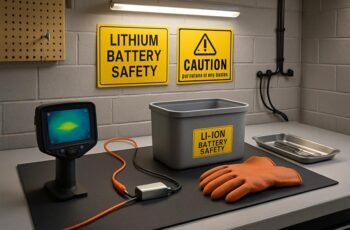
We approach lithium battery charging with strict safety discipline: we match chargers to battery type and standards, verify chemistry, capacity, and form factor, and confirm proper voltage, current, and termination profiles. We must inspect all components, assure insulation integrity, and secure terminations before charging. In a well-ventilated, monitored environment, we manage heat with staged charging and certified hardware, pausing immediately if overheating or swelling occurs. There’s more to align, and the specifics keep evolving.
Key Takeaways
- Use chargers matched to battery type, chemistry, capacity, and form factor with correct voltage, current, and termination profiles.
- Inspect batteries, cables, connectors, and labeling; ensure insulation, continuity, and compatibility before charging.
- Ensure a safe charging environment with ventilation, clear airflow, and monitored temperature and humidity.
- Manage charging speed and heat with appropriate cooling, staged charging, and quick response to overheating indicators.
- Implement daily smart charging routines, temperature monitoring, and safety alerts; isolate and address issues or discontinue charging if thresholds are breached.
Choose Safe Chargers by Battery Type and Standards
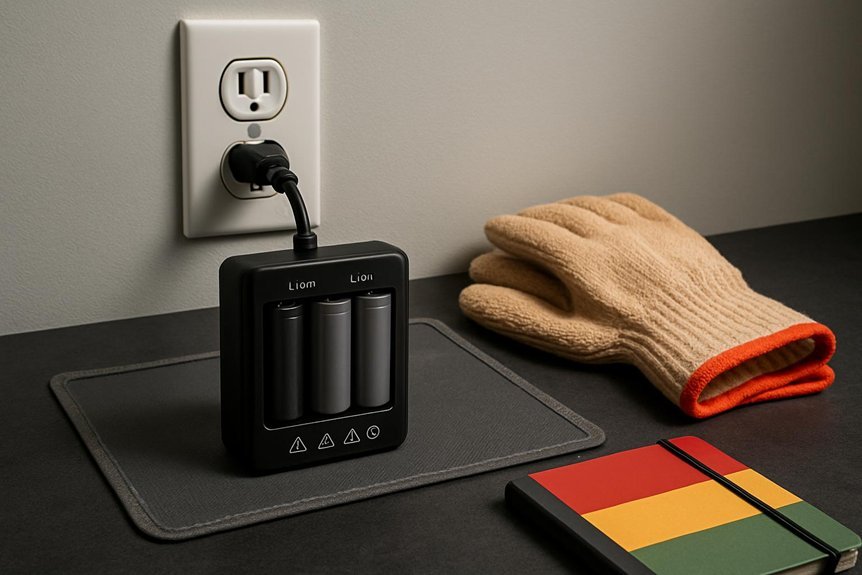
To ensure safe charging, we select chargers that match your battery type and meet established standards. We then verify compatibility with your cell chemistry, capacity, and form factor before proceeding. Our process emphasizes safe chargers that conform to battery standards, ensuring correct voltage, current, and termination profiles. We assess connector compatibility, isolation ratings, and surge resilience to minimize risk during connection and operation. We document manufacturer specifications, warranty coverage, and any certification marks, such as safety and performance attestations. Our method includes cross-checking thermal behavior under typical load conditions, preventing overheat scenarios that could degrade cells. We prioritize chargers that provide clear protection features, including short-circuit, overcharge, and temperature safeguards. By adhering to these criteria, we reduce failure modes and extend pack integrity for reliable energization.
Inspect Battery and Cables Before Charging
Before charging, we inspect the battery and cables to confirm they’re in good condition and compatible with the charger. We follow a precise sequence: inspect batteries, examine cables for cracks or wear, inspect connectors for corrosion, and test insulation where applicable. This ensures a reliable electrical path and minimizes risk.
| Step | Focus |
|---|---|
| 1 | Inspecting batteries for deformation or swelling |
| 2 | Examining cables for cracks and exposed conductors |
| 3 | Inspecting connectors for corrosion and secure terminations |
| 4 | Testing insulation integrity and continuity |
| 5 | Verifying labeling and compatibility with the charger |
This methodical check prevents charging faults and supports safe operation.
Assess Your Charging Environment for Safety and Ventilation
Are you really optimizing safety by evaluating the charging space first? We approach the workspace with a methodical mindset, prioritizing controlled conditions and clear ventilation. Our assessment targets consistent airflow, absence of ignition sources, and stable ambient parameters to prevent gas buildup and overheating. We document observable constraints and establish a location标准 for ongoing checks, ensuring positioning keeps cables and devices unobstructed. We emphasize practical measures for maintaining safe air exchange and rapid response if alarms trigger. By combining routine inspection with established ventilation criteria, we reduce risk and support reliable operation.
Prioritize controlled ventilation and clear airflow to safeguard charging spaces and reduce risk.
- assess ventilation effectiveness and proximity to potential contaminants
- verify unobstructed airflow paths and absence of obstructive clutter
- monitor ambient temperature and humidity relevant to battery chemistry
- confirm airflow safety during all charging phases and equipment use
How Charging Speeds Affect Heat and Safety
Charging speed directly influences heat generation and thermal safety during lithium battery charging. We examine how charging rate governs heat buildup, charging duration, and safety margins. Higher rates raise instantaneous power input, increasing internal resistance losses and surface temperatures. Our approach emphasizes predictable thermal responses: quantify allowable charging rate for a given cell chemistry, ambient temperature, and cooling capability. We evaluate heat management strategies, including active cooling, insulation limits, and staged charging profiles that reduce peak temperatures without compromising total energy delivery. We recommend verifying charger specifications, using matched cells, and avoiding continuous high-rate charging in enclosed spaces. By controlling the charging rate within design tolerances, we minimize thermal runaway risk, preserve cycle life, and maintain overall system safety.
Recognize Overheating and Respond Quickly
How can we quickly spot overheating and react to prevent failure? We notice rising surface temperature, abnormal smell, or swelling, and we act without delay to protect the pack and enclosure. Our approach hinges on overheating awareness and a rapid response, guided by measured checks and predefined thresholds. If indicators appear, we isolate the charger, power down, and move to a safe area. We document the event and review cooling or fault codes before proceeding.
We monitor rising temps, smells, or swelling and act fast to isolate, power down, and move to safety.
- Monitor temperature trends with known baselines and alert thresholds
- Discontinue use if any sign exceeds safe limits or if odors appear
- Perform a controlled cool-down before inspection or handling
- Escalate to service if symptoms persist or recur
Safe Plug, Unplug, and Storage Practices
Safe plug, unplug, and storage practices require disciplined, repeatable steps to minimize fault risk and physical damage. We present a procedure-driven approach to handling lithium battery chargers. Before any action, power down equipment and disconnect power sources. When plugging in, align connectors fully, avoid force, and verify polarity. Unplug with a firm grip on the plug, not the cable, and store away from heat sources or metal objects. For storage practices, cool, dry environments with stable temperatures reduce degradation; maintain a partial charge per manufacturer guidance. Use containers that resist impact and vent gases if needed. Inspect for corrosion, bent pins, or swelling before reuse. Document actions, date, and observed conditions to enable traceability and quick fault isolation. Safe plug, storage practices support reliable operation and longevity.
Use Quality, Certified Chargers and Cables
We must use only quality, certified chargers and cables. Our guidance focuses on reliability and safety, not convenience alone. We verify compatibility with device specifications, amperage, and voltage to prevent overcurrent events. Using quality certified components reduces thermal stress and prolongs life, aligning with cable safety standards and manufacturer recommendations. We assess labels from recognized standards bodies and avoid counterfeit equivalents. In practice, we replace worn connectors and inspect insulation integrity before every use. We keep kits organized to minimize accidental misapplication and ensure consistent performance. The following points guide our selection and handling:
We use only certified chargers and cables, verifying compatibility and safety with every use.
- Verify certification marks and model compatibility
- Inspect insulation, strain relief, and connector wear
- Prefer manufacturer-recommended cable gauges and rated currents
- Replace damaged components immediately, disposing of them safely
Maintain Battery Health to Prevent Safety Risks
Maintaining battery health is essential to prevent safety risks during charging and use. We, as technicians and informed users, monitor charge cycles, temperature, and voltage to sustain performance and minimize danger. Regular inspection helps detect subtle degradation before hazardous conditions develop, and proper storage preserves capacity. We calibrate our expectations with manufacturer guidance, avoiding overdischarge and extreme fast-charging when not required. Adhering to documented limits reduces the likelihood of thermal runaway and cell imbalance, preserving safety for every device.
| Parameter | Action | Rationale |
|---|---|---|
| Temperature | Monitor during use and charging | High temps elevate safety risks |
| Charge cycles | Track cycle count and conditioning | Limits aging, maintains battery health |
| Storage voltage | Store at recommended voltage levels | Prevents capacity loss and hazards |
How to Respond to Swollen or Leaking Batteries
What should you do immediately if you notice a swollen or leaking battery, and why is prompt action essential? We respond with a calm, methodical plan to minimize risk from a swollen battery or leaking battery. Immediate containment and notification reduce thermal runaway risk and limit exposure to electrolytes. We follow established safety steps, then verify disposal or isolation options with local regulations.
- Do not puncture or press the cell; avoid disassembly
- Move the device to a nonflammable, ventilated area away from ignition sources
- Use nonconductive, fire-resistant materials to cradle the device
- Contact manufacturer support or local hazardous-waste facility for proper disposal
We prioritize containment, assessment, and compliant disposal to protect users and property.
Create a Daily Smart Charging Routine
We establish a daily smart charging routine by enabling a consistent schedule, monitoring battery temperature, and leveraging smart charging features. This approach ensures we charge within safe windows, detect thermal deviations, and optimize amperage and timing automatically. We’ll discuss how these elements interrelate to maintain battery health and performance, and how you can implement them in your setup.
Set a Consistent Schedule
A consistent charging schedule minimizes stress on the battery and reduces the risk of heat buildup, so we establish a daily smart routine that aligns charging windows with periods of lower ambient temperature and higher grid efficiency. We define a clear cadence, document time blocks, and enforce discipline to ensure predictable cycles. Our approach focuses on set schedule and routine planning to optimize performance and longevity while minimizing energy waste and thermal exposure.
- Align charging to off-peak hours where feasible
- Restrict fast charging to critical needs only
- Calibrate a fixed daily start time and duration
- Review usage patterns weekly to adjust windows
Monitor Battery Temperature
Temperature monitoring is essential to prevent thermal stress during charging; by continuously tracking cell and pack temperatures, we detect deviations early and adjust the routine accordingly. We implement a defined monitoring cadence, recording ambient and surface temperatures at each stage of the daily charging cycle. We establish alert thresholds for temperature rise rates and absolute limits, triggering immediate halts if either condition is breached. Our protocol includes logging timestamps, sensor calibration checks, and cross-verification between multiple sensors to ensure data integrity. In the event of a temperature anomaly, we apply a controlled cooldown, reassess the charging current, and document the action taken. We integrate a thermal cutoff mechanism to prevent overheat scenarios, maintaining safe, repeatable charging performance.
Use Smart Charging Features
Could a daily smart charging routine streamline safety and efficiency? We choose smart charging features to optimize our workflow, preserving battery health while reducing risk. By scheduling charging during optimal window(s) and limiting peak current, we minimize heat generation and stress. We calibrate thresholds for full charge, avoiding prolonged top-off states that erode longevity. We monitor compatibility with device firmware and charger specs, ensuring safe handoff between stages. We document settings and outcomes to refine the routine over time.
- Schedule charging windows aligned with ambient conditions
- Set conservative charge limits to protect battery health
- Enable temperature-aware charging adjustments
- Log performance metrics for ongoing optimization
Frequently Asked Questions
How Long Should a Full Lithium Battery Charging Cycle Take?
Typically, a full lithium battery charge takes several hours, depending on capacity and charger, often 2–4 hours; we assess current, voltage, and termination.
Note: irrelevant topic safety myth; we’ll ensure our method remains precise and safe for you.
Can Charging at Low Temperatures Harm the Battery Safety?
Low temperature charging can degrade safety; it risks lithium plating and runaway if heated or stressed. We recommend avoiding charging below manufacturer-specified minimums, monitor temperature during charging, and ensure proper thermal management for charging safety.
Do Power Banks Require the Same Safety Checks as Laptops?
Power banks do require the same safety checks as laptops. We follow strict Safety protocols, inspect for damage, monitor temps, verify certifications, and guarantee proper charging environments; we apply uniform standards, treating every device with careful, methodical rigor.
Is It Safe to Mix Different Battery Brands on One Charger?
We don’t recommend mixing different battery brands on one charger. It risks imbalance and thermal runaway. We’ll assess new brand compatibility and monitor closely for mixed chemistry risks before any use, documenting tolerances and charging profiles.
Do Smart Chargers Protect Against Overcharging Automatically?
Yes, smart chargers auto shutoff and provide temp protection. We verify cell balance, monitor voltage curves, and terminate charging when thresholds are met, ensuring safe termination and preventing overcharge through automatic shutoff and thermal monitoring.
Conclusion
We conclude with a precise takeaway: safe charging isn’t optional, it’s systematic. By matching chargers to battery type, inspecting components, and maintaining a controlled environment, we reduce heat and failure risk. An interesting stat: improperly matched chargers can increase failure probability by up to 4x, underscoring the value of certification and proper termination profiles. Together, we’ll follow a disciplined routine, monitor temps, and pause at signs of overheating or swelling to protect both equipment and people.