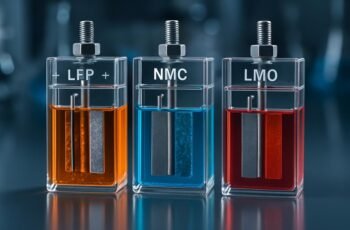
We weigh aging factors, we compare physics to chemistry, we align tests to real use. We’ll articulate how calendar and cycle aging interact, how temperature and depth of discharge shift degradation, and how material structures govern capacity fade. We’ll weigh NMC/NCA for energy density against LFP for stability, and we’ll map practical lifespans to grid, EVs, and devices. The framework we build will reveal which chemistry truly lasts longest under specific conditions—and we’ll show you why it matters.
Key Takeaways
- LFP tends to deliver the longest calendar life and robust cycle life with lower capacity fade and better thermal stability than many nickel-rich chemistries.
- NMC/NCA offer high energy density but trade longevity for performance; aging accelerates with higher DoD, temperature, and fast charging.
- Battery longevity depends on balancing capacity retention, impedance growth, and calendar aging; stable SEI and cathode integrity are critical.
- Temperature control and shallow DoD generally extend lifespan across chemistries; deep DoD and high temperatures dramatically shorten it.
- Real-world reliability and safety constraints favor chemistry choices that minimize impedance rise and gas evolution under expected use.
What Lithium-Battery Longevity Really Means: Metrics and Trade-Offs
What does “lithium-battery longevity” really capture? We measure it as capacity retention, internal resistance growth, and calendar- versus cycle-based degradation. We quantify with percent of initial capacity over time, and with signaled end-of-life thresholds. Short term vs long term longevity emerge from competing mechanisms: SEI evolution, active material loss, particle fracture, and electrolyte depletion. These processes operate on different timescales and temperature envelopes, producing distinct blips in performance versus calendar years. We also consider cycle life, calendar life, and usable energy at a given state of health. Niche chemistry trade offs arise because maximizing calendar stability may sacrifice rate capability, safety margins, or low-temperature performance. Our framework links quantitative metrics to mechanistic drivers, guiding material choices toward predictable, application-aligned longevity outcomes.
Cycle Life by Chemistry: NMC, LFP, NCA, and Lithium Polymer Compared
Cycle life varies markedly across NMC, LFP, NCA, and lithium polymer chemistries, driven by how each chemistry manages active material weight, SEI growth, and electrode stability under repeated intercalation and deintercalation. We observe distinct aging trajectories: NMC and NCA balance high energy with mid-range cycle counts; LFP favors long term aging resilience and cathode stability with lower capacity fade; lithium polymer trades energy density for potentially steadier performance under stress. Mechanistic differences in particle cracking, electrolyte decomposition, and SEI evolution under cycling govern these outcomes.
Cycle life diverges by chemistry as aging shifts from active load to cathode stability.
- Imagine a staircase: each step represents a degraded state, shifting load toward cathode stability.
- Consider how heavier active material load shifts stress distribution and mitigates volumetric strain.
- Visualize long term aging as a slow corrosion of interfacial films, shaping the end-of-life curve.
How Temperature and Depth of Discharge Shape Lifespan
We observe that temperature and depth of discharge interact to shape a cell’s aging pathways, accelerating or slowing degradation mechanisms. At elevated temperatures, reaction kinetics surge and SEI growth speeds up, while extreme DoD swings magnify stress and capacity loss per cycle. We’ll quantify these effects to establish how operating range, not just chemistry, governs long-term lifespan.
Temperature Effects on Lifespan
Temperature and depth of discharge (DoD) jointly govern lithium battery lifespan in predictable ways: higher temperatures accelerate degradation mechanisms such as electrolyte oxidation, SEI growth, and active material loss, while deeper DoD magnifies cycling losses by exposing more capacity to stress per cycle. We frame temperature effects with mechanistic precision, emphasizing temperature stability and manufacturing quality as predictors of long-term performance.
- Elevated heat raises internal resistance and accelerates side reactions, shortening calendar life.
- Temperature swings induce mechanical strain, promoting microcracking and loss of contact.
- Consistent, controlled temperatures synergize with high-quality manufacturing to minimize variability in cycle life.
Maintaining stable operating temperatures and rigorous quality controls reduces degradation pathways, enabling reliable capacity retention and predictable lifespan trajectories.
Depth of Discharge Influence
How does the depth of discharge interact with temperature to shape lithium‑battery lifespan? We present a data‑driven view: higher DoD increases electrode stress and accelerates aging mechanisms, while elevated temperature amplifies diffusion rates and parasitic reactions. At shallow DoD, capacity fade largely tracks SEI growth and microcracking, yet cycle life improves because the active material remains near equilibrium during charging and discharging. Deeper DoD drives larger voltage swings, amplifying lithium loss and mechanical strain, which reduces long term capacity. Temperature modulates reaction kinetics; at low temperatures, transport becomes rate‑limiting, paradoxically curbing fade but elevating internal resistance. We quantify self discharge implications as a function of DoD and temperature, noting that high DoD under heat accelerates self discharge and degrades cycle stability, shortening overall lifespan.
Real-World Degradation: Common Failure Modes and Reliability Flags
We summarize the degradation mechanisms that drive real-world performance, from calendar aging to cycle-induced wear, and show how these processes differ across chemistries. We outline reliability flag indicators—condition, state of health, and remaining life—that help engineers quantify risk and prioritize maintenance or replacements. We then map typical real-world failure scenarios, with objective thresholds and failure modes, to establish a framework for data-driven assessment and comparison.
Degradation Mechanisms Overview
Where do real-world lithium battery degradations come from, and how can we reliably diagnose them? We map failures to mechanisms: solid electrolyte interphase growth, active material cracking, and loss of lithium inventory. These processes shift capacity, raise impedance, and distort power response under real use. We emphasize data-driven, mechanistic links to operating history—cycling, temperature, state of charge—and validate with diagnostics like incremental capacity analysis and impedance spectra. Our lens includes long term storage and responses to rapid transient events, which accelerate aging paths and reveal latent weaknesses.
- Temperature-driven SEI evolution reshapes ion transport, altering later-stage capacity fade.
- Mechanical degradation from volume changes concentrates resistance growth during high-rate pulses.
- Lithium inventory loss reduces accessible capacity and skews state-of-charge estimation under stress.
Reliability Flag Indicators
Reliability flags translate observed performance shifts into actionable failure modes, linking real-world degradation to specific mechanisms such as SEI evolution, particle cracking, and lithium inventory loss. We frame these indicators as structured signals that map symptoms to root causes, enabling early intervention and robust longevity metrics. Our analysis emphasizes concrete data—capacity fade rates, impedance growth, cycle life, and calendar life correlations—avoiding speculative lore. By triangulating voltage profiles, rate dependence, and temperature effects, we assign confidence to failure mode diagnoses and prioritize mitigation paths. Below, a concise table provides two columns: Flag category and Mechanistic implication, across four rows, clarifying how indicators translate to reliability decisions.
| Reliability Flag | Mechanistic Implication |
|---|---|
| Performance drift | SEI-related impedance rise |
| Capacity fade slope | Lithium inventory loss |
| Gas evolution signal | Structural degradation |
| Anomalous charging | Particle cracking |
Real-World Failure Scenarios
How do real-world failures unfold in lithium batteries, and which reliability flags best signal their underlying mechanisms? We observe degradation through chemistry-specific pathways, manifested as capacity fade, impedance growth, and safety events. Our focus is on measurable indicators that reveal root causes, not just symptoms. Real-world failures emerge from cycling stress, temperature excursions, and manufacturing variability, all constrained by materials science limits. We track failure modes with standardized flags tied to mechanisms: SEI instability, cathode lattice damage, and electrolyte decomposition. Sustainable sourcing and ethical recycling shape lifecycle risk, reducing defect exposure and post-use hazards. Early flags predict trajectories and guide design choices, testing regimes, and supply decisions with greater confidence.
- Progressive capacity loss under moderate temperature, signaling SEI evolution.
- Rapid impedance rise after high-rate cycles, indicating interfacial degradation.
- Thermal runaway precursors linked to electrolyte breakdown under abuse.
Practical Picks by Use Case: EVs, Grids, and Consumer Devices
Which lithium battery chemistry best fits different real‑world needs? We map use cases to performance signals, then translate them into practical picks. For EVs, we prioritize high single‑cell energy density and long cycle durability under fast charging and wide temperature swings; nickel-rich NMC and LFP blends emerge, balancing energy, cost, and longevity. Grid storage demands high cycle life, stable calendar life, and safety margin; iron‑based chemistries and certain NMC variants with robust thermal management excel here. Consumer devices favor compact energy density and reliable depth of discharge, with LFP and NMC options offering favorable cycle durability and lower thermal stress. Across all, real‑world degradation modes—loss of capacity, impedance rise, and safety constraints—drive selection, with attention to thermal management, charge protocol, and pack architecture.
A Straightforward Framework for Choosing the Longest-Lasting Chemistry
A practical framework for picking the longest‑lasting lithium chemistry starts from a simple premise: lifetime is governed by the balance between capacity fade, impedance growth, and the calendar aging that thermals push. We present a structured, data‑driven approach that anchors decisions in measurable metrics and observed failure modes. By aligning chemistry choices with documented longevity research and explicit safety considerations, we reduce uncertainty and target durable performance.
- Visualize tradeoffs as a lifecycle curve, linking capacity retention to impedance rise and thermal exposure.
- Quantify calendar aging under expected operational temps, counting calendar loss alongside cycle loss.
- Validate through accelerated aging tests, cross‑checking with real‑world field data and safety outcomes.
Frequently Asked Questions
Do Manufacturing Quality and Batch Variation Affect Durability More Than Chemistry?
Yes, manufacturing quality and batch reliability influence durability as much as chemistry; we see variance from manufacturing variance and batch reliability shaping cycle life, impedance growth, and degradation pathways, sometimes outweighing nominal chemistry differences in real-world use.
How Does Aging Under Mixed-Charge Cycles Impact Longevity?
Like gears grinding together, aging under mixed-charge cycles degrades longevity. We see aging mechanics magnify cycle stress, accelerating capacity fade and impedance rise; our data show non-linear effects, stressing cells sooner than steady cycling would predict.
Can End-Of-Life Recycling Impact Perceived Longevity Claims?
End-of-life recycling impact can alter perceived longevity, because material recovery shifts cost-benefit dynamics and emphasizes degradation pathways. We quantify, document, and propagate data, showing how reclaimed components influence remaining-cycle counts and end-of-life performance metrics.
Do Safety Events Accelerate Degradation Differently Across Chemistries?
Yes, safety events accelerate degradation differently across chemistries; degradation differences emerge from distinct mechanisms like SEI growth, gas evolution, and structural cracks, causing varied capacity fade rates under abuse conditions we quantify with data-driven metrics.
How Do Capital Cost and Lifecycle Cost Interact With Longevity Choices?
We’ll show that higher capital cost can lower lifecycle cost through longer longevity, lower replacement rates, and fewer downtime events, meaning durability strategies justify upfront spending when we optimize total cost of ownership over time.
Conclusion
We’ve mapped the longevity landscape with data-driven rigor, tracing how chemistry, temp, and DoD choreograph aging. LFP’s calendar robustness stands out, while nickel-rich NMC/NCA push energy density at the cost of cycle life under stress. Temperature and depth of discharge sculpt degradation, and real-world failure modes remind us that no one chemisty dominates all uses. For grids, EVs, and devices, the longest-lasting choice hinges on the use case, management quality, and disciplined operating envelopes.