We understand lithium battery short circuits create a low-resistance path that causes rapid current, voltage drop, and heat spike, risking thermal runaway. We’ll review clear signs, immediate actions, and proper handling to prevent harm. Our goal is precise, practical guidance you can act on now. Stay with us as we outline containment, safe storage, and prevention steps that keep systems and people safe, and uncover how to implement robust controls before the next incident arises.
Key Takeaways
- Recognize short-circuit indicators: sudden current spike, rapid temperature rise, and abrupt voltage collapse with possible localized hotspots.
- Immediately power down and isolate the pack from all power sources; remove from shared enclosure if safe.
- Use non-conductive barriers and proper PPE; avoid touching terminals or tools that conduct current.
- Maintain controlled storage and handling: upright, away from metals, proper insulation checks, and labeled, ventilated areas.
- Follow evidence-based response: document events, monitor residual voltage, and consult manufacturer guidelines for safe next steps.
What Is a Lithium Battery Short Circuit (and Why It Matters)
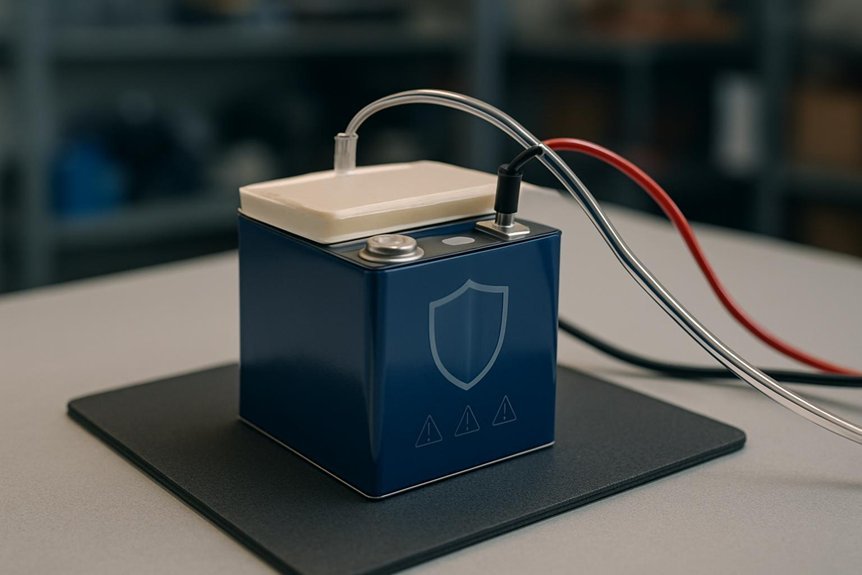
A lithium battery short circuit occurs when a low-resistance path forms between the positive and negative terminals, causing a rapid, uncontrolled current flow. We define this condition by abrupt current rise, elevated temperatures, and potential thermal runaway if unchecked. In practice, short circuit causes include internal defects, separator compromise, or external damage that bypasses normal impedance. We approach diagnosis methodically: confirm electrical continuity between terminals, measure instantaneous current, and monitor voltage collapse patterns. Our team emphasizes rigorous short circuit diagnosis protocols to distinguish true shorts from transient faults, ensuring safe handling and isolation procedures. Battery purity matters because contaminants or manufacturing variances alter resistance profiles, masking or exaggerating fault signatures. Early identification enables controlled disconnection, prevents propagation, and preserves system integrity while guiding remediation or replacement decisions.
How to Spot the Signs a Short Is Happening
Short circuits don’t announce themselves; they manifest as rapid, measurable changes in the battery’s electrical and thermal profile. We observe sudden current spikes, voltage dips, and temperature rises that exceed normal operating ranges. Look for abrupt impedance shifts, inconsistent cell voltage behavior, or localized hotspots on the pack surface. Audible pops or acrid, chemical smells can accompany thermal events, but don’t rely on perception alone; rely on instrumentation. We consistently compare live data against established baselines, flagging deviations beyond predefined thresholds. Be mindful of common short circuit myths and battery myths that downplay or misattribute early warning signs. Treat any unexpected parameter excursion as a potential fault, escalate for safe assessment, and isolate the affected module. Accuracy, documentation, and preventive checks remain essential to minimize risk.
Immediate Steps If a Short Is Suspected
We observe visual signs of a potential short and act immediately to reduce risk. We power down the device or system and move to a safe area, following proper isolation procedures. We will reassess and verify no residual heat or faults before proceeding with further steps.
Observe Visual Signs
What visual cues should we watch for to identify a smart issue in a lithium battery when a short is suspected? We observe rapid heating, hissing, venting, smoke, or a swollen pack. Distinguish dimming indicators from flicker in indicator lights and unusual odors. Electrical insulation damage or blistered casings signal panel-level strain. Deformation, electrolyte sheen, or crystallization on terminals demands cautious handling. We emphasize that short circuit myths vs. battery myths can mislead; rely on measured temperature rise and current draw rather than assumptions.
| Cue | Indicator | Action |
|---|---|---|
| Temperature | Rapid heat increase | Monitor with IR or contact thermometer |
| Visual | Melting, swelling, venting | Isolate and inspect safely |
| Odor/Smoke | Distinct chemical smell | Evacuate area, ventilate |
Power Down Immediately
Rapid indicators from the visual signs you observed demand immediate action: if a short is suspected, power down the system at once and isolate the battery pack from all power sources. We follow a controlled shutdown procedure to prevent propagation of fault currents. First, disable main power, then disconnect auxiliary circuits that can backfeed energy. Remove the pack from any shared enclosure if safe to do so, using non-conductive tools and proper PPE. Monitor for residual voltage and verify zero-energy state before handling. Communicate clearly to all team members to avoid accidental re-energization. We address short circuit myths and battery myths by sticking to verifiable steps and documented SOPs, not speculation. After isolation, document the event, timestamp actions, and review protective measures for continuous safety.
Move to Safe Area
When a short is suspected, move quickly to a safe area to limit exposure and prevent escalation. We, as a safety-focused team, guide you to separate the incident from flammable surroundings and ventilate if needed. Do not touch the pack or tools that may conduct current; isolate only with non-conductive barriers or fire-rated containment as trained. Monitor for venting, heat buildup, or smoke, and call emergency responders when conditions worsen. Keep bystanders away and maintain a clear exit path. Do not propagate myths like “shorts can’t cause fire” or “battery myths” that encourage risky handling. Once isolated, assess available extinguishing options suitable for lithium fires, such as Class D or specialized devices, only if trained. Document timing, actions, and outcomes for post-incident review.
Safe Handling and Storage to Prevent Shorts
We’ll cover proper storage practices, highlighting how container design, segregation, and ambient conditions reduce short-circuit hazards. Safe handling habits—including clean workspaces, minimal dangling leads, and correct charging procedures—are critical to prevent unintended connections. Together, these measures form a precise, safety-focused baseline for preventing shorts.
Proper Storage Practices
Is storage really a single-step task, or is it a continuous safety measure that prevents shorts? We approach storage as a controlled process that minimizes exposure to risks. We ensure cells remain within specified state-of-charge ranges and verify proper packaging to avoid terminal contact. We implement mechanical safeguards and use rated containers that provide robust electrical isolation from conductive surfaces and other packs. We maintain separation from heat sources, moisture, and contaminants, reducing potential degradation that could lead to short circuit terminology pitfalls. We label and organize inventory to enable rapid isolation if a fault is detected. We document storage conditions, monitor ambient temperature, and enforce access controls. This disciplined approach supports electrical isolation, preserves integrity, and enables safe, reliable long-term storage.
Avoid Short-Circuit Hazards
Safe handling and storage practices reduce the odds of a short by keeping electrical paths isolated and materials controlled. We communicate clear constraints to prevent accidental contact or bridging between terminals, modules, and conductive surfaces. In practice, we separate packs, insulate exposed terminals, and avoid placing batteries near metals, liquids, or heat sources. We minimize movement that could cause internal damage, and we inspect for damaged insulation before use. To counter short circuit myths, we verify proper enclosure design, venting, and protective circuitry are intact. Table illustrates risk controls:
| Scenario | Control | Outcome |
|---|---|---|
| Loose hardware | Secure fasteners | Reduced contact risk |
| Grounded surface | Insulation layer | Prevents path formation |
| Foreign metal | No metal contact policy | Eliminates bridging |
| Damaged pack | Replace, not repair | Maintains integrity |
| Handling | Gloves, tools | Maintains safety |
Battery safety remains our priority, not assumptions.
Safe Handling Habits
Safe handling habits minimize short-circuit risk by keeping terminals and conductors isolated during every step of storage and use. We, as readers and handlers, follow strict separation protocols to prevent contact between exposed metal and battery terminals. Store packs upright, in dedicated compartments, away from conductive tools, liquids, and incompatible materials. Inspect containers for damage or swelling before transport, and never force connectors or gaps. When handling, wear appropriate PPE and minimize surface exposure time; avoid stacking energized modules. Transport and storage areas require grounded surfaces, clear labeling, and controlled environmental conditions—temperature, humidity, and ventilation kept within specifications. Note that battery chemistry varies by model; always consult manufacturer guidelines and safety data. Not relevant to this topic beyond establishing disciplined practices that reduce fault currents and thermal runaways.
How to Choose Safe Chargers and Cables
Choosing safe chargers and cables starts with verifying specifications and build quality. We review manufacturer ratings, including input/output amperage, voltage, and protection features, ensuring compatibility with our cells. Look for official certifications, UL/IEC marks, and genuine labels that resist tampering. Cables should meet current rating and insulation standards; avoid thin, worn, or improvised leads. Prefer devices with short circuit protection, temperature monitoring, and automatic shutoff when anomalies arise. Avoid USB adapters promising rapid charging unless they specify compatible chemistry safeguards. We address common misconceptions: short circuit myths and charger myths may tempt shortcuts, but safe practice demands verified components, not rumors. We test fit and connector integrity, confirm strain relief, and inspect for corrosion. Consistency between charger, cable, and battery specifications minimizes risk during charging.
Setting Up a Safe Charging Environment and Adequate Ventilation
To set up a safe charging environment, we position the battery workstation in a well-ventilated area away from flammable materials and sources of heat, and we maintain unobstructed airflow around charging equipment.
- We isolate charging from living spaces and ignition sources, ensuring no clutter blocks vents or cables.
- We monitor ambient temperature and humidity, keeping within manufacturer specifications to prevent condensation and thermal stress.
- We use dedicated, surge-protected outlets and clearly labeled, purpose-built charging trays to minimize cross-talk and short circuit risk.
- We train users to recognize short circuit myths and charging myths, replying with checks like fuse status, insulation integrity, and cable condition before every session.
Fire Suppression and Containment for Li Battery Fires
What’s the most effective way to contain a lithium battery fire and prevent spread? We address containment with trained response, prioritizing rapid cooling, isolation, and shutdown. Use appropriate extinguishing methods: large fires require water spray or flood to cool neighboring cells and limit thermal runaway; avoid solid fire suppressants that can insulate heat. If feasible, isolate the source and ventilate to reduce toxic fumes, while firefighters use full PPE. For small, contained fires, remove combustible surroundings and suppress with water or Class D agents only if suitable. Acknowledge short circuit myths and battery myths: don’t assume a single approach fits all chemistries or pack configurations. Document events, sequence actions, and re-evaluate procedures after containment to prevent re-ignition.
When to Repair, Replace, or Call a Pro
When should you repair, replace, or call a pro for lithium battery issues? We guide readers to evaluate risk, not speculatively repair. If symptoms persist after basic checks, we escalate. Short circuit myths suggest DIY fixes can be unsafe; battery myths often understate failure risk. We prioritize professional assessment for integrity, insulation, and thermal behavior. Replace when cell imbalance, swelling, or leakage is evident, or if protection circuits are compromised. Repair only under proper controls, with manufacturer-approved methods and validated parts. Call a licensed technician for diagnostics, high-energy systems, or difficult access. Never ignore abnormal odors, heat, or smoke. Be proactive with documentation of symptoms and testing results to support pro evaluation.
- Signs prompt escalation: heat, swelling, odor, or damage
- Verify safety protocols before handling any unit
- Documentation aids accurate pro diagnosis
- Rely on certified technicians and OEM guidance
Post-Incident Inspection, Documentation, and Prevention
We establish strict post-incident recordkeeping and prompt inspection of all affected components to verify containment and identify failure modes. We document findings clearly, rate severity, and assign corrective actions to prevent recurrence, sharing results with the team. These steps—inspection aftermath best practices and prevention through documentation—drive continual safety improvements.
Post-Incident Recordkeeping
Post-incident recordkeeping is essential to prevent recurrence and drive continuous safety improvements. We document findings, timelines, and actions with clear attribution, ensuring traceability and accountability across teams. Our records link root causes to corrective steps, enabling trend analysis and proactive risk reduction. We distinguish between relevant data and the irrelevant topic or unrelated concept for framing, so readers focus on actions that matter. We maintain tamper-evident logs, preserve evidence, and schedule follow-ups to verify effectiveness. Our process emphasizes reproducibility, auditability, and timely communication to stakeholders.
- Capture incident timeline, materials involved, and battery chemistry
- Log corrective actions, owners, due dates, and verification steps
- Archive evidence safely and ensure accessibility for audits
- Schedule post-closure reviews to confirm preventive impact
Inspection Aftermath Best Practices
Have you documented the aftermath clearly? We inspect the scene methodically, capture burn patterns, temperatures, and battery IDs, and log all actions for traceability. Our after-action review confirms root cause trends, confirms containment, and guides corrective steps. We distinguish data points from assumptions, verify credentials, and maintain strict access control over records. We confront short circuit myths with data, not anecdote, and perform battery mythbusting to prevent misinterpretation of conditions. The following table highlights critical evidence to collect and preserve:
| Item | Standard Procedure | Verification Method |
|---|---|---|
| Visual condition | Document scorch zones | Photo archive, scale references |
| Electrical readings | Record peak currents | Calibrate meters before use |
| Thermal data | Log temperatures | Thermal camera, sensor checks |
| Recovery steps | Timeline actions | Cross-check with SOPs |
Prevention Through Documentation
What concrete steps can we take to guarantee prevention through rigorous documentation after a lithium battery short circuit incident?
We document every phase of the event: equipment, timestamps, and personnel involved, then compare outcomes to established safety baselines. We record root-cause hypotheses and immediately verify with targeted tests, avoiding unrelated topic conjecture. We standardize incident reports to prevent redundant concept repetition, ensuring concise, actionable findings. We preserve chain-of-custody for all materials and data, and archive environmental conditions, charge states, and thermal profiles. We require signed corrections for any deviations from procedure, and mandate a formal lessons-learned review before returning devices to service. Documentation must support traceability, compliance, and continuous improvement, not ambiguity. Finally, we enforce access controls to protect sensitive information and prevent misinterpretation, ensuring clarity for all stakeholders.
Everyday Habits to Minimize Short-Circuit Risk
To minimize short-circuit risk in daily use, we consistently inspect and manage our lithium-ion devices and accessories for damage, wear, and exposed conductors, and we replace any compromised components before reuse. We train users to store batteries upright, away from metal objects, and to avoid jamming chargers or cables into tightly packed compartments. We verify connector integrity, inspect insulation, and discontinue use if swelling, heat, or odor appears. We maintain charging environments within manufacturer specs, monitor temperature during operation, and unplug after full charge to prevent accumulation of heat. We address short circuit myths with data-driven guidance, and we uphold battery ethics by disposing of damaged units responsibly. Education, routine checks, and proper handling minimize short-circuit risk and extend system reliability.
Frequently Asked Questions
Can a Damaged Battery Short in Storage Without Usage?
Yes, a damaged battery can short in storage even without use. We emphasize storage safety and handling protocols for damaged cells, isolating them, avoiding terminals contact, and using approved containers to prevent thermal runaway and cross-contamination risks.
Do All Li-Batteries Short-Circuit During Charging?
Short circuit risks during charging aren’t universal for all Li‑batteries. We caution you that improper charging or damaged cells can cause a failure; charging safety hinges on chemistry, protection circuits, and safe handling, not blanket guarantees.
Can Shortcuts Occur From Thermal Expansion Alone?
Short answer: thermal expansion alone can cause a short circuit risk in stressed cells. We must monitor tolerances, vents, and insulation; isolated components must move freely, and any contact risk should trigger shutdown and containment.
Are Third-Party Chargers Always Safer Than Bundled Ones?
Third party safety isn’t automatically better; charger compatibility matters more. We advise evaluating certification, safety features, and device requirements before use, and we remain cautious about third party safety claims that overlook integration with our system and batteries.
How Often Should I Test for Internal Cell Faults?
We test for internal cell faults quarterly, to catch drift before it drifts further. Our testing cadence targets fault indicators early, reducing risk; we monitor trends, schedule maintenance, and adjust intervals as data demands, keeping you and equipment safer.
Conclusion
In closing, we’ve mapped clear steps to reduce Li battery short-circuit risk and protect lives and property. Stay vigilant for signs like sudden current surges, heat, swelling, or venting, and act fast with zero-energy verification and isolation. Use proper storage, certified chargers, and non-conductive barriers. When in doubt, call pros for containment and post-incident review. It’s a tightrope we walk every day—better safe than sorry, a fracture in safety avoided is a win.